Easter: May 15th
Friday of the Sixth Week of Easter; Opt. Mem. of St. Isidore (USA)
MASS READINGS
May 15, 2026 (Readings on USCCB website)
PROPERS [Show]
COLLECT PRAYER
Friday of the Sixth Week of Easter after Ascension Thursday: O God, who restore us to eternal life in the Resurrection of Christ, raise us up, we pray, to the author of our salvation, who is seated at your right hand, so that, when our Savior comes again in majesty, those you have given new birth in Baptism may be clothed with blessed immortality. Through our Lord Jesus Christ, your Son, who lives and reigns with you in the unity of the Holy Spirit, God, for ever and ever.
Friday Before Ascension Sunday: Hear our prayers, O Lord, so that what was promised by the sanctifying power of your Word may everywhere be accomplished through the working of the Gospel and that all your adopted children may attain what the testimony of truth has foretold. Through our Lord Jesus Christ, your Son, who lives and reigns with you in the unity of the Holy Spirit, God, for ever and ever.
Optional Memorial of St. Isidore the Farmer: Lord God, to whom belongs all creation, and who call us to serve you by caring for the gifts that surround us, inspire us by the example of Saint Isidore to share our food with the hungry and to work for the salvation of all people. Through our Lord Jesus Christ, your Son, who lives and reigns with you in the unity of the Holy Spirit, God, for ever and ever.
Recipes (2)
Activities (6)
Prayers (17)
Library (21)
Blog & Podcasts (3)
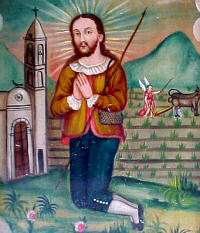
The United States celebrates the Optional Memorial of St. Isidore the Farmer (1070-1130). He was a Spanish laborer who worked most of his life as a ploughman for a nobleman who lived near Madrid, Spain. Although working many hours a day, he never failed to attend daily Mass, and spend time praying before the Holy Eucharist. He married a maid-servant, Maria de la Cabeza, who was also canonized a saint. They were always willing to help their neighbors and worked with the poor in the city slums. In 1947, he was proclaimed the Patron of the Catholic Rural Life Conference in the United States.
>>>Today is Day 2 of the Pentecost Novena to the Holy Spirit.<<<
Meditation for Friday of the Sixth Week of Easter
Christ the Lord
1. "The Lord is in Sinai, in the holy place" (Alleluia verse). "Let us praise the King of kings" (Antiphon at Lauds). The feast of the Ascension is a day of triumph for Christ. He is the Lord.
2. Christ is the Lord, the Kyrios (Phil. 2:11). He has accomplished man's deliverance from sin, and has taken His seat "on the right hand of the Majesty on high, being made so much better than the angels, as He hath inherited a more excellent name than they. For to which of the angels hath He [God] at any time said: Thou art My Son, today have I begotten Thee.... Sit on My right hand until I make Thy enemies Thy footstool" (Heb. 1: 3-5, 13). It was not to the angels that He subjected the world of the future (the Church of the New Testament), but to Christ, His Son. "What is man that Thou art mindful of Him? Or the son of man that Thou visitest him?….Thou hast crowned Him with glory and honor [through His ascension]. . .. Thou hast subjected all things under His feet" (Ps. 8:5 ff.; Heb. 2:6 ff.). If it is said, "Thou hast subjected all things under His feet," then there is nothing that is not subject to Him (Heb. 1:2). He Himself had assured us: "All power is given to Me in heaven and in earth" (Matt. 28:18).
When we sing the Gloria we joyfully acknowledge His dominion: "Thou who sittest at the right hand of the Father, have mercy on us. For Thou alone art holy; Thou alone art the Lord; Thou alone, O Jesus Christ, art most high, together with the Holy Ghost, in the glory of God the Father." We firmly believe that Christ, God Incarnate, is the Lord. We thank God that He has thus exalted our Lord and that He has subjected all things to His dominion. We, too, will be subject to Him, to His will, to His commandments, to His Church and its ministers.
The reign of Christ gives Him the right to rule over all that has been made subject to Him, in heaven and on earth, in time and eternity. Men and angels and all created things, both now and throughout all eternity, must obey the will of the Father and of His risen Son, our Savior, and honor Them. "Thou alone art the Lord." Christ is the Lord, not only of the Sabbath, but of all days; not only of a part of the day, but of the whole day; not only of one locality, but of the whole world. All our internal and external acts, all of our actions and deeds, must be performed to serve Him and promote His honor; they must preach Christ and be subject to His will and pleasure.
Our most personal desires, our most secret ambitions, our very essence and being belong to Him. "Thou alone art the Lord." He is the absolute Master of all things. His is a supremacy to which all else is subdued. God has made us completely and entirely dependent on Christ in all our desires and actions. This dependence embraces not only individuals, but the whole community; it includes all nations and all races. Today heaven and earth and hell must all confess, now and forever, that Christ is the Lord (cf. Phil. 2:10 ff.). We willingly accept this domination of Christ over us, over all mankind, over all creation. We pray that all may be subject to Him and confess Him as their Master. "Thy kingdom come."
3. "He that shall humble himself shall be exalted" (Matt. 23:12). He "emptied Himself, taking the form of a servant, being made in the likeness of men, and in habit found as a man. He humbled Himself, becoming obedient unto death, even to the death of the cross. For which cause God also hath exalted Him and hath given Him a name which is above all names. That in the name of Jesus, every knee should bow, of those that are in heaven, on earth, and under the earth" (Phil. 2:7 ff.). We may often feel that Satan is still the true lord of the world.
Often we are faced with the baffling riddle of sin, and are overawed by the overwhelming power of Satan, by the infidelity, evil, and sin we see about us. Yet our faith in the power and dominion of Christ over sin remains firm, even though it is not apparent. We place our trust entirely in His strong arm, in His wise providence, in His love which moves Him to work for the salvation of all men. We cannot comprehend the secrets of His wisdom any more than we can understand the love, power, and wisdom of God. "Blessed are they that have not seen and have believed" (John 20:29).
—Benedict Bauer, O.S.B, from The Light of the World, Vol II
St. Isidore the Farmer
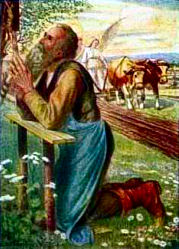 When he was barely old enough to wield a hoe, Isidore entered the service of John de Vergas, a wealthy landowner from Madrid, and worked faithfully on his estate outside the city for the rest of his life. He married a young woman as simple and upright as himself who also became a saint-Maria de la Cabeza. They had one son, who died as a child.
Isidore had deep religious instincts. He rose early in the morning to go to church and spent many a holiday devoutly visiting the churches of Madrid and surrounding areas. All day long, as he walked behind the plow, he communed with God. His devotion, one might say, became a problem, for his fellow workers sometimes complained that he often showed up late because of lingering in church too long.
He was known for his love of the poor, and there are accounts of Isidore's supplying them miraculously with food. He had a great concern for the proper treatment of animals.
He died May 15, 1130, and was declared a saint in 1622 with Ignatius of Loyola, Francis Xavier, Teresa of Avila and Philip Neri. Together, the group is known in Spain as "the five saints."
Patronage: against the death of children; agricultural workers; day laborers; farm workers; farmers; field hands; for rain; husbandmen; laborers; livestock; Mexican peasants; ranchers; Spanish peasants; rural communities; Farmers; farm workers; ranchers; rural communities; National Catholic Rural Life Conference in the United States.
See CatholicSaints.info for a full listing of organizations and locations that claim St. Isidore as patron.
Symbols and Representation: White oxen; spade; hoe or rake; plough
Highlights and Things to Do:
- St. Isidore (and his wife Maria) are the patrons of the Catholic Rural Life Conference. Read this reflection on St. Isidore, their patron, some ideas to celebrate his feast and Novena to St. Isidore.
- Learn more about St. Isidore the Farmer:
- See Christian Iconography for some images of St. Isidore.
- The remains of St. Isidore Hand his wife Santa María de la Cabeza are located in Church of San Isidro in Madrid.
- Establishing or replenishing a a Mary garden would be an appropriate way to celebrate the combination of the feast of St. Isidore and the month of May, dedicated to Mary.
- Visit mgardens.org to learn more about Mary Gardens.
- There is also a lovely book on Mary gardens printed by St. Anthony Messenger Press called Mary's Flowers: Gardens, Legends and Meditations by Vincenzina Krymow.
- Visit Stokes Marys Gardens.
- Another book by Vincenzina Krymow is Healing Plants of the Bible which explains Biblical gardens and plants.
Two books we especially recommend: Cooking for Christ by Florence Berger (although we prefer the original 1949 edition; this is an edited version), and Rural Life Celebration Guide.