Easter: May 16th
Saturday of the Sixth Week of Easter
Other Commemorations: St. Ubaldus, Bishop (RM); St. Simon Stock, Religious (RM); St. Brendan, Abbot (RM); St. Honoratus, Bishop (RM)
MASS READINGS
May 16, 2026 (Readings on USCCB website)
PROPERS [Show]
COLLECT PRAYER
Saturday of the Sixth Week of Easter after Ascension: O God, whose Son, at his Ascension to the heavens, was pleased to promise the Holy Spirit to the Apostles, grant, we pray, that, just as they received manifold gifts of heavenly teaching, so on us, too, you may bestow spiritual gifts. Through our Lord Jesus Christ, your Son, who lives and reigns with you in the unity of the Holy Spirit, God, for ever and ever.
Saturday before Ascension Sunday: Constantly shape our minds, we pray, O Lord, by the practice of good works, that, trying always for what is better, we may strive to hold ever fast to the Paschal Mystery. Through our Lord Jesus Christ, your Son, who lives and reigns with you in the unity of the Holy Spirit, God, for ever and ever.
Recipes (5)
Activities (6)
Prayers (6)
Library (6)
Blog & Podcasts (0)
The Roman Martyrology commemorates several saints for this date:
- St. Ubaldus (1085-1160): Bishop of Gubbio. He is remembered in central Italy as a Bishop who was entirely devoted to the duties of his office. He led a life of exceptional austerity. He belonged to the Order of Canons Regular of St. Augustine. He died on May 16, 1160.
- St. Simon Stock (1165-1265): Simon was a hermit who became a member of the Carmelite order. He received a vision of the Blessed Mother promising salvation to all those who wore the brown scapular which she showed him—a vision that led to the widespread devotion to Mary over the next centuries of wearing this scapular in her honor.
- St. Brendan, Abbot of Clonfert (Born c.484-489; died c.577-583): He was often called "Brendan the Navigator" or "the Voyager" or "the Bold". He is one of the early Irish monastic saints and chiefly renowned for his legendary quest to the "Isle of the Blessed," also called Saint Brendan's Island. He is considered one of the Twelve Apostles of Ireland.
- St. Honoratus of Amiens (d. 653): Also called Honorius or Honore. He was bishop of Amiens, France in the sixth century. He is known as a patron saint of bakers and confectioners.
The Saturday after Ascension Thursday is the Feast of Mary, Queen of Apostles, celebrated in some areas and by certain religious congregations.
>>>Today is Day 3 of the Pentecost Novena to the Holy Spirit.<<<
Meditation: Saturday of the Sixth Week of Easter:
"Behold, I am with you"
1. "After He had spoken to them, He was taken up into the heavens, and sitteth on the right hand of God" (Gospel). The period of Christ's visible residence on earth has been completed. Nevertheless He remains among us through His word: "Behold, I am with you all days, even to the consummation of world" (Matt. 28:20).
2. "And they, adoring, went back into Jerusalem with great joy. And they were always in the Temple praising and blessing God" (Luke 24:52 f.). Although the Savior had departed, the disciples were not saddened, but were rather filled with joy. One of the greatest and most inspiring joys of the Church is the knowledge that now, even though the Master has withdrawn His visible presence, she is united to Him by a more intimate union. She is now joined to Him in the unity of the mystical body as the members are joined to the head. From this moment on, she realizes that the words of the Master apply to her: "I am the vine, you the branches" (John 15:5). Now He lives in us and among us. We in turn live by Him as His members, as the branches live by the vine. During the time of His visible presence on earth, Christ completed the work of redemption. But He still continues with this work and perfects it in each one of us, although He Himself is sitting at the right hand of His Father in heaven.
By Christ's death on the cross we were enabled to become members of His body; but we have been incorporated, not in the physical body which He possessed on earth, but in the glorified mystical body which became a reality with His ascension. He found it necessary to withdraw from us in order to get closer to us, in order to live in us, to be one with us, to share with us the fruit of His life on earth and of His death on the cross. Of what advantage for us would the death of Christ be, or His teachings, or the example He gave us, or the exertions He underwent for us, had He not risen and ascended into heaven? Of what profit would all these things be to us, if He had not been exalted, if He had not ascended on high that we might share His glorified life with Him? He is the head of the mystical body, and we are the members. Why, then, should we be grieved by His departure? "It is expedient to you that I go" (John 16:7). "And He hath subjected all things under His feet, and hath made Him head over all the Church, which is His body. and the fullness of Him who is filled all in all" (Eph. 1:22 f.). His body possesses the fullness of all gifts and graces, which He acquired at the time of His ascension. "He that descended is the same also that ascended above all the heavens, that He might fill all things" (Eph. 4:10). Thus Christ's ascension is not a day of sadness for us, but rather a day of joy. So, like the infant Church, which was a witness of the ascension, we return from the memory of the ascension "with great joy,... praising and blessing God" (Luke 24:52 f.).
"Behold, I am with you all days." He looks after us and cares for us, and even returns to us in the Holy Sacrifice of the Mass. Had He not been glorified, had He not ascended into heaven, had He not been given a place at the right hand of the Father, we should now have no Sacrifice of the Mass, no Holy Communion, no sacrament of baptism, no sacrament of penance, no priesthood, and no Church. But now that He sits at the right hand of the Father, He finds a way to be present among us in body and soul, to return to us as God and man, to truly give Himself to us under the appearance of bread and wine, to be at once the priest and the victim of our sacrifice. The whole community gathered about the altar is united with Him and offers itself also in the sacrifice, thus becoming with Him a holocaust to the Father. Love, devotion, and the spirit of sacrifice stream from that altar and envelop the sacrificing, praying community. Here at the altar men gain the courage and the strength to suffer their daily cares and difficulties. Here, through the reception of Holy Communion, during those moments of silent adoration at the steps of the altar, they gain the courage and the strength to endure the burdens of their state of life and the hardships imposed on them by the obligations of family life and fraternal charity. Here they feel the enlivening, consoling presence of the glorified Lord. "Behold, I am with you all days."
3. "Sing ye to the Lord who mounteth above the heaven of heavens to the east, alleluia." Thus the Church today bursts forth in joy at the time of Holy Communion. He who ascended in glory and sat at the right hand of the Father, now descends again to earth and comes to us in Holy Communion, and nourishes us with His glorified flesh and blood. In this manner He plants in us the seed of the resurrection of the body, and prepares us for the resurrection which we confidently expect.
Christ the risen Lord reposes now with His human nature in the bosom of the Father. And in a sense we also repose there with Him, for, "ascending on high, He hath led captivity captive" (Alleluia verse). Thus He freed us from the captivity of sin and the devil. Where the head is, there the members must also be. And although our Head is in heaven, He is simultaneously on earth at all times. He lives, prays, works and suffers in the baptized, in us who are His members. "And I live, now not I; but Christ liveth in me" (Gal. 2:20). He lives among us in the Blessed Sacrament, loving us, coming close to us, nourishing our souls with His life. "Come to me all you that labor and are burdened, and I will refresh you" (Matt. 11:28).
—Benedict Bauer, O.S.B, from The Light of the World, Vol II
Mary, Queen of the Apostles
The feast of the Queen of Apostles was established on the first Saturday after Ascension Thursday by the Sacred Congregation of Rites at the request of the Pallottine Fathers. Mary initiated her mission as Queen of Apostles in the Cenacle. She gathered the apostles together, comforted them, and assisted them in prayer. Together with them she hoped, desired and prayed; with them her petitions were heeded and she received the Holy Spirit on the day of Pentecost.
Because the Blessed Mother occupies a most important position in God's plan of salvation, all humanity should pay homage to her. Whoever spreads devotion to the Queen of Apostles is an apostolic benefactor of the human race, because devotion to Mary is a treasure. Blessed is the person who possesses this treasure! Mary's devotees will never be without grace; in any danger, in every circumstance they will always have the means to obtain every grace from God.
Several religious congregations practice devotion to Mary under the title of Queen of Apostles, including the Pallotines, the Marianists, and the congregations founded by Bl. James Alberione (the Society of St. Paul, the Daughters of St. Paul, and several others). In the twentieth century, Bl. Alberione promoted this devotion.
—Excerpted from Favorite Prayers and Novenas, copyright 1997 Pauline Books & Media
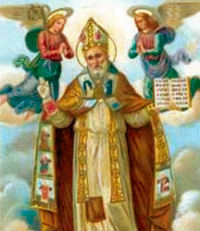
St. Ubaldus
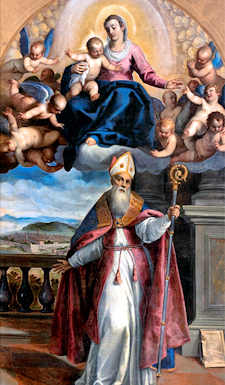 The saint was born in 1085 in Gubbio, Italy, and was from a noble family. He was related to Saint Sperandea. Ubaldus' father, Rovaldo Baldassini, died when the boy was very young; his mother was an invalid, probably afflicted with a neurological disease. Because of his mother's condition, he was raised by his uncle. He was ordained a priest, and quickly made a canon. Against his own wishes but upon the request of Pope Honorius II, he became the bishop of Gubbio in 1128. He lived at the time of Frederick Barbarossa, but little is know of his life, save that he was able to defend his city against the anger of the German Emperor.
In this capacity he was a model of apostolic simplicity, pastoral zeal, and personal holiness. His aid is popularly invoked against evil spirits. The tomb and shrine of Ubaldus is still a place of pilgrimage.
The power St. Ubaldus possessed against evil spirits was evident. The Church moves in a spirit world-—good angels are all about, while constant vigilance is exercised against Satan and his devils. The liturgy contains a considerable number of exorcisms and adjurations. Then there are a series of sacramentals directed against the power of evil spirits; for example, holy water, palms, candles. Hold these sacramentals in highest esteem.
—Excerpted from The Church's Year of Grace, Pius Parsch
Symbols and Representation: bishop giving a blessing as angels carry his crozier; bishop delivering a blessing while a devil flees from it; bishop holding a model of Gubbio
Patronage: against autism; against demonic possession; against migraine; against neuralgia; against obsession; autistic children; autistics; Gubbio, Italy; Montovi, Italy; obsessive compulsives; possessed people; sick children
Highlights and Things to Do:
- Learn more about St. Ubaldus:
- See his statue on St. Peter's Basilica Colonnade.
- Find out more about the Festa of St. Ubaldo, or Festa Die Ceri.
- His relics are located in Basilica of Sant Ubaldo, Gubbio. It is thought his body is still incorrupt.
St. Simon Stock
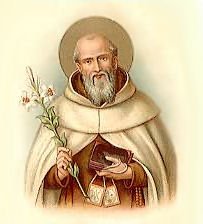 Little is known of his early life. Legend says that at age twelve he began to live as a hermit in a hollow oak tree; the name Stock is believed derived from the old English for tree trunk. Itinerant preacher. Pilgrim to the Holy Lands, but left when invading Muslims chased out Christians. Joined the Carmelite Order soon after its arrival in England.
Simon lived and studied for several years in Rome, Italy and Mount Carmel. Elected sixth general of the Carmelites in 1247 around age 82. He helped the Order spread through England, southern and western Europe. Founded houses in Cambridge, England in 1248, Oxford in 1253, Paris, France in 1260, and Bologna, Italy in 1260. Revised the Rule of the Order to make them mendicant friars instead of hermits.
Regardless of these successes, the Order was oppressed on all sides, including by the clergy and other orders. The friars took their woes to their patroness, the Virgin Mary. Tradition says that in answer, she appeared to Simon bringing him the brown Scapular of Mount Carmel. “This shall be the privilege for you and for all the Carmelites,” she told him, “that anyone dying in this habit shall be saved.” On January 13, 1252 the Order received a letter of protection from Pope Innocent IV, protecting them from harassment.
—Excerpted from CatholicSaints.Info
Patronage: Bordeaux, France
Symbols and Representation: Carmelite friar holding a scapular; Carmelite friar receiving the scapular from the Blessed Virgin; Carmelite friar surrounded by and praying for souls in purgatory; elderly man in a Carmelite habit in prayer
Highlights and Things to Do:
- Read more about St. Simon Stock:
- Read the Catechesis and Ritual for the Scapular of Our Lady of Mount Carmel.
- Find out more about the Brown Scapular Confraternity.
St. Brendan
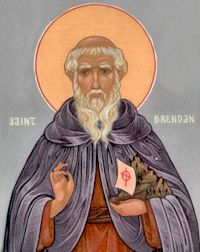 Brendan was born in Tralee in what would one day be known as Country Kerry, Ireland, about the year 484 (just ten years after the death of St. Patrick). What we know about his life comes to us through a tract known as Navigate Sancti Brendani Abbatis, (The Voyages of St. Brendan the Abbot), written about three centuries after his death. This recounts how Brendan founded the monastery of Clonfert near the center of Ireland. There he served for many years as abbot of a community of over 3000 monks (a number which historians tell us was common for sixth century Ireland). Fervent in zeal, Brendan was filled with desire to bring to other lands the faith which had only recently transformed his own homeland.
One day an itinerant monk named Barrind visited Clonfert and shared with Brendan and his brothers how he and a hermit named Mernoc had undertaken a voyage to the Promised Land of the Saints. Barrind described sailing to a land in the west, where they walked about for fifteen days without needing to eat or drink. Reaching a river, they met a man who told them many things about this strange Land, which, he said, had been there since the creation of the world. He instructed the two travelers to return home, and escorted them back to their boat, whereupon they set sail and returned to Mernoc's monastery.
Enthralled with Berrind's tale, Brendan selected fourteen monks from his own community and confided to them his desire to visit the Promised Land of the Saints. After praying and fasting, Brendan and his companions set out for Inishmore of the Aran Islands to seek the blessing of St. Edna. Near a small creek under a mountain now called Brendan's Seat, they pitched camp and built a small wood-framed boat, covered in oxhides tanned with oak bark, and smeared the joints with animal fat to seal them. In the boat they placed supplies for forty days and other equipment. As they prepared to set sail, three strange monks approached them, asking to be taken along. Brendan agreed, but warned that two of them would endure a hideous end, and that the third would not return from the voyage.
Brendan and his companions sailed westward for fifteen days until they lost their bearings and drifted to an island which looked like a huge rock tower with streams cascading down its cliffs. Finding a small harbor, they landed, and were greeted by a dog which led them to a hall where they found food set out for them. They stayed for several days, and the whole time they were on the island they saw no one, yet always found meals set out for them. After three days, as they boarded the boat to leave, one of the three monks who had joined them went into a fit. A demon leaped from his breast, and he died. It was then discovered that he had tried to steal a silver platter from the hall.
Their journey next took them to a large island called the Island of Sheep because of the numerous flocks which roamed its hills. They stayed there from Holy Thursday through Holy Saturday. While there, a man known as the Steward provided for them, and gave them fresh meat to take with them. He instructed them to travel to another island to celebrate Easter. Soon after leaving the Island of Sheep, they found a small barren island and landed there. But when they lit the fire to roast some of the meat they had been given, the island began to shake and move, and the monks scrambled back into their boat. They watched as the island moved away, their fire still burning. Brendan informed his monks that the "island" was in fact Jasconius, the largest whale in the ocean. Across a channel from the Island of Sheep the travelers found the Paradise of Birds, with a river leading inland. A mile upstream they discovered a huge tree covered with white birds. At vespers and at other times the birds burst into hymns and verses. One of the flock flew down to the boat and began speaking to Brendan, informing him that he and his companions would search seven years before reaching the Promised Land of the Saints. Throughout their stay on the Paradise of Birds, the Steward brought them food and water and provided for all their needs. When the Feast of Pentecost came, the Steward instructed them to set sail once again.
For many months they traveled westward and saw no sign of island or coast. Finally, just before Christmas, they spotted an island. When they reached the shore they found a white-haired elder who led them to the nearby Monastery of St. Ailbe. At the door of the monastery they were greeted in silence by eleven monks. The abbot washed their feet and led them to a meal of roots and bread. The abbot broke the silence to explain that no cooked food was ever eaten at the monastery, that the bread was miraculously provided, that their lamps never burned out, and that the monks never grew older. They had been on the island for eighty years, never speaking a word. After the other monks had gone to sleep, the abbot led Brendan to the chapel, where they watched as a fiery arrow sped through a window, touched the lamps at the altar to replenish their oil, and sped out again. When Epiphany came, Brendan and his companions left the Monastery of St. Ailbe and set sail again. They sailed until Lent, without sight of any land, their food and water depleted. After three days without water, they came upon an island where they found a well. But after drinking the water, the monks fell into a deep sleep, some for three days, some for two, some for one. Once they all awoke, Brendan ordered that they leave the island immediately.
Sailing toward the north, they hit a calm and their boat drifted aimlessly for twenty-five days. Finally a wind sped them eastward, returning them to the Island of Sheep on Holy Thursday. The Steward greeted them there, providing them with shelter and fresh clothing. Having observed Holy Saturday, he instructed them to sail off again to observe Easter on the back of Jasconius, the whale, then to proceed to the Paradise of Birds. They did as the Steward said. Again the Steward provided the travelers with food and water while they stayed on the Paradise of Birds. He instructed Brendan that they would repeat the cycle for several years-spending Holy Thursday on the Island of Sheep, Easter on the whale. Easter to Pentecost on the Paradise of Birds, and Christmas to Epiphany with the monks of the monastery of St. Ailbe. The times spent sailing between these islands would bring many adventures.
And so it happened. During one of these times the monks saw speeding toward their boat a huge beast spewing foam from his snout, looking as though it will devour them. The monks cried out in fear, but just as it drew next to the boat a second beast came from the west and attacked the first beast, cutting it into three pieces. Then the second beast swam back the way it had come. On another occasion a flying griffin attacked their boat, but before it could strike, a large bird dove out of the sky and killed the griffin. One day the companions came upon an island on which they found three choirs—one of boys, one of youth and one of elders. Throughout the day they sang the praises of God. A cloud of extraordinary brightness covered the island from dusk till dawn. When the travelers were ready to leave, the choirs invited one of the three monks who had joined Brendan's company to stay with them on the island. With Brendan's blessing, the monk remained. After this the wind blew them to a rocky, barren island from which came the sounds of hammer and anvil. Filled with apprehension, Brendan and his companions made a valiant effort to row away, but an islander appeared from out of a forge and threw a huge piece of slag at them. It flew over their heads, and when it fell into the sea, the water boiled and hissed. Other islanders rushed to the shore, likewise hurling slag at the boat. The water all around the Island of Smiths steamed like a furnace, and a horrible stench arose. Brendan informed his companions that they were on the edges of Hell.
Soon they were run aground at an island at the base of a huge black cliff. The third of the monks who had joined the band jumped off the boat and began walking towards the cliff, saying he was powerless to turn back. As he reached the cliff, demons carried him off and set him ablaze. Another time they saw a man chained to a pillar of rock, the wind and waves flailing against him. Brendan called out to him, and was told that he was Judas, upon whom the Lord showed mercy by freeing him from his torments in Hell to sit on this rock on Sundays and holy days.
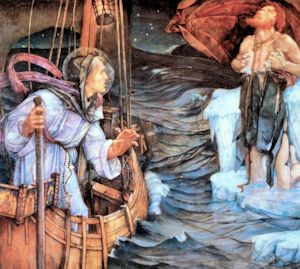 Finally the travelers reached an island where Brendan found an ancient monk sitting at the entrance to a cave. The ancient one told Brendan he had been a companion of St. Patrick and had been a hermit on the island for ninety years since Patrick's death. The hermit instructed Brendan to return once more to the Island of Sheep and once again to the Paradise of Birds, and after that he would be led to the Promised land of the Saints. There he and his companions would stay for forty days, and then be brought safely home to Ireland. After receiving the ancient monk's blessing, the companions sailed off and came to the Island of Sheep where they were once again attended to by the Steward. This time when they prepared to leave the Steward joined them in their boat. Next they met Jasconius who brought them on his back to the Paradise of Birds. After filling their water vessels, they companions set sail with the Steward as their guide, for, he said, without him they would never find the Promised Land of the Saints.
On the fortieth day a great fog swallowed up their boat. The Steward told them that the fog always surrounded the land for which they had been searching these seven years. An hour later a brilliant light shone forth, and the boat touched shore. The monks disembarked and found a beautiful land filled with fruit-laden trees. They explored the land for forty days, never coming to the end of it. But on the fortieth day they discovered a wide river, which Brendan said they should not cross. A young man approached and greeted each of them by name. He explained that God had delayed them in finding the Promised Land of the Saints so that they might discover many things along the way. He instructed them to gather up fruit and supplies and to set sail for, he said, Brendan's last days were near. The Promised Land, he assured them, would be made known to Brendan's successors at a time when Christians were being persecuted, so that they might find a new home in peace. Brendan and his companions gathered up fruit and, taking their leave of the Steward, sailed out into the fog. They came again to the island of the ancient hermit, and stayed there with him for three days. Then they set sail once again and returned safely to Ireland. The monastery at Clonfert greeted him with great joy, and he recounted to them everything which they had encountered on their journey. Finally he told them of his approaching death, as foretold by the young man. After making everything ready, Brendan received the sacraments, and soon thereafter died among his companions in about the year 570.
While the story of The Voyage of Brendan is filled with fanciful images, many modern scholars believe it has an historical foundation. Some claim that Brendan's voyage brought him to the shores of North America, making him and his companions the first Europeans to reach the continent—nearly a thousand years before Columbus. In 1977 a modern navigator built a replica of Brendan's boat and retraced his route across the Atlantic to Newfoundland, proving that such a journey was indeed possible.
Whether or not Brendan's voyage is historically factual, the story speaks to us throughout the centuries. We, too, are on a journey. Our God has invited us to travel with our companions, and to invite others to journey with us along the way. We are cared for by the Steward and often make the journey through the years from Epiphany to Holy Thursday to Easter. We encounter many strange and wonderful things along the way. And, in the end, we, too, are promised that we will be brought safely home.
—Excerpted from St. Brendan's Catholic Church and School
Patronage: boatmen; mariners; sailors; travelers; watermen; whales; diocese of Ardfert, Ireland; diocese of Clonfert, Ireland; diocese of Kerry, Ireland
Symbols or Representation: priest celebrating Mass on board ship with fish gathering to listen; whale; member of a group of monks in a small boat.
Highlights and Things to Do:
- Read more about St. Brendan at
- Did St. Brendan Reach North America 500 Years before the Vikings? Read more about his at National Geographic.
- Learn more about Fenit Harbor, St. Brendan’s birthplace.
- Who are the Twelve Apostles of Ireland?
- Brendan is interred in the Clonfert Cathedral, Clonfert, County Galway in Ireland, which was founded by St. Brendan.
St. Honoratus of Amiens (also Honorius and Honoré)
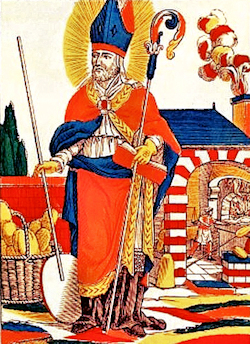 St. Honoratus was born to the nobility. He was known to be pious as a child, educated by Saint Beatus of Amiens. When he was elected, he was reluctant to be bishop of Amiens, France, believing himself unworthy. Legend says that a ray of divine light and holy oil appeared upon his head at the time of his selection as bishop.
As a priest and bishop, he was known for his charity and piety, totally devoting himself to the exercise of pious works and the celebration of divine worship, while disciplining himself with fasting and vigils.
In the centuries following the holy bishop's death, a number of miraculous cures were attributed to his intercession. A particularly striking prodigy, witnessed by many of the clergy and laity in Amiens, occurred in a church to which the body of Honoratus had been brought temporarily for the veneration of the faithful there. On the day that the relic was to be returned to the cathedral, those present saw the corpus of a crucifix in the church fully bow toward the saint's body as it was being carried out.
Legend says that when word reached the family home in Porthieu that Honorius had been chosen bishop, his old nursemaid, who was baking bread at the time, announced that the boy was no more going to be a bishop that then baker‘s peel she was leaning on would turn back into a tree. The wooden peel promptly grew roots and branches and turned into a blackberry tree what was still be shown to pilgrims 900 years later. This naturally led to a baker‘s peel being one of his emblems, and his patronage of trades associated with baking.
—Adapted from CatholicSaints.info and Catholic Online
Patronage: against drought; bakers; bakers of holy wafers; cake makers; candlemakers; chandlers; confectioners; corn chandlers; florists; flour merchants; oil refiners; pastry chefs
Symbols and Representation: baker‘s peel or shovel; bishop with a large Host; bishop with three Hosts on a baker‘s shovel; loaves of bread; prelate with a hand reaching from heaven to give him bread for the Mass
Highlights and Things to Do:
- Find out more about St. Honoratus:
- Bake a cake in honor of St. Honoratus, patron of bakers. The Gateau St. Honoré is named after this saint. This is difficult cake, with many different challenges. See Michael Foley and Father Leo Patalinghug's recipe that simplifies it a bit.
- St. Honoratus' relics reside in the Cathedral of Amiens.