Easter: May 14th
Feast of St. Matthias, Apostle and Martyr or Solemnity of the Ascension (for certain ecclesiastical provinces)
MASS READINGS
May 14, 2026 (Readings on USCCB website)
PROPERS [Show]
COLLECT PRAYER
Feast of St. Matthias: O God, who assigned Saint Matthias a place in the college of Apostles, grant us, through his intercession, that, rejoicing at how your love has been allotted to us, we may merit to be numbered among the elect. Through our Lord Jesus Christ, your Son, who lives and reigns with you in the unity of the Holy Spirit, God, for ever and ever.
Ascension Thursday: Gladden us with holy joys, almighty God, and make us rejoice with devout thanksgiving, for the Ascension of Christ your Son is our exaltation, and, where the Head has gone before in glory, the Body is called to follow in hope. Through our Lord Jesus Christ, your Son, who lives and reigns with you in the unity of the Holy Spirit, God, for ever and ever.
Recipes (2)
Activities (7)
Prayers (7)
Library (1)
Blog & Podcasts (0)
Today is the Feast of St. Matthias, Apostle and Martyr. After the Ascension of Jesus, St. Peter proposed to the assembled faithful that they choose a disciple of Christ to fill the place of the traitor Judas in the first missionary band. Lots were drawn, with the result in favor of Matthias. According to one ancient tradition, this missioner labored in Ethiopia and was martyred there. Thus did St. Matthias receive "the crown of life which God has promised to those who love him." The Church venerates St. Matthias on an equal footing with the other Apostles, whose voices resound throughout the world, from generation to generation, giving testimony of what they saw and heard in their life with our Lord. His name is mentioned in the Canon of the Mass.
In the United States, the ecclesiastical provinces of Boston, Hartford, New York, Newark, Omaha, and Philadelphia have retained the celebration of the Solemnity of the Ascension on the proper Thursday while all other provinces have transferred this solemnity to the Seventh Sunday of Easter, June 1.
Today marks the beginning of the Pentecost Novena to the Holy Spirit, honoring the original novena (9 days of prayer) of the Apostles and Mary, awaiting the promised coming of the Paraclete. Catholic Culture has several versions to use. We also highly recommend this 10-Day Devotion to the Holy Spirit from the St. Josemaria Institute, taken from The Handbook of Prayers. The actual timespan between Ascension Thursday and Pentecost is 10 days, so you can choose a 9 or 10 day devotion. If you choose a 9-day devotion, end a day early or start Friday after Ascension Thursday.
Meditation for Thursday of the Sixth Week of Easter or Ascension Thursday:
The Glorified Christ
1. On this day Christ's triumph is complete. The victory which He gained by His resurrection from the dead is today made perfect. The Lord, together with the human nature He assumed, has ascended to the Father. He now shares in the dominion of heaven and earth; He now rules all hearts and all souls.
2. Forty days have elapsed since Easter. During this period it was the intention of divine Providence that our faith in the resurrection of Christ should be confirmed and strengthened. The disciples had been bewildered by the fact that their Master had died on the cross. He had breathed forth His spirit, and His body had been buried. All this had weakened their faith and aroused doubts in the minds of the dejected disciples. During the forty days that followed, the apostles and disciples acquired such a firm and steadfast faith that they were not saddened by our Lord's ascension, but were rather filled with joy.
And indeed the Ascension was a cause for joy. Human nature had been exalted above the highest heavens and placed above the angels and archangels. It had been allowed to approach the very throne of God. The apostles knew now that they would be allowed to share in the glory of Him whose nature they shared.
Since the ascension of Christ is our exaltation, and whither the glory of the head has gone first, there the hope of the body is also called, let us rejoice with gladness and delight in giving thanks. For today not only have we been confirmed as the possessors of paradise, but in Christ we have even penetrated the heights of heaven, having gained far more through the ineffable grace of Christ than we had lost through the malice of the devil. For those whom the virulent enemy cast down from the happiness of their first state, these the Son of God has placed as one body with Himself at the right hand of the Father, who lives and reigns in the unity of the Holy Ghost for all eternity. Amen (St. Leo the Great).
3. Christ, our head, "hath raised us up together, and hath made us sit together in the heavenly places" (Eph. 2:6). We are "heirs indeed of God and joint heirs with Christ" (Rom. 8:17), called to share the inheritance of Christ. "Now you are the body of Christ, members of member" (I Cor. 12:27), "For no man ever hated his own flesh; but nourisheth and cherisheth it, as also Christ doth the Church" (Eph. 5:29). Now the members and the body share in that which belongs to the head. Thus we possess even today the riches and glory and exaltation of the ascension in Christ our head.
Christ's victory and triumph are not His personal victory and triumph, but belong to the whole Christ, to the entire Church, When He died on the cross He embodied the whole of mankind, and the whole of mankind shared in His death. As the second Adam, He includes the whole of mankind also in His resurrection and ascension. He won the victory and has triumphed, not only for Himself, but for us also, for the whole Church. Our head has been taken up into heaven, where He reserves a place also for us. That place already belongs to us and is secured for us by Christ. That does not mean that God will one day take us to Himself in heaven, but rather that God has already brought us to heaven in Christ.
"And if I shall go and prepare a place for you, I will come again and will take you to Myself, that where I am you also may be And whither I go you know, and the way you know" (John 14:3 f.).
How could we do anything else but rejoice, at least to the extent of our belief? Our joy as Christians on this occasion will be in direct proportion to our faith.
What must we do that we may be certain to share in the ascension later on? We need do only one thing, remain united to Christ. How can we remain united to Him? By becoming members of His body, His Church, and by living in harmony with its teachings.
—Benedict Bauer, O.S.B, from The Light of the World, Vol II
Ascension Thursday
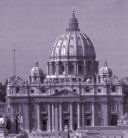
Station with San Pietro in Vaticano (St. Peter's in the Vatican):
For the solemnity of the Ascension, we return again to St. Peter's in the Vatican. Here we join Peter and the other apostles watching Jesus ascend triumphantly into heaven. The Church acclaims Him in His holy humanity, invited to sit on the Father's right hand and to share His glory. But Christ's Ascension is the pledge of our own. Filled with an immense hope, the Church looks up towards her leader, who precedes her into the heavenly home and takes her with Him in His own person. The whole life of the Church is placed between our Lord's Ascension and His return on the last day. Confident that she does not wait in vain, she preaches His Gospel and spreads His grace everywhere until the day when He returns in all His Father's glory for those whom He came down to earth to snatch from Satan's power.
For more on San Pietro in Vaticano, see:
For further information on the Station Churches, see The Stational Church.
St. Matthias
Mathias was one of the first to follow our Savior; and he was an eye-witness of all His divine actions up to the very day of the Ascension. He was one of the seventy-two disciples; but our Lord had not conferred upon him the dignity of an apostle. And yet, he was to have this great glory, for it was of him that David spoke, when he prophesied that another should take the bishopric left vacant by the apostasy of Judas the traitor. In the interval between Jesus' Ascension and the descent of the Holy Ghost, the apostolic college had to complete the mystic number fixed by our Lord Himself, so that there might be the twelve on that solemn day, when the Church, filled with the Holy Ghost, was to manifest herself to the Synagogue. The lot fell on Mathias; he shared with his brother-apostles the persecution in Jerusalem, and, when the time came for the ambassadors of Christ to separate, he set out for the countries allotted to him. Tradition tells us that these were Cappadocia and the provinces bordering on the Caspian Sea.
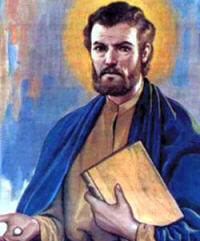 The virtues, labor, and sufferings of St. Mathias have not been handed down to us: this explains the lack of proper lessons on his life, such as we have for the feasts of the rest of the apostles. Clement of Alexandria records in his writings several sayings of our holy apostle. One of these is so very appropriate to the spirit of the present season, that we consider it a duty to quote it. 'It behooves us to combat the flesh, and make use of it, without pampering it by unlawful gratifications. As to the soul, we must develop her power by faith and knowledge.' How profound is the teaching contained in these few words! Sin has deranged the order which the Creator had established. It gave the outward man such a tendency to grovel in things which degrade him, that the only means left us for the restoration of the image and likeness of God unto which we were created, is the forcible subjection of the body to the spirit. But the spirit itself, that is, the soul, was also impaired by original sin, and her inclinations were made prone to evil; what is to be her protection? Faith and knowledge. Faith humbles her, and then exalts and rewards her; and the reward is knowledge.
—Excerpted from The Liturgical Year, Abbot Gueranger O.S.B.
Symbols and Representation: lance; spear
Patronage: Alcoholism; carpenters; reformed alcoholics; smallpox; tailors; diocese of Gary; Indiana; diocese of Great Falls-Billings, Montana
Highlights and Things to Do:
- Celebrate the triumph of St. Matthias by reading the hymn taken from the Menaea of the Greeks.
- Learn more about St. Matthias: