Easter: May 13th
Wednesday of the Sixth Week of Easter; Opt. Mem. of Our Lady of Fatima; Minor Rogation Day
MASS READINGS
May 13, 2026 (Readings on USCCB website)
PROPERS [Show]
COLLECT PRAYER
Wednesday of the Sixth Week of Easter: Grant, we pray, O Lord, that, as we celebrate in mystery the solemnities of your Son's Resurrection, so, too, we may be worthy to rejoice at his coming with all the Saints. Through our Lord Jesus Christ, your Son, who lives and reigns with you in the unity of the Holy Spirit, God, for ever and ever.
Optional Memorial of Our Lady of Fatima: O God, who chose the Mother of your Son to be our Mother also, grant us that, persevering in penance and prayer for the salvation of the world, we may further more effectively each day the reign of Christ. Who lives and reigns with you in the unity of the Holy Spirit, God, for ever and ever.
Vigil for the Ascension: O God, whose Son today ascended to the heavens as the Apostles looked on, grant, we pray, that, in accordance with his promise, we may be worthy for him to live with us always on earth, and we with him in heaven. Who lives and reigns with you in the unity of the Holy Spirit, God, for ever and ever.
Recipes (2)
Activities (9)
Prayers (13)
Library (11)
Blog & Podcasts (5)
Today the Church celebrates an Optional Memorial of Our Lady of Fatima, which is a title of the Blessed Virgin Mary following apparitions to three shepherd children — Lucia, Jacinta and Francisco — in Portugal in 1917. The message of Fatima includes a call to conversion of heart, repentance from sin and a dedication to the Blessed Virgin Mary, especially through praying the Rosary. This optional memorial is new to the USA liturgical calendar and is inscribed on May 13.
Today is also the traditional commemoration of Our Lady of the Most Blessed Sacrament. This title was given to our Blessed Mother in May 1868 by Saint Peter Julian Eymard to honor her relationship to the Holy Eucharist and to place her before us as a model in our duties and devotion to the Blessed Sacrament.
Julian of Norwich, England (1342-1423) is traditionally honored today. She is not included in the Roman Martyrology but popular piety sees her as a holy woman of God, and so often refer to her as Mother, Saint or Blessed Julian. She is most known for her book, Revelations of Divine Love.
Today also marks the final day of the traditional observance of the Minor Rogation Days, which fall Monday through Wednesday preceding Ascension Thursday. Each of these days has a traditional Station Church. Wednesday is the Station with San Pietro in Vaticano (St. Peter's in the Vatican).

Minor Rogation Days
Monday, Tuesday and Wednesday before the Ascension we commemorate the traditional dates for the Minor Rogation Days. These are days of prayer and formerly fasting, which take place every year on April 25th and the three days preceding the feast of the Ascension, the former being known as the Major Rogation and the latter as the Minor Rogations. The word “rogation” has its origins in the Latin word rogare, which means to supplicate or ask, and the purpose of Rogation Days is to beg God for His mercy, to turn away His anger, and to ask Him to bless the produce of field and garden while protecting us from natural disasters. The Rogation Days no longer appear on the General Roman Calendar, but are celebrated according to the local conference of bishops.
In the ancient Church Rogation days were quite common; some recurred annually, others were introduced at times of particular need, e.g., averting war or pestilence. The practice of three Rogation days before the feast of Christ's Ascension originated in Gaul (modern France). The saintly bishop Mamertus of Vienne introduced these days of prayer and penance when catastrophe threatened the city and its neighborhood about the year 450 A.D. Quickly the custom spread, and eventually it was incorporated into the liturgy of the Western Church.
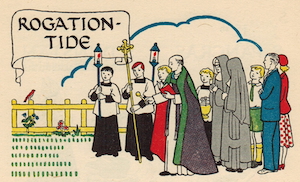
The celebration of Rogation Days consists in a procession followed by the Rogation Mass. In this procession we may sense the last remnant of the obsolete station processions observed by ancient Christians almost daily during Lent and during the first week after Easter. They would gather in a church known as the ecclesia collecta (hence the word "Collect") and from there walk in procession with the bishop and clergy to another church singing the Litany of the Saints and the Kyrie. The place of destination was known as the statio or station church, and holy Mass was celebrated there.
The four Rogation days have preserved the main elements of this venerable rite, an observance that we should respect and foster. For we should pray both perseveringly and in common, since special efficacy and power is attached to such prayer. Our prayer should not only be sincere and personal, we should also pray as units of a community, for to this type of prayer a special efficacy is attached. In the Rogation procession the Litany of the Saints is recited; it gives us an opportunity to call upon the entire Church triumphant to intercede in our behalf. The prayers concluding the Litany are usually beautiful and edifying.
What petitions will surely be answered?
Those which, according to Christ's words, are made in "the right spirit," and which are offered in the Name of Jesus, i.e., tend to further the kingdom of God. In the "Our Father" Christ has given us a summary of such petitions. Therefore, if our wishes are similar to those in the Lord's Prayer, we can assume that they will be heard. These petitions fall under three headings: God's kingdom, daily bread, sin. God will certainly grant petitions of this kind.
—Excerpted from The Church's Year of Grace, Pius Parsch
Highlights and Things to Do:
- Rogation Days: Cross Days (Activity)
- Rogation Day Prayers (Prayer)
- Read more about the Rogation Days at Catholic Saints Info.
- For more see Rogation Days.
The Third Rogation Day
We keep the third and last of the Rogation Days with our pastor, St. Peter. With profound reverence and filial devotion we will chant today the invocation: "Sancte Peter, ora pro nobis." Great is St. Peter's joy whenever the Church Militant calls upon his triumphant lambs and sheep, the apostles and martyrs, the pontiffs and confessors, the virgin and widows and all the saints, the glorious flock which the keybearer of heaven has already admitted to his Master in glory seated at the right hand of the Father. We salute thee, blessed Peter, immovable rock of the Church and shepherd of our souls. We entrust ourselves anew to thee, in soul and body. Pray the eternal Father that He would bless the holy, Catholic Church, grant her peace, protect, unite and govern her throughout the world, together with our holy Father, Pope N., our Bishop N., and all true believers and promoters of the Catholic and apostolic faith (Canon). St. Peter, pray for us.
Meditation for Wednesday of the Sixth Week of Easter, Vigil of the Ascension
Final Minor Rogation Day: Before the gates of the Father
1. Today we live with our Lord and Savior. The thought that concerns Him most today is the realization: "I come to Thee," to the Father. The Son knocks at the door of the Father and begs admission for Himself and for His disciples.
2. "Father, the hour is come; glorify Thy Son, that Thy Son may glorify Thee. . . . I have glorified Thee on earth: I have finished the work which Thou gavest Me to do; and now glorify Thou Me, O Father, with Thyself, with the glory which I had before the world was" (Gospel). Christ asks His Father to let His human nature share in that glory which He posessed as the Son of God from all eternity. How completely He has humbled Himself! Although He was God, at the moment of His incarnation He took on our lowly human nature and "emptied Himself taking the form of a servant…He humbled Himself, becoming obedient unto death, even to the death of the cross" (Phil. 2:7 f.). By a life of poverty, humility, and suffering, and by complete subjection to the will of the Father, He has fulfilled the task which was given to Him. Now He returns to the Father, and we share His feelings and His joy. We join in His prayer to the Father: "Father,... glorify Thy Son" as He has glorified Thee. Give also to His humanity the glory that is justly His. Exalt Him above the world and above the highest heavens. Take Him to Thyself and set His throne at the right hand of Thy majesty. Let the scepter of His power extend to the ends of the earth. Let Him rule in the human nature He has assumed as King and Master, and let every knee bow to Him, "of those that are in heaven, on earth, and under the earth" (Phil. 2:10). Let His name and His gospel be made known to all mankind. Let all men be incorporated in Him, that they may feel the power of His salvation and may be saved through Him. Prepare for Him a spouse pure and spotless, a holy and blessed Church. Make that Church holy, universal, mighty, and invincible. Give Him power over souls, over hearts, over peoples, and over all ages. Let all offer sacrifice to Him, and may He extend His sway over all men. May He save all men and dive them life that they may possess it in its fullness.
"I have manifested Thy name to the men whom Thou hast given Me out of the world. Thine they were, and to Me thou gavest them, and they have kept Thy word. Now they have known that all things which Thou hast given Me are from Thee; because the words which Thou gavest Me, I have given to them; and they have received them, and they have known in very deed that I came out from Thee, and they have believed that Thou didst send Me. I pray for them; I pray not for the world, but for them whom Thou hast given Me; because they are Thine and all My things are Thine, and Thine are Mine" (Gospel). We belong to Him as the members of the body belong to the head. He cannot go to His Father without us. He desires that we, His brothers, share in His eternal inheritance. "I pray for them ... whom Thou hast given Me." He prays for us because we have been united to Him through our baptism, through our daily Holy Communion. How shall we measure this ineffable love of the Savior? How intense is His desire that the gates of heaven be opened to all men, and that in the mansion of His heavenly Father a place be prepared for us! O Lord I believe in You, and I trust and confide entirely in You.
3. "Declare it with the voice of joy and let it be heard, alleluia; declare it even to the ends of the earth: The lord hath delivered His people, alleluia, alleluia" (Introit). We have been delivered. He will take us with Him to His Father. "Shout with joy to God, all the earth, sing ye a psalm to His name; give glory to His praise. Glory be to the Father and to the Son and to the Holy Ghost" (Introit). The Lord has delivered His people. He goes now to prepare a place for them in heaven, and very soon we shall join Him there. "It is truly meet and just, right and profitable to salvation, to extol Thee indeed at all times, O Lord, but especially with the highest praise to magnify Thee at this time, when Christ our Pasch was sacrificed. For He is the true lamb who hath taken away the sins of the world. Who by dying hath overcome our death, and by rising again hath restored our life" (Preface for Easter). We have been delivered.
"Sing ye to the Lord, alleluia; sing unto the Lord and bless His name; show forth His salvation from day to day, alleluia, alleluia" (Communion). Praise Him from day to day for the work of salvation which He has accomplished for us, and which He will one day bestow on us at our entrance into heaven.
—Benedict Bauer, O.S.B, from The Light of the World, Vol II
Wednesday of the Sixth Week of Easter, Wednesday of the Lesser Rogation Days
Station with San Pietro in Vaticano (St. Peter's in the Vatican):
Today is the third and last Rogation day. If possible we will take part in the ancient and venerable station procession and in chanting the Litany of the Saints. In spirit we will feel ourselves present within the stational church of St. Peter at Rome, and in union with all Christendom celebrate the Rogation Mass.
For more on San Pietro in Vaticano, see:
For further information on the Station Churches, see The Stational Church.
St. Isidore the Farmer
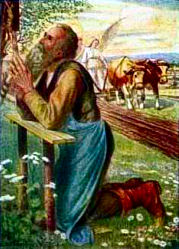 When he was barely old enough to wield a hoe, Isidore entered the service of John de Vergas, a wealthy landowner from Madrid, and worked faithfully on his estate outside the city for the rest of his life. He married a young woman as simple and upright as himself who also became a saint-Maria de la Cabeza. They had one son, who died as a child.
Isidore had deep religious instincts. He rose early in the morning to go to church and spent many a holiday devoutly visiting the churches of Madrid and surrounding areas. All day long, as he walked behind the plow, he communed with God. His devotion, one might say, became a problem, for his fellow workers sometimes complained that he often showed up late because of lingering in church too long.
He was known for his love of the poor, and there are accounts of Isidore's supplying them miraculously with food. He had a great concern for the proper treatment of animals.
He died May 15, 1130, and was declared a saint in 1622 with Ignatius of Loyola, Francis Xavier, Teresa of Avila and Philip Neri. Together, the group is known in Spain as "the five saints."
Patronage: against the death of children; agricultural workers; day laborers; farm workers; farmers; field hands; for rain; husbandmen; laborers; livestock; Mexican peasants; ranchers; Spanish peasants; rural communities; Farmers; farm workers; ranchers; rural communities; National Catholic Rural Life Conference in the United States.
See CatholicSaints.info for a full listing of organizations and locations that claim St. Isidore as patron.
Symbols and Representation: White oxen; spade; hoe or rake; plough
Highlights and Things to Do:
- St. Isidore (and his wife Maria) are the patrons of the Catholic Rural Life Conference. Read this reflection on St. Isidore, their patron, some ideas to celebrate his feast and Novena to St. Isidore.
- Learn more about St. Isidore the Farmer:
- See Christian Iconography for some images of St. Isidore.
- The remains of St. Isidore Hand his wife Santa María de la Cabeza are located in Church of San Isidro in Madrid.
- Establishing or replenishing a a Mary garden would be an appropriate way to celebrate the combination of the feast of St. Isidore and the month of May, dedicated to Mary.
- Visit mgardens.org to learn more about Mary Gardens.
- There is also a lovely book on Mary gardens printed by St. Anthony Messenger Press called Mary's Flowers: Gardens, Legends and Meditations by Vincenzina Krymow.
- Visit Stokes Marys Gardens.
- Another book by Vincenzina Krymow is Healing Plants of the Bible which explains Biblical gardens and plants.
Two books we especially recommend: Cooking for Christ by Florence Berger (although we prefer the original 1949 edition; this is an edited version), and Rural Life Celebration Guide.