Easter: May 12th
Tuesday of the Sixth Week of Easter; Opt Mem of Sts. Nereus & Achilleus, Martyrs; Opt Mem of St. Pancras, Martyr; Minor Rogation Day
Other Commemorations: Bl. Imelda Lambertini, Virgin (RM)
MASS READINGS
May 12, 2026 (Readings on USCCB website)
PROPERS [Show]
COLLECT PRAYER
Tuesday of the Sixth Week of Easter: Grant, almighty and merciful God, that we may in truth receive a share in the Resurrection of Christ your Son. Who lives and reigns with you in the unity of the Holy Spirit, God, for ever and ever.
Optional Memorial of Sts. Nereus and Achilleus: Grant, we pray, almighty God, that we, who know the great courage of the glorious Martyrs Nereus and Achilleus in confessing you, may experience their loving intercession for us in your presence. Through our Lord Jesus Christ, your Son, who lives and reigns with you in the unity of the Holy Spirit, God, for ever and ever.
Optional Memorial of St. Pancras: May your Church rejoice, O God, confident in the intercession of the Martyr Saint Pancras, and by his glorious prayers may she persevere in devotion to you and stand ever firm. Through our Lord Jesus Christ, your Son, who lives and reigns with you in the unity of the Holy Spirit, God, for ever and ever.
Recipes (1)
Activities (8)
Prayers (9)
Library (5)
Blog & Podcasts (4)
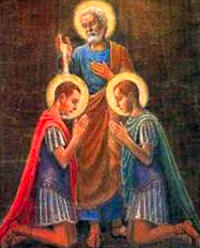
The Church celebrates the Optional Memorial of Saints Nereus and Achilleus (d. 98) who were Roman soldiers in the household of Flavia Domitilla. They were instructed and converted by St. Peter. These two soldiers in turn inspired St. Domitilla to consecrate her virginity to God. Thereupon, Aurelianus, the fiancee of Domitilla, reported all three to the Roman authorities as being Christians. They were martyred out of hatred for Christianity.
It is also the Optional Memorial of Saint Pancras (d. 290), a noble Phrygian youth, came to Rome at the age of fourteen and was martyred in 275 because he refused to offer sacrifices to the pagan gods.
The Roman Martyrology commemorates Bl. Imelda Lambertini (1322-1333), daughter of Count Egano Lambertini of Bologna and Castora Galuzzi. She was a student at Dominican Convent of Valdi-Pietra in Bologna and had a great devotion to Saint Agnes of Rome, of whom she may have had visions. On May 12, 1333 she miraculously received her First Communion, and immediately after died in an ecstasy of love and joy.
Today continues the traditional observance of the Minor Rogation Days, which fall Monday through Wednesday preceding Ascension Thursday. Each of these days has a traditional Station Church. Tuesday is San Giovanni in Laterano (St. John Lateran).

Minor Rogation Days
Monday, Tuesday and Wednesday before the Ascension we commemorate the traditional dates for the Minor Rogation Days. These are days of prayer and formerly fasting, which take place every year on April 25th and the three days preceding the feast of the Ascension, the former being known as the Major Rogation and the latter as the Minor Rogations. The word “rogation” has its origins in the Latin word rogare, which means to supplicate or ask, and the purpose of Rogation Days is to beg God for His mercy, to turn away His anger, and to ask Him to bless the produce of field and garden while protecting us from natural disasters. The Rogation Days no longer appear on the General Roman Calendar, but are celebrated according to the local conference of bishops.
In the ancient Church Rogation days were quite common; some recurred annually, others were introduced at times of particular need, e.g., averting war or pestilence. The practice of three Rogation days before the feast of Christ's Ascension originated in Gaul (modern France). The saintly bishop Mamertus of Vienne introduced these days of prayer and penance when catastrophe threatened the city and its neighborhood about the year 450 A.D. Quickly the custom spread, and eventually it was incorporated into the liturgy of the Western Church.
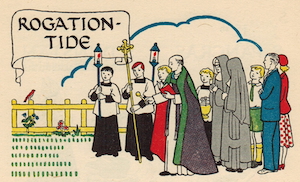
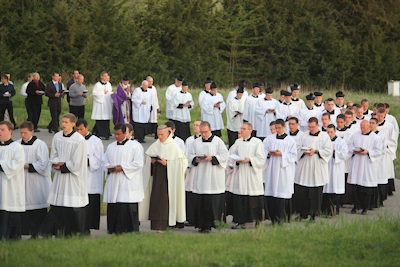
The celebration of Rogation Days consists in a procession followed by the Rogation Mass. In this procession we may sense the last remnant of the obsolete station processions observed by ancient Christians almost daily during Lent and during the first week after Easter. They would gather in a church known as the ecclesia collecta (hence the word "Collect") and from there walk in procession with the bishop and clergy to another church singing the Litany of the Saints and the Kyrie. The place of destination was known as the statio or station church, and holy Mass was celebrated there.
The four Rogation days have preserved the main elements of this venerable rite, an observance that we should respect and foster. For we should pray both perseveringly and in common, since special efficacy and power is attached to such prayer. Our prayer should not only be sincere and personal, we should also pray as units of a community, for to this type of prayer a special efficacy is attached. In the Rogation procession the Litany of the Saints is recited; it gives us an opportunity to call upon the entire Church triumphant to intercede in our behalf. The prayers concluding the Litany are usually beautiful and edifying.
What petitions will surely be answered?
Those which, according to Christ's words, are made in "the right spirit," and which are offered in the Name of Jesus, i.e., tend to further the kingdom of God. In the "Our Father" Christ has given us a summary of such petitions. Therefore, if our wishes are similar to those in the Lord's Prayer, we can assume that they will be heard. These petitions fall under three headings: God's kingdom, daily bread, sin. God will certainly grant petitions of this kind.
—Excerpted from The Church's Year of Grace, Pius Parsch
Highlights and Things to Do:
- Rogation Days: Cross Days (Activity)
- Rogation Day Prayers (Prayer)
- Read more about the Rogation Days at Catholic Saints Info.
- For more see Rogation Days.
The Second Rogation Day is the Station at St. John Lateran.
If at all possible, we will take part in the in the Rogation procession and Mass today and tomorrow. In spirit we will observe the venerable liturgy at St. John Lateran, the church where baptisms were administered in ancient times. It may aid our piety to group our petitions on these three days. The first day we will devote to our personal needs; the second, to family and community; the third, to the needs of the universal Church. Not only at the morning liturgy but throughout the day we will continue to pour forth our pleading to God.
Reflections on the Nature of True Prayer.
In the Rogation liturgy we are reminded of what a great privilege it is to place our needs before God in prayer. The liturgical texts provide 1) instruction on the value and significance of prayer; 2) incentives and aids on how to pray fervently and perseveringly. We need but look at the beautiful Gospel triptych with Christ's words: "Ask and it shall be given to you; seek, and you shall find; knock and it shall be opened to you. For everyone who asks receives...," in the center panel flanked by the importunate friend and the pleading child. Petition is the key to the riches of God's fatherly heart, the key that opens up the treasures of divine mercy.
Yet if we are honest, we will be very ready to admit having had doubts concerning Christ's words just quoted. How often we asked in vain for some favor! What then are the qualities that our petition lacked? How must we pray in order to have our prayers heard? The answer may lie in the object for which we pray, in defects in our disposition, or in the spirit that animates us.
a) The object of prayer. The words of Christ are indeed general in character, they set no limit to the object of one's petition. Nevertheless, our Savior clearly stated that only such pleas will be answered which harmonize with the aims of the kingdom of God. He said: "If you, evil as you are, know how to give good gifts to your children, how much more will your Father in heaven give good things to those who ask him!"
God will not give his children harmful gifts. The phrase "good things" is mystical and can perhaps be best explained as covering items that will serve our eternal goal. Certainly we may pray for material favorites, but on the condition that they will be "good things" for us. Sometimes God answers a prayer by granting the opposite to that which is asked; instead of a stone, a serpent, or scorpion, He blesses us with bread, eggs, or fish.
b) The second reason why our prayers may not be heard lies in our personal disposition, our lack of faith and love and humility. (1) Whenever Christ performed a miracle, He demanded faith as a prerequisite. On one occasion the apostles could not heal a possessed boy; to their queries Jesus said, "Because of your little faith; for amen I say to you, if you have faith like a mustard seed, you will say to this mountain: Remove from here, and it will remove. And nothing will be impossible to you" (Mt 17:19). We need the faith that moves mountains. (2) A second obstacle is our lack of love. If we ourselves neither give nor forgive, we can expect no favors from God. In his epistle St. Peter makes a pertinent observation: "Husband, in like manner dwell with your wives considerately, paying honor to the woman as to the weaker vessel...that your prayers be not hindered" (1 Pt 3:7). Our prayers are "hindered" through lack of love for our neighbor. (3) Lack of humility likewise closes God's dispensing hand. We need only recall the story of the publican and the pharisee. The same parable also teaching us that past sin does not prevent prayers from being heard. God listens to the prayer of a humble sinner rather than to the effusions of a just but proud man.
c) Finally, the spirit with which one prays is important. Do you pray perseveringly, in union with others, submissive to God's will? (1) The two Gospel parables speak clearly of persevering, even importunate petition. God wants to hear our prayers. He does not, however, want us to dictate the time when He should respond. There is high pedagogical wisdom in that God does not reply at once to our prayers. Perseverance in pleading is good training spiritually, and it purifies our longing. One who is expecting further gifts will more easily be grateful for benefits already received. Old age had already come upon Zacharias, the father of John the Baptist, before his petition was granted. (2) A special efficacy is attached to prayer made in common. "If two of you shall agree on earth about anything at all for which they ask, it shall be done for them by My Father in heaven" (Mt 18:19). (3) Lastly, our prayer must be rooted deeply in God's holy will. Of this there is no example more moving and convincing than that of Christ Himself during His agony on Mt. Olivet. His Father did not hear Him, did not remove the chalice from Him. And yet our Savior's prayer was answered. He was given strength to drink the chalice to its dregs.
 Prayer does not imply the gratification of one's own will, rather that we submerge our wills in that of God. In prayer, in every act, we must leave behind our own pagan, egotistical selves and selflessly seek the good of God's kingdom. As long as prayer serves nothing more than one's own selfish interests, it will never be heard. However, once our hearts and minds are oriented to welfare of God's kingdom, then prayer will become the bond uniting us most intimately to God. Then we will realize what tremendous power it has.
—Excerpted from The Church's Year of Grace, Pius Parsch
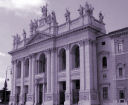
Tuesday of the Sixth Week of Easter, Tuesday of the Lesser Rogation Days,
Station with San Giovanni in Laterano (St. John Lateran)
The Station today is at St. John Lateran which is the seat of the Roman Pontiff, and the cathedral church for the Diocese of Rome. The official name of the basilica in Italian is Santissimo Salvatore e Santi Giovanni Battista ed Evangelista in Laterano. The Lateran is comprised of the Basilica, the Pontifical Palace and the Baptistry. The church is dedicated to the Christ the Savior. In the fifth century the titles of St. John Baptist and St. John the Evangelist were added. The Papal altar contains the wooden altar on which St. Peter is said to have celebrated Mass. This basilica is the mother of all churches and is the only church which has the title of Archbasilica.
The first Rogation Day we kept with our Mother. The second we celebrate with our Brother. In spirit we enter the Lateran Basilica dedicated to our Most Holy Savior, "The First-born among many brethren." In union with our eldest Brother we praise today "His Father and our Father, His God and our God. Especially this second rogation day should fill our souls with renewed awe and respect for the "Our Father" prayer so filled with love for the Father, so divine in origin, so embracing in content; a prayer sanctified by millions of Christ-branches, in particular by the holy martyrs who had it upon their lips while making the supreme sacrifice of their life for Him that taught.
For more on San Giovanni in Laterano, see:
- Churches of Rome
- Rome Art Lover
- Roman Churches
- Aleteia
- Click here for a 360 degree virtual tour.
- The Catholic Traveler
For further information on the Station Churches, see The Stational Church.
St. Nereus and Achilleus
The mention in the Missal of these saints awakens within us today little or no memory, but in the Christian Rome of the first centuries these names were dear to popular piety. The catacomb of Domitilla on the Ardeatine Way was well known, and the two Martyrs Nereus and Achilleus were buried there.
A certain Flavia Domitilla belongs to the illustrious family of the Flavii, which, during the first century, had given three emperors to Rome. She was the wife of the Consul Flavius Clemens, a relative of Domitian, and was one of the aristocratic Romans who had embraced Christianity. She it was who in all probability founded the catacomb referred to. Another Flavia Domitilla, grandchild of the first, was, like her, exiled for the Faith.
The two martyrs Nereus and Achilleus are also celebrated as having been in Domitian's service. Their bodies were translated from the catacomb of Domitilla to another Roman church, the basilica of Fasciola. These are ancient Roman memorials, recalling to our memory that St. Peter, delivered from prison, was preparing to leave Rome, where he feared to be put to death, the at this point on the road the little band (fasciola) tied round his leg became loosened. Stopping to retie it, Christ appeared to him. "Master, whiter goest Thou?" demanded the Apostle. "I go to Rome," replied his Lord, "there to be crucified again." Peter understood. He it was who returned to Rome, where he was to be sacrificed.
The basilica of the Fasciola, for a time abandoned, was bestowed as a title on the famous cardinal Baronius, towards the close of the sixteenth century. The Cardinal restored it, and it may be visited today. It was known by the names of SS. Nereus and Achilleus even before their translation.
The Acts of these Martyrs do not belong to the class of Acta sincera; fantastic details have been added, embroidered upon authentic facts which are guaranteed by these tombs and these churches. On of St. Gregory's Homilies was pronounced over their tomb, and a Damasian inscription is dedicated to them.
Archeologists have studied these Acts profoundly during the last few years. The latest hypothesis, which appears more or less justified, would place their martyrdom in the reign of Nero, in the year 63. In this case these two soldiers, of Germanic origin, would be the proto-martyrs of the Roman Church.
—Excerpted from The Year's Liturgy, Volume 2 by Fernand Cabrol, OSB
Symbols and Representation: Two posts and lions; fire; two swords.
Highlights and Things to Do:
- Even though Nereus and Achilleus died for Christ about 1800 years ago, Christians are still suffering and dying for their faith in this century. Offer a prayer for the persecuted Church and for the modern martyrs.
- These two Roman soldiers threw away their "shields, their armor, and their blood-stained javelins" and gave their lives for Christ. Examine how much you are willing to sacrifice for the love of Christ and offer up a small sacrifice today.
- Read more about Nereus and Achilleus:
- See the statues on the St. Peter's Colonnade: Nereus and Achilleus.
- Their remains are located in Santi Nereo e Achilleo (Church of Saints Nereus and Achilleus) in Rome.
St. Pancras
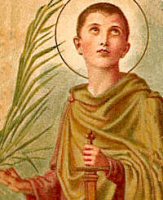 Pancratius was the descendant of a noble Phrygian family. As a youth of fourteen, he came to Rome while Diocletian and Maximian were in power (about 304). He was baptized by the Pope and given instructions in the Christian religion. Arrested for his action, he steadfastly refused to sacrifice to the pagan gods and was condemned to death. With manly courage, he bared his neck for the sword and received the martyr's crown. During the night his body was removed by the pious matron Octavilla, anointed with sweet smelling balsam and interred on the Via Aurelia.
Pancratius is the patron saint of fidelity to oaths. The basilica that Pope Symmachus erected over his remains about the year 500 later became a station church (since 1798 his relics have been lost). On the first Sunday after Easter the saint exhorted the catechumens gathered at his station church to remain loyal to their baptismal vows. The saint warns us to proceed slowly and prudently before taking an oath or vow. But once our word is given we must remain true to our pledge, true unto death itself, whether it concerns baptismal vows, ordination vows, profession vows, or marriage vows.
—Excerpted from The Church's Year of Grace, Pius Parsch.
Symbols and Representation: Sword and stone; armor; Saracen crown under his feet.
Patronage: Against false witness; against perjury; children; cramps; headaches; fidelity to oaths; treaties.
Highlights and Things to Do:
- Read more about St. Pancras:
- See St. Pancras' statue on the St. Peter's Basilica Colonnade.
- The Church of San Pancrazio was built over the tomb of St. Pancras. Saints in Rome gives more expansion on the location of Pancras' relics.
Bl. Imelda Lambertini
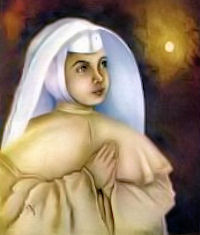 Bl. Imelda Lambertini is a model for all in her great love for the Blessed Sacrament. Born in Bologna, she was a pious child who begged her parents to allow her to become a Dominican when she was just nine. Her parents, though saddened at having to be separated from their only child, recognized God's will for their daughter, and Imelda joined the nuns at Val di Pietra.
Her status among the nuns is unclear. She received the habit and participated in the life of the nuns to some extent.
At that time, children were not allowed to make their First Holy Communion until age 14, but Imelda prayed continually that she would be able to receive Our Lord without having to wait so long. When she was 11, after Mass on the vigil of the Feast of the Ascension, the Sacred Host was seen suspended amidst a brilliant light above Imelda's head. The chaplain, who was immediately summoned, gave the Host to Imelda. Afterwords, the nuns left her alone to make her thanksgiving. The prioress soon discovered, however, that Imelda, who had been in ecstasy, had died shortly after receiving her First Holy Communion, so much in love was she with Our Lord in the Eucharist.
Blessed Imelda was declared Patroness of First Communicants by Pope St. Pius X.
Symbols and Representation: very young Dominican novice kneeling before the altar with a sacred Host appearing above her; wearing first communion dress, chapel veil with attached to a chaplet of flowers on her head and rosary
Patronage: First Communicants
Highlights and Things to Do:
- Read more about Bl. Imelda:
- Catholic Cuisine has an inspirational post on "Kids in the Kitchen," inspired by young Blessed Imelda.
- Bl. Imelda's body remains incorrupt, and it is located in the San Sigismondo Church in Bologna, Italy.