Ordinary Time: September 19th
Saturday of the Twenty-Fourth Week in Ordinary Time; Opt Mem of St. Januarius, Bishop & Martyr; Ember Saturday
Other Commemorations: Our Lady of La Salette ; Other Titles: St. Gennaro
MASS READINGS
September 19, 2026 (Readings on USCCB website)
PROPERS [Show]
COLLECT PRAYER
Twenty-Fourth Week in Ordinary Time: Look upon us, O God, Creator and ruler of all things, and, that we may feel the working of your mercy, grant that we may serve you with all our heart. Through our Lord Jesus Christ, your Son, who lives and reigns with you in the unity of the Holy Spirit, God, for ever and ever.
Optional Memorial of St. Januarius: O God, who grant us to venerate the memory of the Martyr Saint Januarius, give us, we pray, the joy of his company in blessed happiness for all eternity. Through our Lord Jesus Christ, your Son, who lives and reigns with you in the unity of the Holy Spirit, God, for ever and ever.
Recipes (5)
Activities (11)
Prayers (8)
Library (5)
Blog & Podcasts (7)
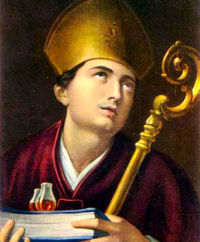
Today is the Optional Memorial of St. Januarius (d. 304). Very little is known about this martyr saint. He was Bishop of Benevento in Campania. He died near Naples, about the year 304, martyred under the persecution of Emperor Diocletian. Around the year 400 the relics of St. Januarius were moved to Naples, which honors Januarius as a patron saint. He supposedly protected Naples from a threatened eruption of the volcano Mt. Vesuvius. The "miracle of Januarius" has world-wide fame. At least three times a year—on his feast day, December 16 and the first Sunday of May—the sealed vial with congealed blood of the saint liquifies, froths and bubbles up. This miraculous event has occurred every year, with rare exceptions. Popular tradition holds that the liquefaction is a sign that the year will be preserved from disasters. (In 1939, the beginning of World War II, the blood did not bubble up. But the blood does not always liquefy, and failed to do so September 1939, 1940, 1943, 1973, 1980, and in December 2016 and 2020.)
It is also the anniversary of the apparition of Our Lady of La Salette in 1846. The Blessed Virgin Mary appeared to two small children, Melanie Mathieu and Maximin Giraud, on the mountain of La Salette in the French Alps. She was crying, and around her neck was a crucifix, with a hammer and pincers on either side. —Adapted from CatholicSaints.info
It is Ember Saturday of the Autumn or September Embertide. The September Ember Days fall after the third Sunday of September near the Feast of the Exaltation of the Holy Cross (September 14), and are days of thanksgiving for the completed harvest of fruits and grapes and historically commemorated as a "wine-press feast." But these Ember Days are also days of penance and atonement since the traditional liturgy connected them with the Jewish celebration of the New Year and Day of Atonement, Yom Kippur. The Station churches were part of the quarterly Ember Days, with Ember Saturdays always being the Station with San Pietro in Vaticano (St. Peter's in the Vatican).
See September or Fall Ember Days and Contemporary Observation of Ember Days.
Meditation: Ember Saturday, a day for expiation and thanksgiving!
This excerpt from Pius Parsch is based on the 1962 Missal. The current Missal does not include special propers and readings for Ember Days.
1. Holy Mass (Venite). Ember Saturday is the official thanksgiving day for all the blessings of the past quarter-year. Especially in autumn when we garner the fruits of nature should we be more conscious of God’s Providence both in the temporal and spiritual orders. In ancient times today’s Mass served as a thanksgiving sacrifice and as a renewals of the Christian covenant with God. The text presumes that the Ember days are the Christian counterpart to the Old Testament feasts of Atonement and Tabernacles, highlighting penance and and gratitude respectively.
The liturgical celebration, observed during the night between Saturday and Sunday and of obligation for all the faithful, was unusually festive. The faithful gathered at St. Peter’s for an entrance song the Invitatory (Psalm 94) was sung. The first four Lessons belonged specifically to the night-vigil and formed a greeting worthy of the enthroned King. The Readings tap the marrow of the Ember celebration, its connection with the Jewish feasts of the seventh month, Yom Kippur and the feast of Tabernacles. The autumn Ember days are days of penance for past failings and of gratitude for the harvest (and redemption); such too is the spiritual import of the Lessons. The first reviews the Mosaic legislation concerning the Day of Atonement, the second concerning the feast of Tabernacles, Israel’s great thanksgiving feast.
The two Graduals echo their respective Lessons; the first “Forgive” (Day of Atonement), the second, “How lovely are Thy tabernacles” (feast of Tabernacles). The third and fourth Lessons, from the prophets Micheas and Zacharias, are comforting messages in which God reaffirms His readiness to forgive the sins of His people and to grant them good things provided they remain faithful. God is also concerned over the manner in which we fast: “The fast of the fourth month, and the fast of the fifth, and the fast of the seventh, and the fast of the tenth shall be to the house of Judah joy and gladness and a great solemnity!” By which our Ember days, of course, are meant. The Orations offer God our festive fast and plead forgiveness. As on other Ember Saturdays, the fifth Lesson is already part of the morning service; the assembled faithful are praying Lauds; the three youths in the fiery furnace prefigure the resurrection of Christ and of Christians.
In the Epistle St. Paul shows how the ceremonies of the old covenant were types of the new; our day of atonement is Good Friday when Christ, the divine High Priest, entered the most holy sanctuary of heaven with His own Blood and wrought eternal redemption; every Mass is Good Friday repeated. In the Tract we chant the shortest Laud psalm as we express our gratefulness for God’s merciful work of redemption and HIs fidelity in fulfilling the prophecies.
Presently the High Priest Himself appears, first “teaching on the Sabbath” (in the Foremass), then offering Himself (in the Oblation). The unfruitful “fig tree in the orchard” and the “bowed-down woman” are the faithful. God is the landlord, Christ the pleading gardener; till now we have been unfruitful.
We also resemble the bowed-down woman; wholly taken up with earthy concerns, too often we are “unable to look upward”; but on this Christian Sabbath, Christ seeks “to free us from the bonds of Satan” and make us spiritually “erect.” Thus the Gospel insinuates the workings of grace in today’s holy Sacrifice.
At the sacrificial Banquet we once more recall the institution of the feast of Tabernacles as a remembrance of the deliverance from Egypt and the wanderings through the wilderness—for the Eucharist is the fulfillment of those two historical events by providing deliverance from sin and the true Manna from heaven. A classic, thought-packed Postcommunion: May the sacramental energy of the Eucharist realize its power in us, and may we one day enjoy face to face what now we see in a veiled manner. Three realities are noted: the first is the sign—this shows the sacrament. Underneath the sign is hidden the second reality, the sacrament’s efficacy—what the sacraments contain. And lastly, the rerun veritas, the future unveiling.
2. A “Spiritual Renewal” Day. For a “day of recollection” no better meditation points could be found than those in the Lessons of today’s Ember Mass. Of the two areas of thought proper to the formulary, viz., the Ember festivity is the Christian “Day of Atonement” and the Christian Feast of Tabernacles (or thanksgiving day at harvest time), let us pursue the former in some detail.
a) The Old Testament type. The Day of Atonement, Yom Kippur, was the great penitential observance of Mosaic Law, Israel’s “confession day.” With us “penance days” are not feast days, but among the Jews it was otherwise; Yom Kippur was a day of strict rest, absolutely no type of work was permitted and the spirit of the occasion was festive, celebrabitis. The day’s liturgy exemplified the nation’s effort to expiate sin; on this one day of the year, the high priest would enter the Holy of Holies with sacrificial blood and sprinkle the ark of the covenant in atonement for his own and his people’s sins. Meanwhile the people did penance through fasting, humbling themselves before Yahweh.
b) The New Testament fulfillment. Mosaic festivals were shadows which took on flesh and blood in the Church of Christ. Good Friday was the real, the unique day of atonement in the sight of God. How well St. Paul affirmed this truth in the Epistle of today’s Mass: “Christ appeared as the high priest of coming (Messianic) blessings. He entered the greater and more perfect tabernacle not made by human hands (i.e., heavenly in nature) not with the blood of goats and steers but with His own blood—once and for all He entered the (heavenly) Holy of Holies—after He had effected an eternal redemption (i.e., one with lasting effects in contrast to the annually repeated Jewish day of atonement).” For the sacrifice on the Cross constituted the perfect reconciliation of God with mankind; and every holy Mass, as it renders present that sacrifice on Golgotha, is Yom Kippur par excellence.
Every Sunday then would be the Christian atonement feast. But because we Christians are so irresponsive and dull to the inner nature of spiritual realities, holy Church introduced special expiation days during the course of the Church year. Among these are Ember days. Ember Saturdays, particularly September Ember Saturday, have preserved best this original spirit. Anyone who seeks to develop his spiritual life on a liturgical basis would have to use the Ember days during the four seasons as times of genuine spiritual renewal. The peculiar means of keeping these days is evident from the liturgy itself—acts of penance and fasting, confession of sin, humbling ourselves before God and neighbor, and nevertheless rejoicing, in the best sense of the word. Our conduct would exemplify the prophet’s statement (fourth Lesson), “The fast proper to the fourth, fifth, seventh and tenth months (i.e., the four Ember weeks) should mean joy and exultation to the house of Judah (viz,, Catholics) and high festival; you only need to love truth (obedience) and peace.”
c) Application. God appeals directly to my heart in the Gospel. The two parables, one in word and one in sign, should move me deeply. I am that barren fig tree. The infinitely just God is the landlord, our Savior the pleading caretaker. If God should summon me to His judgement seat today (the command to destroy the tree), would there be any “fruit”? To what extent would I resemble the barren fig tree? Why does it occupy ground? But Christ intercedes, says a kindly word in my behalf: “Perhaps there will be some return—next crop! If not, it can then be cut down.” The coming quarter-year mark must mark a change, genuine improvement.
The parable in sign is equally instructive. My soul is so badly bowed down to earth, it find “looking upwards” toward heavenly realities extremely painful. Christ must make me stand erect again. The coming season as no other is the season of hope, of preparation for the parousia, of longing for the heavenly Jerusalem, of expectation for the returning Lord. Jesus, have mercy. Free me from stooping down to the earthly, the sensual. Straighten me out for heaven. Now! Jesus, have mercy.
—Excerpted from Pius Parsch, Year of Grace, Volume 5
 Ember Saturday of the Autumn or September Embertide
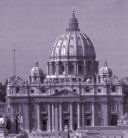
Station with San Pietro in Vaticano (St. Peter's in the Vatican):
We celebrate this closing and thanksgiving day of Ember Week "in the house of Peter." It is the night between Saturday and Sunday as in the spirit of the ancient Church we gather at St. Peter's, the station for all Christendom. "Let us fast on Wednesday and Friday, and on Saturday let us celebrate the vigil at the tomb of blessed Peter the Apostle, by whose merits and prayers we believe that we shall be aided, so that we may please our merciful God by our fast and prayer." That was the announcement made by the Great Leo to the holy people of God fifteen centuries ago. That is the program for Christ’s flock of today. "Let us celebrate the vigil at the tomb of blessed Peter"! This ember vigil, like all other vigils, was held at night and ended at daybreak with the celebration of the Holy Eucharist, the mystery of "Light and Life" (phos-zoe). "Watching, prayer, fast, sorrow for past transgressions, resolutions for the future, conferring of holy orders, offering of grapes (wine), and the climax, the eucharistic Banquet, were the eight milestones on this nocturnal journey. (Msgr. Martin Hellriegel)
For more on San Pietro in Vaticano, see:
For further information on the Station Churches, see The Stational Church.
St. Januarius
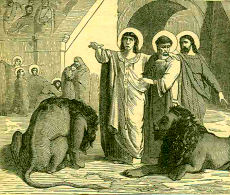 Together with his deacons Socius and Festus, and his lector Desiderius, Januarius, bishop of Beneventum, was subjected to most atrocious torturing during the Diocletian persecution (about 304). Nevertheless, with God's aid they were preserved unmaimed. The wild animals let loose upon them would not attack. Beheaded at Puteoli, their bodies were reverently interred in the neighboring cities. Eventually the remains of St. Januarius became the prized possession of the city of Naples.
"Even to the present time the blood of the saint that is preserved in a glass vial will become fluid shortly after it is brought close to the head of the saint; then it bubbles up in a remarkable manner, as if it had just been shed" (Breviary). Cardinal Schuster makes this statement in his Liber Sacramentorum (vol. 8, p. 233): "The author has seen the marvel of the blood liquefaction at closest range and can give witness to the fact. Taking into consideration all the scientific investigations that have been made, he would say that a natural explanation of the phenomena does not seem possible."
—Excerpted from The Church's Year of Grace, Pius Parsch
Patronage: patron of Naples, Italy; blood banks; volcanic eruptions
Symbols and Representation: heated oven; two red vials on Bible; bishop's mitre (headdress); palm frond (symbol of martyrdom); crown (of martyrdom)
Highlights and Things to Do:
- Find out more about this "miracle of Januarius," including photos.
- Choose Italian cuisine, particularly Neapolitan for dinner. A simple treat could be Neapolitan style ice cream—ice cream made with the three different flavors (usually vanilla, chocolate and strawberry, but originally had the colors of the Italian flag: green/pistachio, white/vanilla and red/cherry) all packed together side by side.
- If you live close to New York City you can participate in The Feast of San Gennaro celebrated in lower Manhattan.
- Read more about St. Januarius:
- See some food ideas for the feast day at Catholic Cuisine.
Our Lady of La Salette
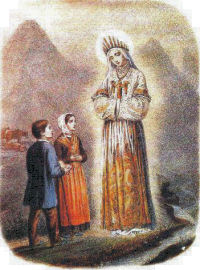 On September 19, 1846, the Blessed Virgin Mary appeared to Maximin Giraud and Melanie Calvat on the mountain of La Salette, France. After thorough investigation the Catholic Church gave approval to the message and secret of La Salette as written by Melanie. The account was published in Lecce on November 15, 1879 with the imprimatur of Bishop Zola of Lecce. Mary's message was much the same as at Fatima, "If my people do not wish to submit themselves, I am forced to let go of the hand of my Son. It is so heavy and weighs me down so much I can no longer keep hold of it." She lamented with tears those who do not keep Sunday holy and who take the name of the Lord in vain. She indicated that if men did not stop offending Our Lord the potato crop would fail. She gave Maximin his secret which he never revealed. She then turned to Melanie and gave her a secret which Melanie revealed 30 years later only to the Holy Father, who gave orders that it was never to be revealed.
Highlights and Things to Do:
- Visit online the Basilica of La Salette. Read especially the story of the apparition and the message of Our Lady.
- Find out more about the La Salette Missionaries.
- Read Pope St. John Paul II's Address to the Missionaries of Our Lady of La Salette, May 4, 2000.
- For further reading on the apparition, see:
- See also the Shrine of La Salette in Attleboro, Massachusetts.
- Read some La Salette poetry at University of Dayton and CatholicSaints.info.
- For some fun In the kitchen, try Catholic Cuisine's Mini Blueberry Galettes.