Ordinary Time: September 18th
Friday of the Twenty-Fourth Week in Ordinary Time; Ember Friday
Other Commemorations: St. Joseph of Cupertino, Priest (RM)
MASS READINGS
September 18, 2026 (Readings on USCCB website)
PROPERS [Show]
COLLECT PRAYER
Twenty-Fourth Week in Ordinary Time: Look upon us, O God, Creator and ruler of all things, and, that we may feel the working of your mercy, grant that we may serve you With all our heart. Through our Lord Jesus Christ, your Son, who lives and reigns with you in the unity of the Holy Spirit, God, for ever and ever.
Recipes (1)
Activities (7)
Prayers (4)
Library (0)
Blog & Podcasts (5)
The Roman Martyrology commemorates St. Joseph of Cupertino (1603-1663), who was born at Cupertino, Italy, and died in Osimo. He was of lowly origin and had little formal education. In his youth he was employed as an apprentice to a shoemaker. He joined the Conventual Franciscans as a lay brother but was later ordained a priest. He was noted for his great austerities, his angelic purity, his great devotion to Our Lady and especially for his ardent love of God.
It is also Ember Friday of the Autumn or September Embertide. The September Ember Days fall after the third Sunday of September near the Feast of the Exaltation of the Holy Cross (September 14), and are days of thanksgiving for the completed harvest of fruits and grapes, being historically commemorated as a "wine-press feast." But these Ember Days are also days of penance and atonement since the traditional liturgy connected them with the Jewish celebration of the New Year and Day of Atonement, Yom Kippur. The Station churches were part of the Ember Days, with Ember Fridays always being the Station with the Twelve Holy Apostles (Santi Dodici Apostoli, also Santi Apostoli).
See September or Fall Ember Days and Contemporary Observation of Ember Days.
Meditation: Ember Friday in September, “Do penance”
This excerpt from Benedict Baur is based on the 1962 Missal. The current Missal does not include special propers and readings for Ember Days.
At the church of the Twelve Apostles we were absolved of our sins on Holy Thursday and received again into the community of the Church and reconciled with God. Today we assemble again at this stational church to do penance for the sins and infidelities of the last three months and to obtain pardon. We come with Magdalen, the sinner and penitent, to hear from Christ Himself the words: “Thy faith hath made thee safe; go in peace” (Gospel). “Let the heart of them rejoice that seek the Lord; seek ye the Lord and be strengthened” (Introit).
“Return, O Israel, to the Lord thy God; for thou hast fallen down by thy iniquity. Take with you words and return to the Lord and say to Him: “Take away all iniquity and receive the good, and we will render the calves of our lips…Neither will we say anymore: The works of our hands are our gods” (Epistle). Thus we are called to do penance with a contrite and humble heart and to confess to the Lord. Magdalen is an example for us. She comes to the Lord and throws herself at His feet. She washes His feet with tears, kisses them, and anoints them with the ointment she has brought with her. She comes with a heart full of shame, full of contrition, full of courage, in self-accusation and humility. She is determined to amend her life. The Lord responds to this contrition and love which He Himself through His mercy planted in the heart of the sinful woman. “Many sins are forgiven her, because she hath loved much; but to whom less is forgiven, he liveth less. And He said to her: Thy sins are forgiven thee” (Gospel). We, too, are sinners. We, too, are penitent. We come to Him in the Holy Sacrifice, when He appears in our midst. We confess to Him that we have sinned and have offended God. We accuse ourselves in the presence of His representative. We hear the consoling words: “I absolve thee of thy sins. Go in peace.” We obtain pardon in proportion to our contrition and love. “To whom less is forgiven, he liveth less.” But on the other hand, less is forgiven to Him who loves less.
“I will heal their breaches, I will love them freely; for My wrath is turned away from them. I will be as the dew; Israel shall spring as the lily, and his root shall shoot forth as that of Libanus. His branches shall spread, and his glory shall be as the olive tree, and his smell as that of Libanus…. They shall live upon wheat [the Eucharist], and they shall blossom as a vine” (Epistle). With great tenderness and charity the Lord accepts the contrite, penitent soul, as is clear from His reception of the sinner Magdalen. Simon the Pharisee is a witness against the sinner who entered and threw herself at the feet of Jesus. He says to himself, “This man, if He were a prophet, would know surely who and what manner of woman this is that toucheth Him, that she is a sinner” (Gospel). But the Lord has come in search of sinners that He may save them. He has no word of blame for Magdalen. He does not wait until He is begged before she is allowed to appear before Him. He draws her with the power of His love and grace, and He forgives her entire debt. She renounces the false gods she has served till now, and follows the Lord. She is the first of the holy women to see the risen Savior. She received special graces and becomes a great saint, whom we may all admire and imitate.
The self-righteous Pharisee, who has invited the Lord for dinner and the sinful, penitent, contrite Magdalen present a striking contrast. The Pharisee is a type of the Jewish people, while Magdalen represented those converted from the Gentiles. In the mind of the liturgy, we are the contrite Magdalen, for the first step to grace and holiness is penitence.
We give expression to our repentance when we fast on Ember days. We sanctify our fast through the celebration of the Eucharistic sacrifice. At this sacrifice we unite our fasting and penance to the suffering and death of the Lord, and we beseech God that He may be pleased with the sacrifice of our fast and make us worthy of His grace, which we expect from the Mass. This grace will lead us to the promises of eternal life (Secret).
Christians in our day seem to have lost their sense of the necessity of penance and reparation. It is therefore even more necessary to accompany the liturgy today into the house of Simon the Pharisee and learn from the example of Mary Magdalen, how to do penance for our sins. From this holy penitent we can learn to trust in the mercy of the Lord, and thus to be purified so that we may share His blessedness.
Prayer: Grant, O almighty God, we beseech Thee, that by our devout keeping of the holy observances year by year, we may in body and in soul give pleasure to Thee. Through Christ our Lord. Amen.
—from The Light of the World, Volume Three by Benedict Baur, O.S.B.
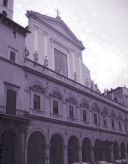
Ember Friday of the Autumn or September Embertide
Station with Santi Dodici Apostoli (also Santi Apostoli, the Twelve Holy Apostles):
Traditionally, this is the place where the Romans choose their candidates for priesthood (Rite of Election). It was erected by Julius I (337-352) over the barracks of ancient Rome's firemen and entrusted since 1463 to the Conventual Franciscans. Originally dedicated to the Apostles St. James and St. Philip, it was rededicated to all the Apostles in the 16th century.
The Church leads us today to the "the twelve apostles," on whom the Lord conferred His power to forgive and retain sins. Bearers they are of those precious keys that open the merciful heart of God as well as the contrite heart of man, uniting the latter to the former by means of the cleansing and sanctifying blood of Jesus Christ. This Ember Friday is an appropriate occasion for giving our weekly "Friday-abstinence" a new spirit. So often we observe the day thoughtlessly—perhaps even reluctantly....Give your soul a new direction by a fruitful "ember confession." The sacrament of penance is the sacrament of liberty which frees us from the disgracing chains of our sins. True humility and sorrow are oil from the Holy Spirit which make the "keys of forgiveness" turn with heavenly smoothness. "Remove from me reproach and contempt, because I have sought out Thy commandments, O Lord; for They testimonies are my meditation."
For more on Santi Dodici Apostoli, see:
For further information on the Station Churches, see The Stational Church.
St. Joseph of Cupertino
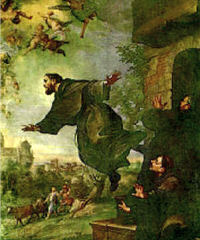
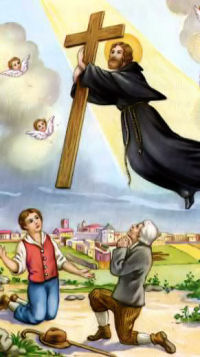 Joseph of Cupertino was such an extraordinary saint that his fellow-Christians could scarcely cope with him. First of all he was forgetful, even as a child, often not turning up for the scanty meals his impoverished widowed mother prepared. He would wander about the village of Cupertino, Italy, where he was born, gazing open-mouthed at everything. He found it hard to learn. And he was clumsy.
When he was seventeen he decided he wanted to become a monk or friar. The Franciscans would not take him because, they said, he was too stupid. The Capuchins threw him out after eight months because he broke everything. Eventually a Franciscan house at La Grotella accepted him as a stableboy.
He prayed and fasted and did his best to perform every task to perfection. Eventually the delighted brothers decided to accept him as one of their equals, and in 1628 he was ordained priest. From that time onwards Joseph of Cupertino was continually passing into ecstatic trances, sometimes even appearing to float above the ground. No meals could be taken in the monastery without some extraordinary interruption because of Joseph's miraculous behaviour. For thirty-five years the community decided that he should be kept out of the choir and refectory.
Naturally enough his miracles and above all the reports of his supernatural levitations attracted countless curious visitors. In 1653 the church authorities transferred him to a Capuchin friary in the hills of Pietarossa and kept him completely out of sight. Finally Saint Joseph was allowed to join his own order at a place called Osima, but he was still kept out of sight until his death in 1663. All this he bore without the remotest complaint. Fittingly the twentieth century has made the saint patron of pilots and airline passengers.
—Excerpted from A Calendar of Saints by James Bentley
Patronage: aviation; air crews; Air Forces; air travelers; aircraft pilots; astronauts; aviators; flyers; paratroopers; students; mental handicaps; examinations, students; test takers; Cupertino, Italy; Osimo, Italy
Symbols and Representation: airplane
Highlights and Things To Do:
- Very few saints have recorded that they levitated during prayer. See if you can find some other saints that have also levitated.
- Read more about St. Joseph of Cupertino:
- Watch this YouTube video on St. Joseph of Cupertino.
- St. Joseph suffered severely at the hands of his own ecclesiastical superiors. It is a bitter thing to find no aid or comfort among one's own brethren, and, moreover, to be misunderstood and condemned by them. Even this, however, is permitted by God, as shown in the life of St. Joseph. Pray for the grace to endure misunderstanding and rejection.
- The Basilica of San Giuseppe da Copertino, Osimo is the location where St. Joseph's remains were placed under the main altar in 1771; now they are housed in a crypt constructed in 1963.