Easter: May 23rd
Saturday of the Seventh Week of Easter (Vigil of Pentecost)
Other Commemorations: St. John Baptist de Rossi, Priest (RM)
MASS READINGS
May 23, 2026 (Readings on USCCB website)
PROPERS [Show]
COLLECT PRAYER
Saturday of the Seventh Week of Easter, Morning Mass: Grant, we pray, almighty God, that we, who have celebrated the paschal festivities, may by your gift hold fast to them in the way that we live our lives. Through our Lord Jesus Christ, your Son, who lives and reigns with you in the unity of the Holy Spirit, God, for ever and ever.
Vigil for Pentecost: Almighty ever-living God, who willed the Paschal Mystery to be encompassed as a sign in fifty days, grant that from out of the scattered nations the confusion of many tongues may be gathered by heavenly grace into one great confession of your name. Through our Lord Jesus Christ, your Son, who lives and reigns with you in the unity of the Holy Spirit, God, for ever and ever.
Recipes (3)
Activities (8)
Prayers (7)
Library (4)
Blog & Podcasts (0)
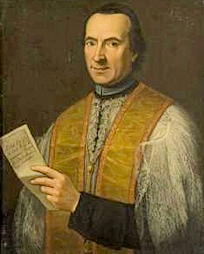
The Roman Martyrology commemorates St. John Baptist de Rossi (1698-1764), who was from Genoa, and studied and worked in Rome before becoming a priest there and a canon of Santa Maria in Cosmedin. He worked tirelessly for homeless women, the sick, prisoners and workers, and was a very popular confessor, being called a second Philip Neri.
Tomorrow is the Solemnity of Pentecost, the end of the Easter season. Observance of the solemnity begins with First Vespers (Evening Prayer I) in the Liturgy of the Hours, and a special Vigil Mass before or after First Vespers. The liturgical day is from midnight to midnight in the Church's observance, except for Sunday and solemnities which begin with the evening of the preceding day.
The Pentecost Vigil liturgy has an Extended Form which echoes the Easter Vigil. There are four readings and Responsorial Psalms and prayers:
- 1st: Genesis 11:1-9 and Psalm 33(32): It was called Babel because there the Lord confused the speech of all the world.
- 2nd: Exodus 19:3-8a, 16-20b and Canticle of Daniel or Psalm 19 (18): The Lord came down upon Mount Sinai before all the people.
- 3rd: Ezekiel 37:1-14 and Psalm 107 (106): Dry bones of Israel, I will bring spirit into you, that you may come to life.
- 4th: Joel 3:1-5 and Psalm 104 (103): I will pour out my spirit upon the servants and handmaids.
>>>Today is Day 10 of the Pentecost Novena to the Holy Spirit.<<<
Meditation for Saturday of the Seventh Week of Easter:
Preparation for Pentecost: Prayer to the Father and the Son from Whom the Holy Ghost proceeds
Let us ask the Holy Ghost to enter into us and increase in us the abundance of His gifts. Fervent prayer is the condition of His indwelling in our souls. Humility is another condition. Let us come before Him with the intimate conviction of our inward poverty.
Despite our miseries, let us invoke Him; on account of these very miseries, He will hear us. Veni, Pater pauperum.
And since He is one with the Father and the Son, let us say likewise to the Father: Father, send down upon us, in the name of Thy Son Jesus, the Spirit of love that He may fill us with the intimate sense of our divine filiation. And Thou, O Jesus, our High Priest, now sitting at Thy Father's right hand, intercede for us, so that this mission of the Spirit, Whom Thou didst promise to us and didst merit for us, may be abundant; that it may be an impetuous river making glad the city of souls; or rather, according to Thine own words, "a fountain of water, springing up unto life." Hoc autem dicebat de Spiritu Sancto quem accepturi erant credentes in eum.
—Dom Columba Marmion, Christ in His Mysteries, p. 340
Pentecost Vigil,
Station with San Giovanni in Laterano (St. John Lateran)
The Station is at St. John Lateran, beside the Baptistery. The night before Pentecost, like that before Easter, was at Rome, and in many other churches, a baptismal feast. Baptism was administered to those who, for one reason or another, had not received it at Easter; or to fresh candidates. Hence the resemblance between these two Virgils. It also expresses the idea of our Baptism by the Holy Spirit.
For more on San Giovanni in Laterano, see:
- Churches of Rome
- Rome Art Lover
- Roman Churches
- Aleteia
- Click here for a 360 degree virtual tour.
For further information on the Station Churches, see The Stational Church.
St. John Baptist de Rossi
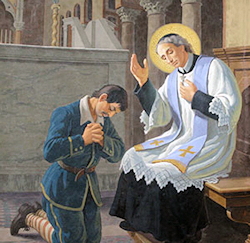
After three years he was called to Rome by a relative, Lorenzo de Rossi, who was canon at St. Mary in Cosmedin. He pursued his studies at the Collegium Romanum under the direction of the Jesuits, and soon became a model by his talents, application to study, and virtue. As a member of the Sodality of the Blessed Virgin and of the Ristretto of the Twelve Apostles established at the college, he led the members in the meetings and pious exercises, in visits to the sick in the hospitals and in other works of mercy, and merited even then the name of apostle.
At the age of sixteen he entered the clerical state. Owing to indiscreet practices of mortification he contracted spells of epilepsy, notwithstanding which he made his course of scholastic philosophy and theology, in the college of the Dominicans, and, with dispensation, was ordained priest on 8 March, 1721. Having reached the desired goal, he bound himself by vow to accept no ecclesiastical benefice unless commanded by obedience. He fulfilled the duties of the sacred ministry by devoting himself to the laborers, herds, and teamsters of the Campagna, preaching to them early in the morning, or late in the evening, at the old Forum Romanum (Campo Vaccino), and by visiting, instructing, and assisting the poor at the hospital of St. Galla. In 1731 he established near St. Galla another hospital as a home of refuge for the unfortunates who wander the city by night ("Rom. Brev.", tr. Bute, Summer, 573).
In 1735 he became titular canon at St. Mary in Cosmedin, and, on the death of Lorenzo two years later, obedience forced him to accept the canonry. The house belonging to it, however, he would not use, but employed the rent for good purposes.
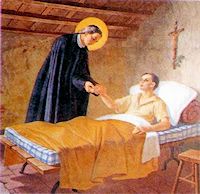 For a number of years John was afraid, on account of his sickness, to enter the confessional, and it was his custom to send to other priests the sinners whom he had brought to repentance by his instructions and sermons. In 1738 a dangerous sickness befell him, and to regain his health he went to Cività Castellana, a day's journey from Rome. The bishop of the place induced him to hear confessions, and after reviewing his moral theology he received the unusual faculty of hearing confessions in any of the churches of Rome. He showed extraordinary zeal in the exercise of this privilege and spent many hours every day in hearing the confessions of the illiterate and the poor whom he sought in the hospitals and in their homes. He preached to such five and six times a day in churches, chapels, convents, hospitals, barracks, and prison cells, so that he became the apostle of the abandoned, a second Philip Neri, a hunter of souls.
In 1763, worn out by such labors and continued ill-health, his strength began to ebb away, and after several attacks of paralysis he died at his quarters in Trinità de' Pellegrini. He was buried in that church under a marble slab at the altar of the Blessed Virgin. God honoured his servant by miracles, and only seventeen years after his death the process of beatification was begun, but the troubled state of Europe during the succeeding years prevented progress in the cause until it was resumed by Pius IX, who on 13 May, 1860, solemnly pronounced his beatification. As new signs still distinguished him, Leo XIII, on 8 December, 1881, enrolled him among the saints.
—Excerpted from The Catholic Encyclopedia
Patronage: of the abandoned
Highlights and Things to Do:
- Read the life of St. John Baptist de Rossi free at Google Books
- Read more about St. John Baptist de Rossi:
- His relics are located in Rome at the Church of San Giovanni Battista de Rossi.