Lent: February 21st
Saturday after Ash Wednesday; Opt. Mem. of St. Peter Damian, Bishop & Doctor
MASS READINGS
February 21, 2026 (Readings on USCCB website)
PROPERS [Show]
COLLECT PRAYER
Saturday After Ash Wednesday: Almighty ever-living God, look with compassion on our weakness and ensure us your protection by stretching forth the right hand of your majesty. Through our Lord Jesus Christ, your Son, who lives and reigns with you in the unity of the Holy Spirit, God, for ever and ever.
Optional Memorial of St. Peter Damian: Grant, we pray, almighty God, that we may so follow the teaching and example of the Bishop Saint Peter Damian, that, putting nothing before Christ and always ardent in the service of your Church, we may be led to the joys of eternal light. Through our Lord Jesus Christ, your Son, who lives and reigns with you in the unity of the Holy Spirit, God, for ever and ever.
Recipes (3)
Activities (9)
Prayers (7)
Library (5)
Blog & Podcasts (5)
» Enjoy our Liturgical Seasons series of e-books!
Not only fasting, private prayer, and almsgiving, but also corporate worship helps to form the thorough Christian. All worship centers in Christ, the one mediator. His presence and priesthood are the hope of the world Through Him as their Head, all His members give the Trinity due homage, thanksgiving, and reparation. By worshiping together, men express their dependence upon one another and deepen their vital unity.
"Do not be amazed at this, because the hour is coming in which all who are in the tombs will hear his voice and will come out, those who have done good deeds to the resurrection of life, but those who have done wicked deeds to the resurrection of condemnation (Jn. 5:28-29)."
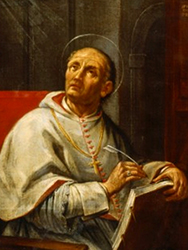
The Church celebrates the Optional Memorial of St. Peter Damian (1007-1072), a man of vehemence in all his actions who was brought up in the hard school of poverty, found that he had the vocation of a reformer. He exercised it in the first place against himself as one of the hermits of Fontavellana in about 1035, but he did not remain for long hidden in his cell: his colleagues soon made him their abbot (1043). In 1057, Stephen IX made him Cardinal Bishop of Ostia. By his preaching and writings he was one of the valuable collaborators of the eleventh century popes in their great work of reform. Pope Leo XII declared him a Doctor of the Church in 1823.
Lenten Meditation on the Gospel, Luke 5:27-32
The Pharisees expressed astonishment to the disciples that their master ate with sinners. Christ then asserts that he has come for the sake of the sick and the sinners, not the healthy or the just (vv. 12-13).
Doubtless the "just" he has in mind are those incapable of transcending the conventional notion of distributive justice and recognizing God's mercy. Their attitude is that of the workers in the vineyard (Mt 20:1-16), or of the elder son who resents his father's generosity to the prodigal son (Lk 15:11-32), or again of the Pharisees who fulfills all justice to the smallest mite but resents the sinner seeking divine mercy (Lk 18:9-14). He is actually opposing to a religion constructed on human justice one that depends on divine mercy. When he cites Hosea 6:6 (v.13) he is pointing out that the prophets had already questioned the value of ritual, even perfectly executed ritual, as against a religion of love and mercy.
The numerous meals taken by Jesus with sinners, the father’s pardon for the prodigal which takes the form of a sumptuous banquet (Lk 15:22-24), Jesus’ attitude to Judas at the Supper (Mt 26:20-25), his anxiety to offer the bread and wine for the remission of sins (Mt 26:28), are a clear demonstration of the early Christian concept of the Eucharist as a sacrament of pardon (Mt 18:15-18). An overly specialist theology of the Eucharist and of penance has tended to render obscure the link between the two sacraments. Penance actually derives its efficacy from the Eucharist. Any theology of penance which makes it a purifying rite preparatory to the Eucharist, on the basis that the Eucharist itself is not in essence a rite of pardon, lessens the value of both sacraments. When the father assembles his family at a meal and communicates his own life to them, does not that simple gesture include pardon? Our great theological and pastoral need is eucharistic celebration which will be once more "for the remission of sins."
—Guide for the Christian Assembly, Thierry Maertens and Jean Frisque
Saturday after Ash Wednesday
Station with Sant’Agostino in Campo Marzio (St. Augustine), formerly St. Tryphon
The station for today is at the church dedicated to St. Augustine of Hippo. The church was built on the same location of the former 8th century church dedicated to St. Tryphon of Campsada. Michelangelo was one of the artists commissioned for the decoration of the church. The Renaissance facade, one of the first in this style, is built of travertine marble said to be from the ruins of the Colosseum.
For more on Sant’Agostino, see:
- Churches of Rome Info
- The Station Churches of Rome
- Rome Art Lover
- PNAC
- Aleteia
- Station Church
- The Catholic Traveler
For further information on the Station Churches, see The Stational Church.
St. Peter Damian
St. Peter Damian must be numbered among the greatest of the Church's reformers in the Middle Ages, yes, even among the truly extraordinary persons of all times. In Damian the scholar, men admire wealth of wisdom: in Damian the preacher of God's word, apostolic zeal; in Damian the monk, austerity and self-denial; in Damian the priest, piety and zeal for souls; in Damian the cardinal, loyalty and submission to the Holy See together with generous enthusiasm and devotion for the good of Mother Church. He was a personal friend of Pope Gregory VII. He died in 1072 at the age of 65.
On one occasion he wrote to a young nephew, "If I may speak figuratively, drive out the roaring beasts from your domain; do not cease from protecting yourself daily by receiving the Flesh and Blood of the Lord. Let your secret foe see your lips reddened with the Blood of Christ. He will shudder, cower back, and flee to his dark, dank retreat."
In his poem, the Divine Comedy, Dante places Damian in the "seventh heaven." That was his place for holy people who loved to think about or contemplate God.
—Excerpted from The Church's Year of Grace, Pius Parsch
Patronage: Faenza, Italy
Symbols and Representation: Cardinal bearing a discipline in his hand; pilgrim holding a papal Bull, to signify his many legations
Highlights and Things to Do:
- Listen to Catholic Culture's Way of the Father's podcast episodes on St. Peter Damian:
- Read Pope Benedict XVI's Message for the 100th Anniversary of St. Peter Damian.
- Read more about St. Peter Damian:
- Pray the Little Office of the Blessed Virgin Mary, St. Peter Damian revised and recommended it. Go to The Mary Page for a copy.
- St. Peter's relics are located in the Cathedral of Faenza, Italy.