Easter: May 4th
Monday of the Fifth Week of Easter
Other Commemorations: The English Martyrs (England); St. Florian, Martyr (RM)
MASS READINGS
May 04, 2026 (Readings on USCCB website)
PROPERS [Show]
COLLECT PRAYER
Monday of the Fifth Week of Easter: May your right hand, O Lord, we pray, encompass your family with perpetual help, so that, defended from all wickedness by the Resurrection of your Only Begotten Son, we may make our way by means of your heavenly gifts. Through our Lord Jesus Christ, your Son, who lives and reigns with you in the unity of the Holy Spirit, God, for ever and ever.
Recipes (1)
Activities (7)
Prayers (5)
Library (7)
Blog & Podcasts (10)
England celebrates the Feast of the English Martyrs, a group of forty men, women, religious, priests, and lay people who were canonized by Pope Paul VI on October 25, 1970 (in Wales this feast is celebrated October 25th as the Six Welsh Martyrs and Companions).
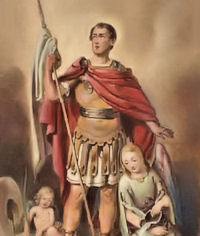
The Roman Martyrology commemorates St. Florian (d. 304), a Roman military officer stationed at Noricum (Austria) who openly declared himself a Christian during the persecution of Emperor Diocletian. With a boulder tied to the neck, he was precipitated from a bridge into the Enns River.
Meditation for Monday of the Fifth Week of Easter:
The Perfect Gift
1. In the Epistle, St. James, the first bishop of Jerusalem, speaks to us. He addresses himself first to the Jewish Christians, then to all the rest of us.
2. "Let no man, when he is tempted, say that he is tempted by God. For God is not a tempter of evils, and He tempteth no man. But every man is tempted by his own concupiscence, being drawn away and allured" (Jas. 1:13 f.). Only that which is good can come from God. Whatever God can give and does give is always a perfect gift. Thus, "of His own will He hath begotten us [the baptized] by the word of truth, that we might be some beginning of His creatures" (Epistle). This is the good gift, the perfect gift, which God gives us: the gift of rebirth by water and the Holy Spirit. We are first and above all the predestined, the consecrated children of God. Today we thank God for this perfect gift of His love and mercy. In humility we ask why God gives this perfect gift to us in preference to millions of others who were more deserving of it than we were. Why does he not tire of continually giving this precious gift to me, who am so unworthy? He renews this gift continually in the sacraments of penance and the Eucharist, and in many other channels of grace. It is His love that prompts Him to do this.
"Let every man be swift to hear, but slow to speak, and slow anger. For the anger of man worketh not the justice of God. For the anger of man worth not the justice of God. Wherefore, casting away all uncleanness and abundance of naughtiness, with meekness receive the ingrafted word, which is able to save your souls." "Be slow to speak and slow to anger"; be not easily aroused and easily vexed; become not easily embittered or irritated. What is pleasing to God cannot be produced in anger. This good gift of God produces in each soul a love of silence and seclusion, so that the soul rests in God. It produces in the soul a meekness and a supernatural calm and peace which are far removed from all animosity and evil. It excludes and overcomes all impatience and irritation. This meekness springs from the fire of love, from self-conquest, from the peace that envelops the soul that is possessed and enlightened by Christ.
In such a soul the sensitiveness of the easily irritated, impatient man, with his degraded and unspiritual inclinations, is replaced by Christian meekness, which gives strength and mastery over one's evil tendencies, and victory over self-love and that sensitiveness so characteristic of the worldly man. Such heroic meekness is born of God; but anger, impatience, and sensitiveness are not born of God, nor of grace, nor are they the fruit of regeneration. Anger is a weakness which attempts to hide behind violent words or deeds, which are unworthy of one who is reborn through Christ. "Blessed are the meek" (Matt. 5:4).
3. With the liturgy of the fourth Sunday after Easter we recognize the "perfect gift," which comes down to us from the Father of light, to be the Holy Ghost, whose coming we await. Through His Word, God has made us His children. Through His Word, that is, through Christ, He gives us the Holy Ghost. On our part we must prepare our souls for His coming through prayer, through the practice of silence and through an ardent longing for him.
When we bring our gifts to the altar at the Offertory of the Mass, we repeat with grateful hearts the words of the Offertory prayer: "Shout with joy to God all the earth, sing ye a psalm to His name; come and hear, and I will tell you, all ye that fear God, what great things the Lord hath done for my soul, alleluia." Among the great things the Lord hath done for my soul is the regeneration of that soul. Then, too, He has bestowed on me the sonship of God, making me share the spirit of Christ; He has given me membership in His Church, and has sent to me the Holy Ghost.
—Benedict Bauer, O.S.B, from The Light of the World, Vol II
St. Florian
The St. Florian commemorated in the Roman Martyrology on May 4th, was an officer of the Roman army, who occupied a high administrative post in Noricum, now part of Austria, and who suffered death for the Faith in the days of Diocletian. His legendary "Acts" state that he gave himself up at Lorch to the soldiers of Aquilinus, the governor, when they were rounding up the Christians, and after making a bold confession, he was twice scourged, half-flayed alive, set on fire, and finally thrown into the river Enns with a stone around his neck. His body, recovered and buried by a pious woman, was eventually removed to the Augustinian Abbey of St. Florian, near Linz. It is said to have been at a later date translated to Rome, and Pope Lucius III, in 1138, gave some of the saint's relics to King Casimir of Poland and to the Bishop of Cracow. Since that time, St. Florian has been regarded as a patron of Poland as well as of Linz, Upper Austria and of firemen. There has been popular devotion to St. Florian in many parts of central Europe, and the tradition as to his martyrdom, not far from the spot where the Enns flows into the Danube, is ancient and reliable. Many miracles of healing are attributed to his intercession and he is invoked as a powerful protector in danger from fire or water.
Patronage: against battle; against drowning; against fire; against flood; drowning victims; harvests; barrel-makers; brewers; chimney sweeps; coopers; fire prevention; firefighters; soap-boilers; Worshipful Company of Firefighters; Austria; Poland; Linz, Austria
Symbols and Representation: bearded warrior with a lance and tub; boy with a millstone; classical warrior leaning on a millstone, pouring water on a fire; dead man on a millstone guarded by an eagle; dead man whose body is being protected by an eagle; man being beaten; man on a journey with a hat and staff; man thrown into a river with a millstone around his neck; man with a palm in his hand and a burning torch under his feet; man with a sword; young man, sometimes in armor, sometimes unarmed, pouring water from a tub on a burning church
Highlights and Things to Do:
- Read a little more about St. Florian:
- See Christian Iconography for iconography of St. Florian.
- St. Florian is patron saint for many, but especially popular with firefighters and brewers. A toast with beer today seems fitting for this saint!
The English Martyrs
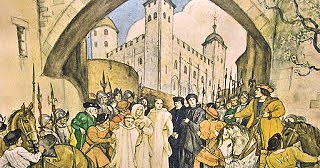 The English Men and Women martyred for the Catholic Faith 1535–1680 and beatified or canonised by the Holy See. On this day in 1535 there died at Tyburn three Carthusian monks, the first of many martyrs, Catholic and Protestant, of the English reformation. Of these martyrs, forty two have been canonised and a further two hundred and forty two declared blessed, but the number of those who died on the scaffold, perished in prison, or suffered harsh persecution for their faith in the course of a century and a half cannot now be reckoned. They came from every walk of life; there are among them rich and poor, married and single, women and men. They are remembered for the example they gave of constancy in their faith, and courage in the face of persecution.
—The Liturgy Office of England and Wales
These forty were canonised by Pope Paul VI on October 25th, 1970. They are representative of the English and Welsh martyrs of the Reformation who died at various dates between 1535 and 1679. Some 200 of these martyrs had already been declared ‘Blessed’ (i.e. ‘beatified’) by previous Popes. They include:
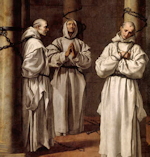 |
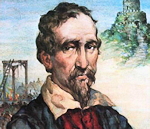
SS. John Houghton, Robert Lawrence and Augustine Webster, the first martyrs (1535), all priors of different Charterhouses (houses of the Carthusian Order, including the one in London) who, by virtue of the Carthusian vow of silence, refused to speak in their own defense. |
 |
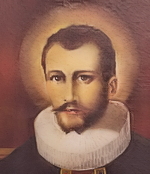
St. Cuthbert Mayne, a Devonian, who was the first martyr not to be a member of a religious order. He was ordained priest at the then newly established English College at Douai in Northern France and was put to death at Launceston in 1577. |
 |
St. Edmund Campion, the famous Jesuit missionary and theologian who published secretly from Stonor Park, the ancient Catholic country house near Henley-on-Thames, who died in 1581 on the same day as St. Ralph Sherwin, the first martyr to have been trained at the English College in Rome. |
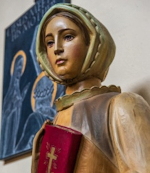 |
St. Margaret Clitherow, the wife of a butcher with a shop in the famous Shambles in York, who allowed her house to be used as a Mass centre, who was sentenced to be crushed to death under a large stone at the Ouse Bridge Tollbooth in the city |
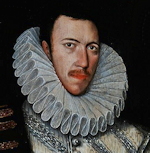 |
St. Philip Howard, eldest son of the fourth Duke of Norfolk (himself executed for treason in 1572) who led a dissolute existence and left behind an unhappy wife in Arundel Castle until he was converted by the preaching of St. Edmund Campion, and died in the Tower in 1595. |
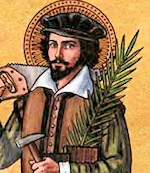 |
St. Nicholas Owen, Jesuit lay brother and master carpenter, who constructed many priests’ hiding-holes in houses throughout the country, some of them so cunningly concealed they were not discovered until centuries later (1606). |
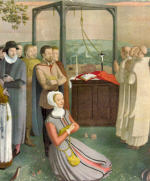 Under James I and Charles I the purge died down, but did not entirely cease. St. John Southworth, missionary in London, was put to death under Cromwell and is venerated in Westminster Cathedral, and the final martyrs died in the aftermath of the Titus Oates plot in 1679. [SS. John Fisher & Thomas More are not included in this list for they had been canonized in 1935].
—Taken from Sacred Heart Parish, Waterloo
| Here is the complete list of the 40: | |
| John Almond | Cuthbert Mayne |
| Edmund Arrowsmith | Henry Morse |
| Ambrose Barlow | Nicholas Owen |
| John Boste | John Payne |
| Alexander Briant | Polydore Plasden |
| Edmund Campion | John Plessington |
| Margaret Clitherow | Richard Reynolds |
| Philip Evans | John Rigby |
| Thomas Garnet | John Roberts |
| Edmund Gennings | Alban Roe |
| Richard Gwyn | Ralph Sherwin |
| John Houghton | Robert Southwell |
| Philip Howard | John Southworth |
| John Jones | John Stone |
| John Kemble | John Wall |
| Luke Kirby | Henry Walpole |
| Robert Lawrence | Margaret Ward |
| David Lewis | Augustine Webster |
| Anne Line | Swithun Wells |
| John Lloyd | Eustace White |
Highlights and Things to Do:
- Listen to the Catholic Culture Audiobooks of St. Robert Southwell, one of the English Martyrs:
- Listen to the Catholic Culture Audiobook of St. Edmund Campion, St. Edmund Campion—Campion’s Brag.
- This Catholic Culture podcast discusses with Benedict Whalen on Ep. 69—Poetry of the English Martyrs.
- If you would like to learn more about the Forty Martyrs you can purchase a pamphlet published by the Catholic Truth Society, A Book of Martyrs by Fr John S. Hogan.
- For a list of the forty martyrs and a little more information about some of them, you can visit this site.
- Read the book Edmund Campion: A Life by Evelyn Waugh.