Lent: March 28th
Saturday of the Fifth Week of Lent
Other Commemorations: St. Gontran, King (RM; St. Stephen Harding, Abbot (RM) ; Other Titles: St. Contran or St. Guntramnus or Guntram
MASS READINGS
March 28, 2026 (Readings on USCCB website)
PROPERS [Show]
COLLECT PRAYER
Saturday of the Fifth Week of Lent: O God, who have made all those reborn in Christ a chosen race and a royal priesthood, grant us, we pray, the grace to will and to do what you command, that the people called to eternal life may be one in the faith of their hearts and the homage of their deeds. Through our Lord Jesus Christ, your Son, who lives and reigns with you in the unity of the Holy Spirit, God, for ever and ever.
Recipes (1)
Activities (7)
Prayers (12)
Library (0)
Blog & Podcasts (0)
The curtain is about to go up on the tumultuous events of Holy Week. This Mass reminds us of the meaning of those events. The plan to kill Jesus is approved and justified. It means the birth of a New Covenant, the New Testament. And in a sense we are there. —The Vatican II Weekday Missal
The Roman Martyrology commemorates St. Gontran (d. 592), also known as Contran or Guntramnus. He was the son of King Clotaire and the grandson of Clovis I. He was raised pagan and became King of Orleans in 561.
St. Stephen Harding (1060-1134) is also commemorated. He became a monk at Molesme Abbey and with St. Robert of Molesme began the Cistercian reform by helping found Citeaux Abbey in 1098. He joyfully accepted St. Bernard and his companions when they joined the Cistercians.
Meditation for Saturday of the Fifth Week of Lent—Christ’s Sacrifice on Calvary
The first reading of today’s Mass relates the intercession of Moses before Yahweh so that He should not punish his People’s infidelity. He invokes moving reasons: the good name of the Lord among the Gentiles, the faithfulness of his People to the Covenant made to Abraham and his descendants… And, in spite of their infidelities and the inconstancy of the chosen People, God forgives once more. Moreover, God’s love for his People, and through his People for the whole human race, will yet reach its supreme manifestation: For God so loved the world that he gave his only Son, that whosoever believes in him should not perish, but have eternal life.
Christ’s total self-surrender on our behalf, which reaches its culmination on Calvary, is an urgent call to us to correspond to his great love for each one of us. On the Cross, Jesus consummated his total self-surrender to his Father’s will, and showed his love for all men, for each and every person. He…loved me and gave himself for me. Faced with this unfathomable mystery of Love, I should ask myself, what do I do for him? How do I correspond to his love?
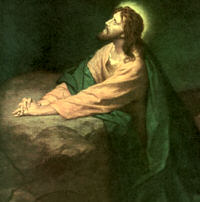
On Calvary, Our Lord, Priest and Victim, offered himself to his heavenly Father, shedding his blood, which became separated from his Body. This is how he carried out his Father’s will to the very end.
It was the Father’s will that the Redemption should be carried out in this way. Jesus accepts it lovingly and with perfect submission. This internal offering of himself is the essence of his Sacrifice. It is his loving submission, without limits, to his Father’s will.
In every true sacrifice there are four essential elements: and all of them are present in the sacrifice of the Cross: priest, victim, internal offering and external manifestation of the sacrifice. The external manifestation must be an expression of one’s interior attitude. Jesus dies on the Cross, externally manifesting (through his words and his deeds) his loving internal surrender. Father, into thy hands I comment my spirit! I have finished the task you committed to me, I have fulfilled your Will. He is, both then and now, at once Priest and Victim. Since, then, we have a great high priest who has passed through the heavens, Jesus, the Son of God, let us hold fast our confession. For we have not a high priest who is unable to sympathise with our weaknesses, but one who in every respect has been tempted as we are, yet without sinning.
The internal offering of Jesus gives full meaning to all the external elements of his voluntary sacrifice—the insults, the stripping of his garments, the crucifixion.
The Sacrifice of the Cross is a single sacrifice. Priest and Victim are one and the same divine person: the Son of God made man. Jesus was not offered up to the Father by Pilate or by Caiphas, or by the crowds surging at his feet. It was He who surrendered himself. At every moment of his life on earth Jesus lived a perfect identification with his Father’s will, but it is on Calvary that the Son’s self-surrender reaches its supreme expression.
We, who want to imitate Jesus, who want only that our life should be a reflection of his, must ask ourselves today in our prayer: do we know how to unite ourselves to Jesus’ offering to the Father and accept God’s will at every moment? Do we unite ourselves to him in our joys and our sorrows and in all the activities that make up each one of our days? Do we unite ourselves to him at the more difficult times, such as moments of failure, pain or illness, and at the easy times, when we feel our souls filled with joy?
My Mother and Lady, teach me how to pronounce a "yes,” which, like yours, will identify with the cry Jesus made before his Father: non mea voluntas…. (Luke 22:42)…not my will but God’s be done.
—Francis Fernandez, In Conversation with God
Saturday of the Fifth Week of Lent
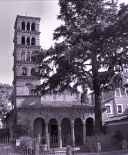
Station with San Giovanni a Porta Latina (St. John before the Latin Gate):
Today's Station takes place in the Church of St. John before the Latin Gate. This ancient basilica is built near the spot where the beloved disciple was, by Domitian's order, plunged into the cauldron of boiling oil. Miraculously, he emerged unharmed, and so then he was sent in exile to the island of Patmos, where he wrote the Book of Revelation (or Apocalypse). The church dates back to about 500 and noted for its simplicity.
For more information on San Giovanni a Porta Latina, see:
- Rome Art Lover
- Roman Churches
- PNAC
- Aleteia
- Station Church
- The Catholic Traveler
- Liturgical Arts Journal
- Walks in Rome
For further information on the Station Churches, see The Stational Church.
St. Gontran or Guntramnus
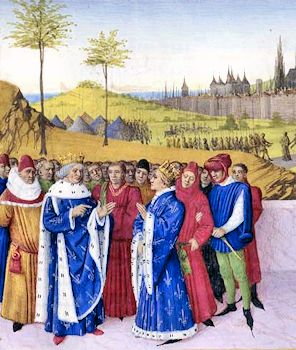 St. Gontran was the son of King Clotaire and grandson of Clovis I and Saint Clotildis. When Clotaire died in 561, his domains were divided among his four sons. While Gontran's brother Caribert reigned at Paris, Sigebert in Metz, and Chilperic in Soissons, he was crowned king of Orleans and Burgundy in 561. He then made Chalons-sur-Saone his capital.
When compelled to take up arms against his ambitious brothers and the Lombards, he made no other use of his victories, gained under the conduct of a brave general called Mommol, than to give peace to his dominions. The crimes in which the barbarous habits of his nation involved him, he effaced by tears of repentance. The prosperity of his reign, both in peace and war, condemns those who suppose that human policy cannot be determined by the maxims of the Gospel, whereas the truth is just the contrary: no others can render a government so efficacious and prosperous.
Saint Gontran always treated the pastors of the Church with respect and veneration. He was the protector of the oppressed, and the tender parent of his subjects. He gave the greatest attention to the care of the sick. He fasted, prayed, wept, and offered himself to God night and day as a victim ready to be sacrificed on the altar of His justice, to avert His indignation, which Saint Gontran believed he himself provoked and drew down upon his innocent people. He was a severe punisher of crimes in his officers and others, and by many wholesome regulations he restrained the barbarous licentiousness of his troops, but no man was ever more ready to forgive offenses against his own person. With royal magnificence, he built and endowed many churches and monasteries.
This good king died on the 23rd of March in 593, in the sixty-eighth year of his age, having reigned thirty-one years.
—Excerpted from Little Pictorial Lives of the Saints, a compilation based on Butler's Lives of the Saints and other sources by John Gilmary Shea (Benziger Brothers: New York, 1894).
Patronage: Divorced people; guardians; repentent murderers
Symbols and Representation: king finding treasure and giving it to the poor; king with three treasure chests, one of which has a globe and cross
Highlights and Things to Do:
- Read more about St. Gontran:
- He was buried in the Church of Saint Marcellus, which he had founded in Chalon. Almost immediately, his subjects proclaimed Gontrand a saint and the Catholic Church celebrates his feast day on 28 March. The Huguenots scattered his ashes in the 16th century. Only his skull remains in the Church of St. Marcellus in a silver case.
- See the print from 1636 in the Met Museum of St. Gontran.
St. Stephen Harding
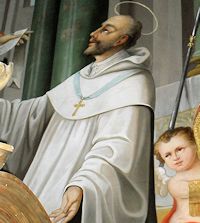 Stephen Harding, son of an English noble, was born at Sherborne in Dorsetshire, England, about the middle of the eleventh century. He consecrated himself to the monastic life in the Abbey of Sherbonne in Dorsetshire, where he received his early education. He later studied in Paris and Rome, where he pursued a brilliant course in humanities, philosophy and theology.
After studying in Paris and Rome, he visited the monastery of Molesmes. Impressed by its leaders, Robert of Molesmes and Alberic (who were later canonized), Stephen joined the community.
After a few years, the three men, along with another 20 monks, established a more austere monastery in Citeaux. Eventually, Robert was recalled to Molesme (1099), Alberic died (1110), and Stephen was elected abbot.
Stephen Harding is credited with writing the famous Carta Caritatis (Charter of Charity—often referred to as the Charter of Love). It was a six page constitution which laid out the relationship between the Cistercian houses and their abbots, set out the obligations and duties inherent in these, and ensured the accountability of all the abbots and houses to the underlying themes of charity and living according to the rule of Benedict.
Since the monastery received very few novices, he began to have doubts that the new institution was pleasing to God. He prayed for enlightenment and received a response that encouraged him and his small community. From Bourgogne a noble youth arrived with 30 companions, asking to be admitted to the abbey. This noble was the future St. Bernard. In 1115 St. Stephen built the abbey of Clairvaux, and installed St. Bernard as its Abbot. From it 800 abbeys were born.
In 1133, Stephen resigned as the head of the order, due to age and disability, and died the following year.
—Excerpted from Catholic Fire
Highlights and Things to Do:
- Read more about St. Stephen Harding at EWTN and CatholicSaints.info.
- Read Carta Caritatis.
- Learn more about the Cistercians.