Make your gift today!
Help keep Catholics around the world educated and informed.
Already donated? Log in to stop seeing these donation pop-ups.
Lent: March 27th
Friday of the Fifth Week of Lent
Other Commemorations: St. Rupert, Bishop (RM)
MASS READINGS
March 27, 2026 (Readings on USCCB website)
PROPERS [Show]
COLLECT PRAYER
Friday of the Fifth Week of Lent: Pardon the offenses of your peoples, we pray, O Lord, and in your goodness set us free from the bonds of the sins we have committed in our weakness. Through our Lord Jesus Christ, your Son, who lives and reigns with you in the unity of the Holy Spirit, God, for ever and ever.
Recipes (1)
Activities (4)
Prayers (11)
Library (4)
Blog & Podcasts (0)
It is one week before Good Friday. Today's Mass is a further reminder of how hatred against Christ escalated in those final days before Holy Week. Fridays of Lent have a special penitential quality. —The Vatican II Weekday Missal
The Roman Martyrology commemorates St. Rupert (d. 718), Bishop and missionary, also listed as Robert of Hrodbert. A member of a noble Frankish family, he was appointed bishop of Worms, Germany, and then dedicated himself to spreading the faith among the Germans. With the patronage of Duke Thedo of Bavaria, he took over the deserted town of Luvavum about 697, which was renamed Salzburg, Austria. Rupert founded a church, a monastery, and a school; brought in groups of missionaries; and established a nunnery at Nonnberg with his sister, Eerentrudis, serving as the first abbess. He died at Salzburg and is venerated as the first archbishop of this major diocese in the West. Rupert is revered as the Apostle of Bavaria and Austria.
Meditation for Friday of the Fifth Week of Lent:
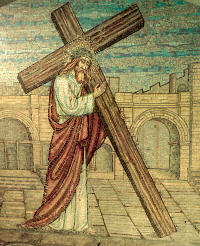
What do we do for the salvation of souls? It is true that we pray for one another, offer a few words of comfort, and do each other slight favors; but we do little more. Christ was more generous. He endured the crowning of thorns and dragged the heavy cross to Calvary. We pamper our bodies as if they were our last end. We prefer to have our heads crowned with laurels and roses. We are impatient and consider ourselves unfortunate whenever we are called on to carry a mere splinter of the cross of Christ. Are we one in spirit with Him?
Now, during Passiontide, we must begin to love and treasure pain and suffering. In the cross, in suffering, in our crucifixion with Christ, we shall find salvation. For Him and with Him we should bear all the slight injustices committed against us. For Him we should suffer freely and willingly the unpleasant and disagreeable things that occur to us. But our faith is weak. We flee from the cross instead of holding it dear, instead of loving it and welcoming it as our Savior did.
What St. Paul says of many Christians of his day is equally true of many in our time: "For many walk, of whom I have told you often (and now tell you weeping) that they are enemies of the cross of Christ. Whose end is destruction; whose God is their belly; whose glory is in their shame; who mind earthly things" (Phil. 3:18 f.).
—Excerpted from The Light of the World by Benedict Baur, O.S.B.
Friday of the Fifth Week of Lent
Station with Santo Stefano Rotondo al Celio (St Stephen's Rotunda at the Coelian Hill):
The Station is in the church of St. Stephen on Monte Celio (the Coelian Hill). The church is dedicated first to St. Stephen, the First Martyr, but is also dedicated unofficially to St. Stephen of Hungary. This is the Hungarian national church, located southeast of the Colosseum, off the usual beaten path. The original site of the church was occupied by a set of barracks housing Roman soldiers and a mithraeum. The earliest church was consecrated by Pope Simplicius between 468 and 483. Its architecture is unique in the late Roman world and the oldest example of a circular church, often thought that it was modeled on the Anastasis of the Holy Sepulchre in Jerusalem. Although the inside is circular, the exterior is on a cruciform plan. The church has undergone various periods of ruination, disrepair, and restoration. The relics of the first martyr were never in the church.
Besides being one of the original churches in the round, another key feature is found on the walls of the church, decorated with numerous frescoes, portraying 34 scenes of martyrdom, commissioned by Gregory XIII in the 16th century. Each painting has a titulus or inscription explaining the scene and giving the name of the emperor who ordered the execution, as well as a quotation from the Bible.
For more information on Santo Stefano Rotondo al Celio, see:
- Churches of Rome Info
- Rome Art Lover
- Roman Churches
- PNAC
- Aleteia
- Station Church
- The Catholic Traveler
- Great Buildings
- Liturgical Arts Journal
- Walks in Rome
- Roman Despatches
For further information on the Station Churches, see The Stational Church.
St. Rupert of Salzburg
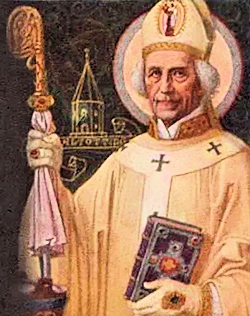 St. Rupert was the first bishop of Salzburg, who, in some legends, is credited with giving the city its name.
Rupert was born in the late seventh century, to a part of the French imperial family. Little is known about his early life, but, like many sons of noblemen, entered the clergy. Rupert was elected bishop of Worms, a German city that was an important seat of power in the Carolingian dynasty.
At first, Rupert's flock welcomed his presence as a caring and faithful bishop. All too soon, however, the relationship between Rupert and the people of Worms soured. Conveniently, a Bavarian Duke, Theodo, asked for Rupert to come south to his palace at Regensburg to come spread Christianity to the diverse tribes he ruled over in Bavaria.
Rupert is often credited with baptizing Theodo, and officially welcoming him into the Church, as the seventeenth-century painting to the left depicts. And with Theodo's blessing, he began his missionary work among the Bavarian tribes.
Rupert found that Bavaria was still, in many ways, truly a wilderness with lots of outbreaks of violence. Thus, Rupert traveled to an old ruined Roman city and renamed it "Salzburg." Rupert founded and rebuilt several different monasteries in the area and lay the foundations of the Salzburg Cathedral. Where, a little over a thousand years later, Wolfgang Amadeus Mozart was baptized.
Rupert died in 710, and there's some dispute whether he had returned back to Worms at the time of his death or whether he died in Salzburg. His successor, Bishop Vergilius of Salzburg, interred his remains in the newly-finished Salzburg Cathedral in 774.
Rupert is known as the "Apostle to the Bavarians" and is a patron saint of Salzburg, Austria, and salt miners.
—Excerpted from Faith ND
Patronage: city of Salzburg, Austria; province of Salzburg, Austria; archdiocese of Salzburg; salt miners
Symbols and Representation: man holding a container of salt (refers to Salzburg and the salt mining there); wearing clerical clothes including mitre; holding a crosier
Highlights and Things to Do:
- Read more about St. Rupert:
- Read about St. Rupert's Fair, the biggest traditional fair in Europe.
- See the Stift St. Peter -- St. Peter's Abby that St. Rupert restored and lived.
- St. Rupert's remains are located at the Salzburg Cathedral at the Volksaltar.