Lent: March 26th
Thursday of the Fifth Week of Lent
Other Commemorations: St. Ludger, Bishop (RM)
MASS READINGS
March 26, 2026 (Readings on USCCB website)
PROPERS [Show]
COLLECT PRAYER
Thursday of the Fifth Week of Lent: Be near, O Lord, to those who plead before you, and look kindly on those who place their hope in your mercy, that, cleansed from the stain of their sins, they may persevere in holy living and be made full heirs of your promise. Through our Lord Jesus Christ, your Son, who lives and reigns with you in the unity of the Holy Spirit, God, for ever and ever.
Recipes (2)
Activities (3)
Prayers (10)
Library (0)
Blog & Podcasts (0)
The weekday Masses towards the end of Lent are like a Passion Play. The Gospels, as one scene after the other, show the mounting hatred and growing tension. This is the “Abraham Mass,” telling of the inheritance received through Abraham. The Opening Prayer reminds us of our great inheritance received from Christ. —The Vatican II Weekday Missal
The Roman Martyrology commemorates St. Ludger of Utrecht (c. 743-809), a missionary among the Frisians and Saxons, founder of Werden Abbey, and the first Bishop of Münster in Westphalia. He has been called the "Apostle of Saxony."
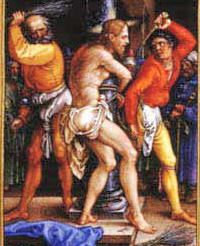
Meditation for Thursday of the Fifth Week of Lent—The Custom of Meditating on Our Lord’s Passion
My people! What have I done, in what way have I offended you? Answer me. I gave you the water of salvation which flowed from my sorrow to drink and you gave me honey and vinegar. My people, what have I done to you? (Liturgy, Good Friday).
The liturgy of these days during Lent brings us closer to the fundamental mystery of our Faith—the Resurrection of the Lord. If the liturgical year is centered upon Easter then this period demands an even greater devotion on our part, given its proximity to the sublime mysteries of divine mercy (St. Leo the Great, Sermon 47). But we should not tread this path too hastily, lest we lose sight of a very simple fact which we might easily overlook. We will not be able to share in Our Lord’s Resurrection unless we unite ourselves with him in his Passion and death (cf. Rom 8:17). If we are to accompany Christ in his glory at the end of Holy Week, we must first enter into his holocaust and be truly united to him as he lies dead on Calvary (St. Josemaria Escriva, Christ is Passing By, 95). So during these days let us accompany Jesus, in our prayers, along his painful way to Calvary and his death on the cross. As we keep him company let us not forget that we too were protagonists in all those horrors, for Jesus bore the burden of our sins (cf 1 Pet 2:24), each and every one of them. We were freed from the hands of the devil and from eternal death at a great price (cf 1 Cor 6:20), that of the Blood of Christ.
The custom of meditating on the Passion began in the very earliest days of Christianity. Many of the faithful in Jerusalem had themselves been present as Christ passed through the streets of the city on the eve of the Pasch. They would never forget Jesus’ sufferings as he made his way to Calvary. The Evangelists dedicated a good part of their writings to the detailed account of those events. We should read our Lord’s Passion constantly, said St. John Chrysostom, what great benefit we will gain by doing so. Even if you are as hard as stone, when you contemplate that He was sarcastically adorned, then ridiculed, beaten and subjected to the final agonies, you will be moved to cast all pride form your soul. How many people have been converted by careful meditation on the Passion!
St. Thomas Aquinas said that the Passion of Christ is enough to serve as a guide and model throughout our lives (St. Thomas, About the Creed). One day while he was visiting St. Bonaventure, St Thomas asked him where he had acquired such good doctrine as the one that he set out in his works. It is said that St. Bonaventure showed him a crucifix, which was blackened from all the kisses he had given it, and explained This is the book that tells me what I should write; the little I know I have learned from it (St. Alphonsus Liguouri, Meditations on Christ’s Passion). From the crucifix the saints learned how to suffer and truly love Christ. We too should learn from it. Your crucifix…As a Christian, you should always carry your crucifix with you. And place it on your desk. And kiss it before going to bed and when you wake up; and when your poor body rebels against your soul, kiss it again (St. Josemaria Escriva, The Way, 302).
Our Lord’s Passion should be a frequent theme in our prayer, but especially so in these days leading up to the central mystery of our redemption.
—Francis Fernandez, In Conversation with God
Thursday of the Fifth Week of Lent
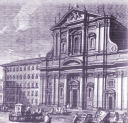
Station with Sant'Apollinare in Campo Marzio or Sant'Apollinare alle Terme (St. Apollinaris at the Baths):
The Station in Rome is in the church of St. Apollinaris, who was a disciple of St. Peter, and afterwards bishop of Ravenna. He was cruelly persecuted several times for his faith and survived, but eventually died a martyr by being beaten and run through with a sword. The church was founded in the early Middle Ages, probably in the 7th century and rebuilt between 1742 and 1748 by the Florentine architect Ferdinando Fuga. Since 1990, the basilica has been the chapel of the Pontifical University of the Holy Cross, entrusted to Opus Dei.
For more on Sant'Apollinare in Campo Marzio, see:
- Rome Art Lover
- Roman Churches
- PNAC
- Aleteia
- Station Church
- The Catholic Traveler
- Walks in Rome
- Roman Despatches
For further information on the Station Churches, see The Stational Church.
St. Ludger
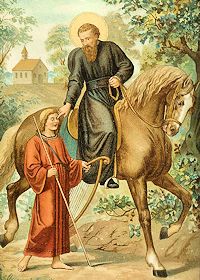 St. Ludger was born in Friesland about the year 743. His father, a nobleman of the first rank, at the child's own request, committed him very young to the care of St. Gregory, the disciple of St. Boniface, and his successors in the government of the see of Utrecht. Gregory educated him in his monastery and gave him the clerical tonsure. Ludger, desirous of further improvement, passed over into England and spent four years and a half under Alcuin, who was rector of a famous school at York.
In 773 he returned home, and St. Gregory dying in 776, his successor, Alberic, compelled our Saint to receive the holy order of priesthood and employed him for several years in preaching the Word of God in Friesland, where he converted great numbers, founded several monasteries, and built many churches.
The pagan Saxons ravaging the country, Ludger traveled to Rome to consult Pope Adrian II, what course to take, and what he thought God required of him. He then retired for three years and a half to Monte Casino, where he wore the habit of the Order and conformed to the practice of the rule during his stay, but made no religious vows.
In 787, Charlemagne overcame the Saxons and conquered Friesland and the coast of the Germanic Ocean as far as Denmark. Ludger, hearing this, returned into East Friesland, where he converted the Saxons to the Faith, as he also did the province of Westphalia. He founded the monastery of Werden, twenty-nine miles from Cologne.
In 802, Hildebald, Archbishop of Cologne, not regarding his strenuous resistance, ordained him Bishop of Munster. He joined in his diocese five cantons of Friesland which he had converted and also founded the monastery of Helmstad in the duchy of Brunswick.
Being accused to the Emperor Charlemagne of wasting his income and neglecting the embellishment of churches, this prince ordered him to appear at court. The morning after his arrival the emperor's chamberlain brought him word that his attendance was required. The Saint, being then at his prayers, told the officer that he would follow him as soon as he had finished them. He was sent for three several times before he was ready, which the courtiers represented as contempt of his Majesty, and the emperor, with some emotion, asked him why he had made him wait so long, though he had sent for him so often. The bishop answered that though he had the most profound respect for his Majesty, yet God was infinitely above him; that whilst we are occupied with Him, it is our duty to forget everything else. This answer made such an impression on the emperor that he dismissed him with honor and disgraced his accusers.
St. Ludger was favored with the gifts of miracles and prophecy. His last sickness, though violent, did not hinder him from continuing his functions to the very last day of his life, which was Passion Sunday, on which day he preached very early in the morning, said Mass towards nine, and preached again before night, foretelling to those that were about him that he should die the following night, and fixing upon the place in his monastery of Werden where he chose to be interred.
He died accordingly on the 26th of March, at midnight.
—Excerpted from Lives of the Saints, by Alban Butler, Benziger Bros. ed. [1894]
Symbols and Representation: bishop holding a cathedral; bishop holding a church and a book; bishop reciting his Breviary; bishop with a swan on either side; bishop with a goose or geese
Patronage: diocese of Essen, Germany; diocese of Münster, Germany; Billerbeck, Germany; Helmstedt, Germany; Münster, Germany; Saxony, Germany; Werden, Germany; Bant-Rutten, Netherlands; Deventer, Netherlands; Dronten, Netherlands; East Frisia, Netherlands; Groningen, Netherlands; Hengelo, Netherlands; Lichtenvoorde, Netherlands; Loenen, Netherlands.
Highlights and Things to Do:
- Read more about St. Ludger: