Make your gift today!
Help keep Catholics around the world educated and informed.
Already donated? Log in to stop seeing these donation pop-ups.
Lent: March 6th
Friday of the Second Week of Lent
Other Commemorations: St. Colette, Virgin and Religious (RM)
MASS READINGS
March 06, 2026 (Readings on USCCB website)
PROPERS [Show]
COLLECT PRAYER
Friday of the Second Week of Lent: Grant, we pray, almighty God, that, purifying us by the sacred practice of penance, you may lead us in sincerity of heart to attain the holy things to come. Through our Lord Jesus Christ, your Son, who lives and reigns with you in the unity of the Holy Spirit, God, for ever and ever.
Recipes (3)
Activities (4)
Prayers (14)
Library (4)
Blog & Podcasts (2)
Today’s first reading and Gospel draw a parallel between Joseph, sold into slavery by his brothers and Jesus, the well-beloved Son of the Father, put to death by the religious leaders of the Jews. Together with the prediction of the passion there is here the condemnation of the wicked servants of God whose proud infidelity is set in opposition to His providential plans.
The pharisees and the high priests to whom Jesus was speaking felt that they were being referred to. They were broken on Him whom they wished to cast out. For being unfaithful and rejecting the Messiah they were themselves rejected and henceforwards the people of God, which includes all nations, will be ruled by a hierarchy whose mission is guaranteed by the Holy Spirit. —St. Andrew Daily Missal
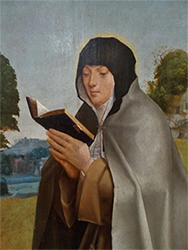
The Roman Martyrology commemorates St. Colette (1381-1447), who revived the Franciscan spirit among the Poor Clares. Her reform spread throughout France, Savoy, Germany, and Flanders, many convents being restored and seventeen new ones founded by her. She helped St. Vincent Ferrer in the work of healing the papal schism.
Meditation for Friday of the Second Week of Lent
In one of the primitive prophecies the Messiah is referred to as the one that is to be sent (Genesis 49:10). The Liturgy presents him to us today in figure and in parable. It tells us the fate he met at the hands of his own brethren. It is a sad story of blind rejection and human ingratitude. The cry "Kill him," has been shrieking down the rugged way of human history from the days of Cain. But God, the master of his plan and our destiny, is not going to let his Messiah be defeated by his enemies. He brings him back to life and glory.
The Church shares and feels this rejection of Christ in the persecution of her members: in the hearts of missionaries expelled from their posts and of Christians imprisoned for the crime of loyalty to God. With firm hope she is looking forward to her own full resurrection and glorification with Christ the Messiah.
Joseph is a type of Christ. He was rejected by his own brothers. Later, God made him their savior. All this is intended by God as a type of what Christ was to go through at the hands of his enemies. If we are of Christ we shall experience a like rejection in our own lives so as to help Christ to save others.
In the Gospel Christ has told us the sad story of his rejection by the chosen people; and of the terrible fate awaiting them. He also reminded his hostile audience that the stone which they rejected has become the corner stone. Humiliation and rejection is the path to glory. This is the way of the Lord. Our Lenten effort is to stay with the Lord at all costs, with the strength provided by the Eucharist.
—St. Andrew Bible Missal
Friday of the Second Week of Lent
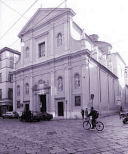
Station with San Vitale (St. Vitalis):
The Station for today is in the church of St. Vitalis, martyr, the father of the two illustrious Milanese martyrs, Sts. Gervasius and Protasius. The church was built about 400, and consecrated by Pope Innocent I in 401/2. The dedication to St. Vitalis and his family was given in 412. The church has been rebuilt several times, of which the most comprehensive rebuilding was that of Pope Sixtus IV before the 1475 Jubilee. It was then granted to Clerics Regular.
For more on San Vitale, see:
- Churches of Rome Info
- The Station Churches of Rome
- The Station Churches of Rome
- Rome Art Lover
- Roman Churches
- PNAC
- Aleteia
- Station Church
- The Catholic Traveler
- Walks in Rome
For further information on the Station Churches, see The Stational Church.
St. Colette
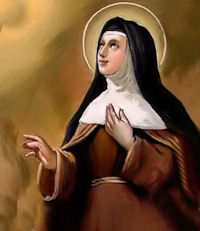 Born in 1380, Nicolette was named in honor of St. Nicholas of Myra. Her loving parents nicknamed her Colette from the time she was a baby. Colette's father was a carpenter at an abbey in Picardy. Quiet and hard-working, Colette was a big help to her mother with the housework. Her parents noticed the child's liking for prayer and her sensitive, loving nature.
When Colette was seventeen, both her parents died. The young woman was placed under the care of the abbot at the monastery where her father had worked. She asked for and received a hut built next to the abbey church. Colette lived there. She spent her time praying and sacrificing for Jesus' Church. More and more people found out about this holy young woman. They went to see her and asked her advice about important problems. They knew that she was wise because she lived close to God. She received everybody with gentle kindness. After each visit, she would pray that her visitors would find peace of soul. Colette was a member of the Third Order of St. Francis. She knew that the religious order of women who followed St. Francis' lifestyle are the Poor Clares. They are named after St. Clare, their foundress, who was a follower of St. Francis. During Colette's time, the Poor Clares needed to go back to the original purpose of their order. St. Francis of Assisi appeared to Colette and asked her to reform the Poor Clares. She must have been surprised and afraid of such a difficult task. But she trusted in God's grace. Colette traveled to the Poor Clare convents. She helped the nuns become more poor and prayerful.
The Poor Clares were inspired by St. Colette's life. She had a great devotion to Jesus in the Eucharist. She also spent time frequently meditating on the passion and death of Jesus. She loved Jesus and her religious vocation very much.
Colette knew exactly when and where she was going to die. She died in one of her convents in Ghent, Flanders, in 1447. She was sixty-seven. Colette was proclaimed a saint by Pope Pius VI in 1807.
—Excerpted from Holy Spirit Interactive
Symbols and Representation: birds; lamb; woman being carried to heaven by an angel; woman delivering a soul from purgatory; Poor Clare nun holding a crucifix and a hook; Poor Clare nun visited by Saint Anne, Saint Francis of Assisi, and/or Saint Clare of Assisi in a vision; Poor Clare nun walking on a stream
Patronage: against eye disorders; against fever; against headaches; against infertility; against the death of parents; craftsmen; Poor Clares; servants; Corbie, France; Ghent, Belgium
Highlights and Things to Do:
- Read more about St. Colette:
- The Colettines are a reformed branch of the Poor Clares. See the Ty Mam Duw Poor Clare Colettine Community for an example of one of the communities.
- St. Colette's relics are at Monastère Sainte-Claire in Poligny, France.