Lent: March 7th
Saturday of the Second Week of Lent; Opt. Mem. of Sts. Perpetua and Felicity, Martyrs
Other Titles: St. Felicitas
MASS READINGS
March 07, 2026 (Readings on USCCB website)
PROPERS [Show]
COLLECT PRAYER
Saturday of the Second Week of Lent: O God, who grant us by glorious healing remedies while still on earth, to be partakers of the things of heaven, guide us, we pray, through this present life and bring us to that light in which you dwell. Through our Lord Jesus Christ, your Son, who lives and reigns with you in the unity of the Holy Spirit, God, for ever and ever.
Optional Memorial of Sts. Perpetua and Felicity: O God, at the urging of whose love the Martyrs Saints Perpetua and Felicity defied their persecutors and overcame the torment of earth, grant, we ask, by their prayers, that we may ever grow in your love. Through our Lord Jesus Christ, your Son, who lives and reigns with you in the unity of the Holy Spirit, God, for ever and ever.
Recipes (3)
Activities (3)
Prayers (12)
Library (2)
Blog & Podcasts (3)
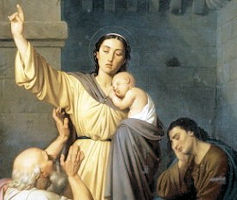
The parable of the prodigal son brings out even more clearly the free choice of God. This time his choice falls on one who is least worthy of it. The prodigal son of the parable is a figure representing us. We are the real prodigal sons whom God has forgiven and brought back into his love and made heirs of the messianic promises. We do not know why we were chosen. If God is so good to forgive our past, call us to salvation and make us recipients of the heritage of his kingdom, it is important that we return to him with a truly contrite heart, and never wander back to the path of sin. How well the Eucharistic celebration today expresses our sentiment of gratitude for the pardon and salvation he sends us through his Son, our Lord Jesus Christ. —St. Andrew Bible Missal
The Church celebrates the Optional Memorial of Saints Perpetual and Felicity (d. 203). The account of their martyrdom forms one of the finest pages of the history of the first centuries of the Church. It shows us clearly the wonderful sentiments of these two women when they heard that they had been condemned to the wild beasts. Knowing their own weakness but relying on the strength of Christ, who was fighting with them, they went to their martyrdom as to a triumphant celebration, to which they were invited by Christ. They were exposed to the fury of wild beasts in the amphitheater at Carthage, A.D. 203, and finally killed by the sword. Their names are still mentioned together in the Roman Canon of the Mass.
Meditation for Saturday of the Second Week of Lent
The story of the Prodigal Son is repeated again today. It is the history of the Church; it is the history of our own desertion. In this Gospel, we are given an urgent call to repentance and conversion. "Father, I have sinned." Penance alone can save us. Our Father welcomes us with mercy. The sin and its eternal punishment are forgiven; the good works which we did before sin and the merits which we lost through sin are revived. The Father receives us again as His children and celebrates a joyful banquet with us at Holy Communion.
In the story of each human life, God's mercy stands on one side and the unfaithfulness of man on the other. Will God have to cast us off as He did the people of Israel? Have we not fully deserved it? Sometimes it appears that God wishes to allow our faithless generation to go its own way. If He does, it will merit a well-deserved punishment.
What can save us from rejection? Only penance, self-examination, and conversion. "Be converted to Me with all your heart, in fasting and in weeping and in mourning" (Joel 2:12).
—Excerpted from The Light of the World by Benedict Baur, O.S.B.
Highlights and Things to Do:
- The parable of the Prodigal Son or The Loving Father in today's Gospel are very important for your children to know. The well-known Catechesis of the Good Shepherd for children was developed by Sofia Cavalletti, a Roman Catholic Hebrew scholar who spent 30 years researching the religious development of children, and Gianna Gobbi, an educator who was trained by Maria Montessori. Through her observation of children's responses to different religious themes, Cavalletti found that an overwhelming number of younger children responded especially well to depictions of Christ as the Good Shepherd and as a Loving and Forgiving Father. Find a local atrium or learn more through Sofia's and Gianna's writings.

Saturday of the Second Week of Lent
Station with Santi Marcellino e Pietro al Laterano (Saints Marcellinus and Peter):
The Station is in the church of Sts. Peter and Marcellinus, two celebrated martyrs of Rome under the persecution of Diocletian. Their relics were brought to the church in 1256, and the church was restored the same year on order from Pope Alexander IV. Santi Marcellino e Pietro al Laterano is a Roman catholic parish on the Via Merulana at the intersection with via Labicana. Their feast day is June 2..
For more on Santi Marcellino e Pietro al Laterano, see:
- The Station Churches of Rome
- Rome Art Lover
- Roman Churches
- PNAC
- Aleteia
- Station Church
- Catholic Traveler
- Walks in Rome
For further information on the Station Churches, see The Stational Church.
Sts. Perpetua and Felicity
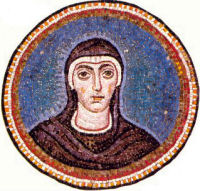 Vibia Perpetua, a well-to-do young woman and mother, and Felicitas, a slave who gave birth to a child three days before suffering a martyr's death, were catechumens. Against such prospective converts the persecution of Septimius Severus was particularly severe. These two holy women suffered death on the seventh of March in Carthage. The Breviary relates the following touching episode:
Now the day had arrived when they were to be thrown to the wild beasts. Felicitas began to be sorrowful because she feared she would have to wait longer than her companions. For eight months she had been pregnant and therefore, according to Roman law, could not be executed before the birth of the child. But the prayers of her fellow sufferers hastened her time and she gave birth to a baby girl.
While she was suffering from the pains of childbirth, one of the guards called out to her, "If you are suffering so much now, what will you do when you are thrown to the wild beasts?" "Now I suffer," she answered, "but there Another will be in me, who will suffer for me, because I will suffer for Him." When she was in travail she had sorrow, but when she was set before the wild beasts she rejoiced (Martyrology).
Finally, on the seventh of March, these heroic women were led into the amphitheater and severely scourged. Then they were tossed about by an exceptionally wild cow, gored, and thrown to the ground.
—Excerpted from The Church's Year of Grace, Pius Parsch
Patronage: Perpetua—Cattle; ranchers; death of children; martyrs; married women; Carthage, Tunisia; Santa Perpètua de Mogoda, Catalonia, Spain
Felicity—Cattle; ranchers; death of children; martyrs; sterility; to have male children
Symbols and Representation: Perpetua—cow; woman with a sword beside her; woman with a bull, ox, leopard or lion in an amphitheater; Seven swords; cauldron of oil and sword; sword with seven heads; eight palms
Felicity—bull; cow; pregnant woman holding a cross; woman with a sword by her; woman with a bull or ox in an amphitheater
Highlights and Things to Do:
- The story of the sufferings of today's saints is preserved for us in authentic "Acts of the Martyrs" that were composed partly by the saints themselves, and partly by eyewitnesses (perhaps Tertullian). The account may be classed with the most beautiful portions of ancient Christian literature that have come down to us. Read CIN's account.
- Read about the locations of their relics.
- Read more about Sts. Perpetua and Felicity:
- Watch Sts. Perpetua and Felicity.
- Listen to Catholic Culture's Way of the Father's podcast, Ep. 15—Perpetua: A Rare Female Voice from Antiquity by Mike Aquilina.
- Listen to Catholic Culture's Audiobook Tertullian—The Martyrdom of Perpetua and Felicity by James Majewski.