Make your gift today!
Help keep Catholics around the world educated and informed.
Already donated? Log in to stop seeing these donation pop-ups.
Lent: February 19th
Thursday after Ash Wednesday
Other Commemorations: Bl. Conrad of Piacenza Confalonieri, Hermit & Franciscan Tertiary (RM), St. Barbatus, Bishop (RM)
MASS READINGS
February 19, 2026 (Readings on USCCB website)
PROPERS [Show]
COLLECT PRAYER
Thursday after Ash Wednesday: Prompt our actions with your inspiration, we pray, O Lord, and further them with your constant help, that all we do may always begin from you and by you be brought to completion. Through our Lord Jesus Christ, your Son, who lives and reigns with you in the unity of the Holy Spirit, God, for ever and ever.
Recipes (1)
Activities (8)
Prayers (7)
Library (0)
Blog & Podcasts (5)
» Enjoy our Liturgical Seasons series of e-books!
The ashes are scarcely washed clean from our foreheads. In this second Lenten Mass we get down to work on our spiritual program. The first four Masses in Lent are a unit. They describe the area of concentration and the dimensions of our Lenten program. Today’s Mass teaches that it is the soul’s life we are concerned with. The Collect or Opening Prayer at Mass is the usual one said when beginning a major work.
"The great themes—the annual catechumenate by which all the people of the Church are renewed in the baptismal promises they repeat at the Easter Vigil; the adventure of God in salvation history and in the coming of the Kingdom in the person of Jesus; and the invitation to deeper friendship with Christ through a more intimate embrace of His Passion and Death—shape the liturgical rhythm of Lent.
"Ash Wednesday, the days immediately following, and the first two weeks of Lent are penitential in character. The prayers and readings of daily Mass and the Liturgy of the Hours calls us to an extended examination of conscience: How am I living as a witness to the Kingdom? Have I been the missionary of the Gospel I am called to be? What is there in me that needs purification, if I am to deepen my friendship with Jesus?
—George Weigel, Roman Pilgrimage: Station Churches
Today The Roman Martyrology commemorates St. Conrad of Piacenza (1290-1351), a Franciscan tertiary hermit celebrated for piety and miraculous cures at Noto in Sicily and St. Barbatus (610-682), Bishop of Benevento, who converted the Lombards.
Meditation for Thursday after Ash Wednesday—Our Ascetic Duty
We disciples of the school of the Gospel have a new and overwhelming reason that calls us to ascetic duty. We are sinners, at least potentially; we must forestall or atone for our faults. We must expiate our shortcomings; we must punish the existing or renascent disorder in our being devastated by original and actual sin; we need some redeeming penalty.
Finally we have the obligation and the desire to follow in the footsteps of our Master, who said: “If any man would come after me, let him deny himself and take up his cross and follow me (Matt 16:24). The imitation of Christ: what a program!
Now we will merely reread to you a quotation from the ancient and great Origen; here it is: “Do you want me to show you again what fasting you must practice? Fast (that is, abstain) from all sin.” This is the fasting that pleases God.
—Pope St. Paul VI, April 4, 1973
Meditation on the Gospel, Luke 9:22-25:
Jesus is not content with demonstrating the eschatological necessity of his own suffering. He has prepared his followers too to accept, in the same spirit, a life of trial. In order to emphasize this teaching, Luke makes a somewhat artificial collection of Jesus’ sayings.
The verbs renounce, take up the cross, follow Christ are really synonymous. Each in its own way indicates what is the essential element of Christian life. In that he himself anticipates the punishment of the cross for his revolutionary ideas, Jesus is warning his followers that, if they remain loyal to his teaching, they must expect the same fate. Consequently one must reject all personal security and accept the mastery’s counsels (the rabbinic meaning of “following someone”) not only in theory but in practical life (“carrying the cross”).
In this context saving one’s life means abandoning Christ’s group of followers, deciding that it is dangerously revolutionary and looking for safety. Losing one’s life means risking life by remaining part of the group. The risk can only be undertaken in complete solidarity with the person of Jesus (“for my sake”).
If this solidarity is maintained throughout ones earthly life, it will be rewarded by an active share in Christ’s resurrection and his eschatological kingdom. It is thus that the paschal mystery is fulfilled for every Christian. This experience in death and resurrection becomes the lot of all his disciples. they in turn carry their cross so that they may live in glory with him.
—Guide for the Christian Assembly, Thierry Maertens and Jean Frisque
Thursday after Ash Wednesday
Station with San Giorgio in Velabro (St. George at Velabrum):
Today's station church is dedicated to St. George, the ever-popular soldier-saint. Pope St. Gregory established a diaconia, an institution that cared for the poor, at the site of this church. The area has a special place in the history of Rome, as an ancient tradition claims that it was here that Romulus killed his brother Remus before founding the city.
For more on San Giorgio in Velabro, see:
- Churches of Rome Info
- The Station Churches of Rome
- Rome Art Lover
- Roman Churches
- PNAC
- Aleteia
- Father Coulter Station Churches
- The Catholic Traveler
For further information on the Station Churches, see The Stational Church.
Bl. Conrad of Piacenza
Blessed Conrad was a Franciscan tertiary and hermit. He was a noble, born at Piacenza, Italy. While hunting, Conrad made a fire that quickly engulfed a neighboring cornfield. A poor man was arrested as an arsonist and condemned to death, but Conrad stepped forward to admit his guilt in the matter. As a result, he had to sell his possessions to pay for the damages. Conrad and his wife decided to enter the religious life. She became a Poor Clare, and he entered the Franciscan Third Order as a hermit. Conrad went to Noto, on Sicily, where he lived the next three decades at St. Martin's Hospital and in a hermitage built by a wealthy friend. During his last years, he lived and prayed in the grotto of Pizzone outside of Noto.
—Excerpted from Our Sunday Visitor's Encyclopedia of Saints
Patronage: against hernias; hunters; Cacciatori, Italy; Calendasco, Italy; city of Noto, Sicily; diocese of Noto, Sicily
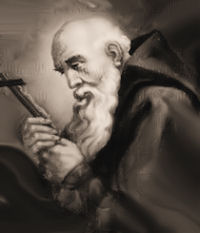
Symbols and Representation: Franciscan hermit with a cross upon which birds perch; bearded, old man with a tau staff, bare feet, Franciscan cincture, and small birds fluttering around him; old man with stags and other animals around him
Highlights and Things to Do:
- Read more about Blessed Conrad of Piacenza:
- St. Conrad's relics are held in the Cathedral of St. Nicholas in Noto, Italy, also called "Noto Cathedral."
St. Barbatus
St. Barbatus was born in the territory of Benevento in Italy, toward the end of the pontificate of St. Gregory the Great, in the beginning of the seventh century. His parents gave him a Christian education, and Barbatus in his youth laid the foundation of that eminent sanctity which recommends him to our veneration.
The innocence, simplicity, and purity of his manners, and his extraordinary progress in all virtues, qualified him for the service of the altar, to which he was assumed by taking Holy Orders as soon as the canons of the Church would allow it. He was immediately employed by his bishop in preaching, for which he had an extraordinary talent, and, after some time, made curate of St. Basil's in Morcona, a town near Benevento. His parishioners were steeled in their irregularities, and they treated him as a disturber of their peace, and persecuted him with the utmost violence. Finding their malice conquered by his patience and humility, and his character shining still more bright, they had recourse to slanders, in which their virulence and success were such that he was obliged to withdraw his charitable endeavors among them.
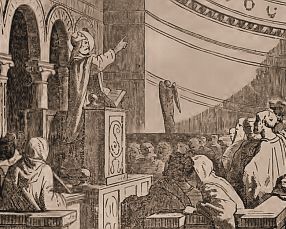 Barbatus returned to Benevento, where he was received with joy. When St. Barbatus entered upon his ministry in that city, the Christians themselves retained many idolatrous superstitions, which even their duke, Prince Romuald, authorized by his example, though son of Grimoald, King of the Lombards, who had edified all Italy by his conversion. They expressed a religious veneration for a golden viper, and prostrated themselves before it; they also paid superstitious honor to a tree, on which they hung the skin of a wild beast; and those ceremonies were closed by public games, in which the skin served for a mark at which bowmen shot arrows over their shoulders. St. Barbatus preached zealously against these abuses, and at length he roused the attention of the people by foretelling the distress of their city, and the calamities which it was to suffer from the army of the Emperor Constans, who, landing soon after in Italy, laid siege to Benevento.
Ildebrand, Bishop of Benevento, dying during the siege, after the public tranquillity was restored St. Barbatus was consecrated bishop on the 10th of March, 663. Barbatus, being invested with the episcopal character, pursued and completed the good work which he had so happily begun, and destroyed every trace of superstition in the whole state. In the year 680 he assisted in a council held by Pope Agatho at Rome, and the year following in the Sixth General Council held at Constantinople against the Monothelites.
He did not long survive this great assembly, for he died on the 29th of February, 682, being about seventy years old, almost nineteen of which he had spent in the episcopal chair.
—-Excerpted from Butler's Lives of the Saints, Benziger Bros. ed. [1894]
Highlights and Things to Do:
- Read more about St. Barbatus: