MASS READINGS
January 28, 2024 (Readings on USCCB website)
PROPERS [Show]
COLLECT PRAYER
Fourth Sunday in Ordinary Time: Grant us, Lord our God, that we may honor you with all our mind, and love everyone in truth of heart. Through our Lord Jesus Christ, your Son, who lives and reigns with you in the unity of the Holy Spirit, God, for ever and ever.
Recipes (1)
Activities (3)
Prayers (3)
Library (0)
Blog & Podcasts (6)
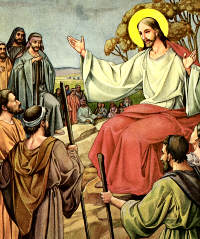
In their synagogue was a man with an unclean spirit; he cried out, "What have you to do with us, Jesus of Nazareth? Have you come to destroy us? I know who you are—the Holy One of God!" Jesus rebuked him and said, "Quiet! Come out of him!" The unclean spirit convulsed him and with a loud cry came out of him (Mark 1:23-26).
The Memorial of St. Thomas Aquinas, which is ordinarily celebrated today, is superseded by the Sunday liturgy.
Commentary of the Mass Readings for the Fourth Sunday in Ordinary Time, Year B:
The First Reading is taken from the Book of Deuteronomy 18:15-20. This central section of this book describes the various offices and officers of the theocratic society which Yahweh, through his servant Moses, is setting up for the Chosen People.
The Second Reading is from the First Letter of St. Paul to the Corinthians 7:32-35. He devotes chapter 7 to answering questions concerning marriage and virginity. In today's extract he emphasizes freedom to serve God fully, freedom from earthly cares which those who choose a life of celibacy have.
The Gospel is from St. Mark 1:21-28. St. Mark makes it clear that, from the very first day of Christ's public ministry, his messianic power began to be manifested to those who saw and heard him. The Jews of Capernaum were "astonished" at his teaching and "amazed" at his power over the evil spirits. "What is this," they asked one another, "a new teaching and the unclean spirits obey him!" But they were still a long way from recognizing him for what he was, the Messiah and Son of God. This is as might be expected, the astounding mystery of the incarnation was way beyond human expectation or human imagination. And it was our Lord's own plan to reveal this mystery, slowly and gradually, so that when the chain of evidence had been completed by his resurrection, his followers could look back and see each link in that chain. Then they would be ready to accept without hesitation the mystery of the incarnation and realize the infinite love and power of God that brought it about. We look back today through the eyes of the Evangelists, and, like them, know that Christ was God as well as man—two natures in one person. We should not therefore be "amazed" at the teaching of Jesus or at his power over the unclean spirits. What should amaze us really is the love that God showed mankind in becoming one of our race.
We are creatures with nothing of our own to boast of. We were created by God, and every talent or power we possess was given us by God. God's benevolence could have stopped there and we would have no right to complain. But when we recall the special gifts he gave man, which raise him above all other created things, we see that he could not, because of his own infinitely benevolent nature, leave us to an earthly fate. What thinking man could be content with a short span of life on earth? What real purpose in life could an intelligent being have who knew that nothing awaited him but eternal oblivion in the grave? What fulfillment would man's intellectual faculties find in a few years of what is for the majority of people perpetual struggle for earthly survival? No, God created us to elevate us, after our earthly sojourn, to an eternal existence where all our desires and potentialities would have their true fulfillment. Hence the incarnation, hence the life, death and resurrection of Christ, who was God's Son, as the central turning point of man's history.
Today, while amazed at God's love for us, let us also be justly amazed at the shabby and grudging return we make for love. Many amongst us even deny that act of God's infinite love, not from convincing historical and logical proofs, but in order to justify their own unwillingness to co-operate with the divine plan for their eternal future. This is not to say that their future, after death, does not concern them; it is a thought which time and again intrudes on all men, but they have allowed the affairs of this world which should be stepping stones to their future life, to become instead mill-stones which crush their spirits and their own true self-interests.
While we sincerely hope that we are not in that class, we can still find many facets in our daily Christian lives which can and should make us amazed at our lack of gratitude to God and to his incarnate Son. 'Leaving out serious sin which turns us away from God if not against him, how warm is our charity, our love of God and neighbor? How much of our time do we give to the things of God and how much to the things of Caesar? How often does our daily struggle for earthly existence and the grumbles and grouses which it causes, blot out from our view the eternal purpose God had in giving us this earthly existence. How often during the past year have we said from our heart: "Thank you, God, for putting me in this world, and thank you a thousand times more, for giving me the opportunity and the means of reaching the next world where I shall live happily forevermore in your presence"? If the true answer for many of us is "not once," then begin today. Let us say it now with all sincerity, and say it often in the years that are left to us.
—Excerpted from The Sunday Readings by Fr. Kevin O'Sullivan, O.F.M.
Meditation: "Fasching"—Mardi Gras: The Ground of Our Freedom
Fasching—Mardi gras—is certainly not a Church festival. Yet on the other hand, it is unthinkable apart from the Church's calendar. Thus if we reflect on its origin and significance, it can contribute to our understanding of faith.
Fasching has many roots, Jewish, pagan and Christian, and all three point to something common to men of all times and places. It shows a certain correspondence to the feast of Purim in the Jewish calendar, which recalls Israel's deliverance from the menace of persecution of the Jews in the Persian empire, a deliverance brought about, in the biblical account, by Queen Esther. The joyful abandon with which this feast is celebrated is intended to express the feeling of liberation, and on this day it is not only a memory but also a promise: the person who is in the hands of the God of Israel is already, in anticipation, freed from the snares of his enemies.
But behind this exuberant, worldly feast, which had and still has a place in the religious calendar, there is also an awareness of that temporal rhythm which was given classical expression in the Book of Ecclesiastes: "For everything there is a season, and a time for every matter under heaven: a time to be born and a time to die; a time to plant and a time to pluck up what is planted;… a time to weep and a time to laugh; a time to mourn and a time to dance" (Qo 3: iff.). Not everything is appropriate at all times; the human being needs a rhythm, and the year gives him this rhythm, both through creation and through the history which faith sets forth in the yearly cycle.
This brings us to the Church's year, which enables man to go through the whole history of salvation in step with the rhythm of creation, simultaneously ordering and purifying the chaotic multiplicity of our nature. Nothing human is omitted from this cycle of creation and history, and only in this way can all human reality, its dark side and its light side, the world of sense and the world of spirit, be saved. Everything finds its place in the whole, which gives it meaning and delivers it from its isolation. So it is foolish to want to prolong Fasching when business and one's agenda seem to recommend it: such extra time, artificially created by ourselves, turns into boredom; man is left alone as his own creator and feels truly forsaken. Then time is no longer the varied gift of creation and history but the monster which devours itself, the empty preoccupation with sameness, whirling us round in a circle of meaninglessness, ultimately devouring us as well.
Let us go back to think about the roots of Fasching. As well as the Jewish, there is the pagan prehistory, whose fierce and menacing features still stare at us in the masks worn in Alpine, Swabian and Alemannic parts of Germany. What lie behind this are the rites for driving out winter and banishing demonic powers: the changes involved in times and seasons seemed to threaten the world's continuance; it was necessary to secure the earth and its fruitfulness against the void to which, in the sleep of winter, the world seemed to come perilously close.
At this point we can observe something of great significance: in the Christian world the demonic mask becomes a light-hearted masquerade, the life-and-death struggle with the demons becomes fun and merriment prior to the seriousness of Lent. This masquerade shows us something we can often see in the psalms and in the prophets: it becomes a mocking of the gods, who no longer need to be feared by those who know the true God. The masks of the gods have become an amusing show, expressing the high spirits of those who can laugh at what once brought terror. To that extent, Fasching actually does contain elements of Christian liberation, the freedom of the One God, perfecting that freedom commemorated in the Jewish feast of Purim.
In the end, however, we are faced with a question: Do we still enjoy this freedom? Or is it not a fact that, ultimately, we would like to free ourselves from God, from creation and from faith, in order to be totally free? And is not the consequence of this that we are once again handed over to the gods, to commercial forces, to greed, to public opinion? God is not the enemy of our freedom but its ground. That is something we ought to relearn in these days. Only love that is almighty can ground a joy that is free from anxiety.
—From Seek That Which Is Above by Joseph Cardinal Ratzinger (Pope Benedict XVI)