Easter: May 22nd
Friday of the Sixth Week of Easter; Optional Memorial of Saint Rita of Cascia, religious
MASS READINGS
May 22, 2020 (Readings on USCCB website)
COLLECT PRAYER
O God, who restore us to eternal life in the Resurrection of Christ, raise us up, we pray, to the author of our salvation, who is seated at your right hand, so that, when our Savior comes again in majesty, those you have given new birth in Baptism may be clothed with blessed immortality. Through our Lord Jesus Christ, your Son who lives and reigns with you in the unity of the Holy Spirit, God, for ever and ever.
Bestow on us, we pray, O Lord, the wisdom and strength of the Cross, with which you were pleased to endow Saint Rita, so that, suffering in every tribulation with Christ, we may participate ever more deeply in his Paschal Mystery. Who lives and reigns with you in the unity of the Holy Spirit, God, for ever and ever.
Recipes (1)
Activities (6)
Prayers (7)
Library (2)
Blog & Podcasts (1)
After eighteen years of married life, St. Rita lost, by death, her husband and her two sons. Called afterwards to the religious state, she professed the Rule of St. Augustine at Cascia her native town, in central Italy. In a life-long and terrible malady her patience, cheerfulness, and union by prayer with almighty God, never failed her. Jesus imprinted on her brow the mark of a thorn from His crown. She died May 22, 1456, and both in life and after death has worked many miracles. This optional memorial is new to the USA liturgical calendar.
St. Stanislaus of Cracow
Stanislaus was born in 1030 and was educated at Gnesen and at Paris. After his ordination to the priesthood he was made a canon of the cathedral at Cracow as well as archdeacon and preacher. Upon the death of the bishop of Cracow, he was nominated bishop of the diocese by Pope Alexander II.
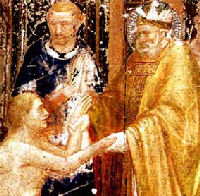 The king at the time, Boleslaus II, trying to strengthen his own power, led an expedition against the grand duchy of Kiev, making himself very unpopular with the nobles of the country, who opposed his policies. St. Stanislaus of Cracow sided with the nobles, led by the king's brother, Ladislaus, and this brought him into conflict with the king.
Stanislaus had opposed the king before for his tyrannical ways and once confronted him boldly for his immoral behavior when Boleslaus had abducted the wife of a Polish nobleman and carried her off to his castle. No one seemed willing to face the king from a fear of his rage, but Stanislaus boldly went to the king and threatened excommunication if he did not change his ways. Furious, the king promised revenge on the bishop. Later, Stanislaus sided with the nobles in their opposition to the king's political policies, and the king accused him of being a traitor and condemned him to death.
At first the king commanded his soldiers to kill the bishop when he was celebrating Mass at St. Michael's chapel in Cracow, but the soldiers refused, fearing to bring down upon themselves the wrath of God. Undeterred, the king himself entered the church, drew his sword, and killed the bishop, ordering his soldiers to dismember the body.
Pope Gregory VII placed the country under interdict and Boleslaus fell from power, fleeing to Hungary, where he entered the monastery of Osiak to do penance for his crime. Stanislaus, canonized by Pope Innocent IV in 1253, is one of the patron saints of Poland.
—The One Year Book of Saints by Rev. Clifford Stevens
Patronage: soldiers in battle; Poland; archdiocese of Cracow, Poland; city of Cracow, Poland; diocese of Plock, Poland; archdiocese of Warsaw
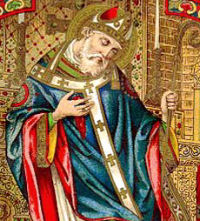
Symbols and Representation: Bishop being hacked to pieces at the foot of an altar; bishop with a sword
Highlights and Things to Do:
- Read more about St. Stanislaus:
- Learn a little more about the city of Kracow where both St. Stanislaus and Pope John Paul II came from.
- For those who are extremely interested in knowing more about Polish history this online book, Polish Americans and Their Communities of Cleveland may prove to be a good source of information.
- The final work of Franz Liszt is the unfinished oratorio St. Stanislaus, for which he left two scenes (one and four) and two polonaises. Learn more about this oratorio here and if you are able find a copy and listen.
- St. Stanislaus' relics are in the The Wawel Royal Cathedral of St Stanislaus and St Wenceslaus in Cracow, Poland.