Sylvester and Constantine
By Thomas V. Mirus ( bio - articles - email ) | May 25, 2026 | In Lives of the Popes
The Peace of the Church is the name given to the period in which the widespread persecution of Christians by the Roman Empire had definitively ended, thanks to the Edict of Milan signed by co-emperors Constantine and Licinius on February 13, 313. Pope St. Miltiades, discussed in the last installment, enjoyed this peace for the last year of his reign, but it was during the long reign of Pope St. Sylvester that the Church settled into the new situation.
Yet the “Peace of the Church” could only be so peaceful. If the Church was now free from external persecution by pagan emperors, she continued to suffer turmoil within herself—indeed, greater material stability probably gave increased scope for internal dissension. The Church would immediately face the most serious outbreak of heresy yet in the form of Arianism, a worldwide crisis calling for a worldwide response.
And despite the immense blessings to the Church and society that accrued not only from mere tolerance but from active state support for the Faith—believe me, I am no opponent of a harmonious cooperation between Church and state—the new dispensation also carried its risks. Almost from the beginning, there were some emperors who fell on the heretical side of doctrinal disputes, and precisely because they took an interest in ecclesiastical matters and saw the unity of the Church as essential to the peace of the state, took it upon themselves to interfere more intimately in the governance of the Church than their pagan predecessors could have.
As Christianity became the official religion of various states around the world, a new set of questions emerged which would be gradually worked out in various theoretical and practical forms during the rest of the first millennium and the following one as well—questions still, of course, of great interest today.
As for our narrative, preserving the Church’s proper independence from imperial authority while encouraging the temporal power to serve the spiritual one required the popes to exercise subtlety, tact, fortitude, and sometimes outright defiance. We saw an example of the requisite prudence already in the last installment, when Pope St. Miltiades held a synod at the request of Constantine, but took steps to ensure that it would be more than just a state commission.
33—St. Sylvester I (314-35)
St. Sylvester (who has the honor of a feast during the Octave of Christmas, on New Year’s Eve) was pope during most of the reign of Constantine, a time of epochal change for the Church—yet we know little about him. Prior to his election, Sylvester is said to have suffered in the persecution of Diocletian.
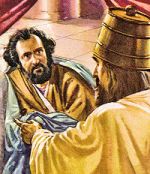
Various apocryphal documents, and a number of important Roman paintings, tell the legend of Sylvester healing Constantine of leprosy, baptizing the emperor, and receiving special rights of secular power from him. In fact, Constantine was only baptized at the very end of his life by Eusebius of Nicomedia, a bishop with Arian beliefs. While the so-called Donation of Constantine, granting the pope secular authority over Rome and the Western Empire, was used as key evidence for the medieval papacy’s claim to political power, it has long been known to be a forgery made centuries after the time of Constantine.
However, Constantine did indeed give great gifts to the Church during St. Sylvester’s pontificate, including the building of many of Rome’s great churches—the original St. Peter’s Basilica, St. John Lateran, Santa Croce in Gerusalemme, and others.

Sylvester’s reign also, of course, coincided with the Council of Nicaea, which was held to address the Arian crisis. Arius, a Libyan priest in Alexandria, denied the divinity of Jesus, saying instead that the Son was a sort of lesser god created by the Father. His slogan about the Son was “There was a time when he was not.” The public controversy over Arianism began in 318 as a dispute in the Alexandrian church, but the debate quickly spread throughout the Empire, and Arianism soon had many adherents. So in 325, Emperor Constantine called for a council to be held in Nicaea, in modern-day Turkey. It was the first ecumenical or general council, meaning that it included bishops from around the whole world.
At this point, it is worth saying a word about the relationship between the emperors and the great Councils. The fact is that only the emperor could afford to pay for a general council (travel expenses, etc.). Thus he was recognized as the one who had, practically speaking, the right to call a general council, even as he was also known not to have a right to make rulings on behalf of the Church. Papal ratification was required in order to render an ecumenical council’s ruling definitive, not only because of the inherent divinely ordained structure of the Church, but also in order to ensure that the emperor would not derail a council by throwing his weight behind an erroneous ruling.

Due to his old age, Pope St. Sylvester did not attend Nicaea personally, but he was involved in negotiations related to the Council, and sent multiple legates to it. The bishop who presided over the Council, Hosius of Cordova, may himself have been acting as Sylvester’s legate. The Byzantine liturgy, as Fr. Aidan Nichols notes, commemorates St. Sylvester as having taken part in the Council in a moral sense: “Father Sylvester…thou didst appear as a pillar of fire, snatching the faithful from the Egyptian error and continually leading them with unerring teaching to the divine light.”
St. Sylvester is also said to have founded the first Roman sacred singing school (schola cantorum).
34—St. Mark (336)
The first Roman martyrology (a catalogue of martyrs arranged in the order of their anniversaries) may have been compiled under Pope St. Mark, or his predecessor St. Sylvester. St. Mark likely founded the Roman basilica that bears his name. He may also have established the custom at that time by which the bishop of Ostia was the one who consecrated the newly elected pope as a bishop. Keep in mind that the early popes were typically chosen from priests or deacons of the Roman church, rather than having been bishops prior to their election—so they needed to be ordained and consecrated before their reign could begin.
(Indeed, for much of the Church’s history, bishops in general were selected from and by the people of the local diocese. The councils of Nicaea and Chalcedon even forbade the transferring of bishops from one diocese to another. Today’s ambitious see-hopping is arguably an unfortunate custom.)

35—St. Julius I (337-52)
Pope St. Julius is known for his handling of the Arian crisis. After an interregnum of four months, he was elected Bishop of Rome in 337, which was also the year of Constantine’s death. That same year, St. Athanasius, the great champion of the orthodox faith against the Arian heresy, returned to his patriarchal See at Alexandria. He had been exiled by Constantine—the first of five times he would be exiled—because of political slanders made against him by the Arians. On his return to Alexandria, the Arians attempted to set up their own bishop against him. Both parties appealed to Rome, and preparations were made for a great synod to settle the dispute.
Meanwhile, Eusebius of Nicomedia, the bishop who had baptized Constantine and deposed St. Athanasius, was now Patriarch of Constantinople and an open Arian. He had held an illegitimate council at Antioch with the Arian bishops, who elected one of their party as bishop of Alexandria, while Constantine’s son Constantius II exiled Athanasius once again. St. Athanasius and other exiled orthodox bishops made their way to Rome, while the Arian bishops under Eusebius refused to attend Pope Julius’s synod. (The historian Fr. Louis Duchesne held that the Nicomedian faction represented the beginnings of the Eastern schism from Rome.)
At the Synod of Rome in 340 or 341, St. Athanasius and another bishop, Marcellus of Ancyra, were cleared of charges against them and acknowledged as the rightful bishops of their dioceses. The Catholic Encyclopedia relates:
Pope Julius communicated this decision in a very notable and able letter to the bishops of the Eusebian party. In this letter he justifies his proceedings in the case, defends in detail his action in reinstating Athanasius, and animadverts strongly on the non-appearance of the Eastern bishops at the council, the convening of which they themselves had suggested. Even if Athanasius and his companions were somewhat to blame, the letter runs, the Alexandrian Church should first have written to the pope.
This whole letter from Pope St. Julius may be read in Chapter 2 of St. Athanasius’s Against the Arians, but the passage just mentioned is worth quoting in full:
Are you ignorant that the custom has been for word to be written first to us, and then for a just decision to be passed from this place? If then any such suspicion rested upon the Bishop there, notice thereof ought to have been sent to the Church of this place; whereas, after neglecting to inform us, and proceeding on their own authority as they pleased, now they desire to obtain our concurrence in their decisions, though we never condemned him. Not so have the constitutions of Paul, not so have the traditions of the Fathers directed; this is another form of procedure, a novel practice. I beseech you, readily bear with me: what I write is for the common good. For what we have received from the blessed Apostle Peter, that I signify to you; and I should not have written this, as deeming that these things were manifest unto all men, had not these proceedings so disturbed us.
Thus Pope St. Julius asserts the pre-eminence of Rome as something well-known throughout the Christian world.

The Western emperor, Constans, and his brother Constantius who ruled over the East, agreed to convene a general council at Sardica in 342 or 343. This included Western and Eastern bishops and papal representatives, but the Eastern Arian bishops once again declined to attend.
One of Sardica’s canons was as follows:
But if judgment have gone against a bishop in any cause, and he think that he has a good case, in order that the question may be reopened, let us, if it be your pleasure, honour the memory of St. Peter the Apostle, and let those who tried the case write to Julius, the bishop of Rome, and if he shall judge that the case should be retried, let that be done…
That is, the pope could override the decision of any local ecclesiastical court in the worldwide Church.
When St. Athanasius was finally able to return to his see in 346, after the death of the illegitimately established Arian bishop, St. Julius wrote a congratulatory letter to the Church at Alexandria. Julius also had the joy of receiving the repentance of two Arian bishops who had been deposed by the Council of Sardica, and restoring them to their sees.
As for his governance in Rome itself, Pope Julius built two basilicas in the city, which are now Santa Maria in Trastevere and Santi Dodici Apostoli. He built three churches over old Christian cemeteries outside the city walls, including a basilica at the tomb of St. Valentine, the ruins of which still exist.

Thomas V. Mirus is President of Trinity Communications and Editor-in-Chief for CatholicCulture.org, hosts both the Catholic Culture Podcast and Lives of the Popes, and co-hosts Criteria: The Catholic Film Podcast. See full bio.
All comments are moderated. To lighten our editing burden, only current donors are allowed to Sound Off. If you are a current donor, log in to see the comment form; otherwise please support our work, and Sound Off!