The First Non-Sainted Pope
By Thomas V. Mirus ( bio - articles - email ) | Jun 08, 2026 | In Lives of the Popes
36—Liberius (352-66)
This is the first installment of the series to be devoted to just one pope—for there is much to say about Liberius, who remains a contentious figure today. He is not only the first pope in history not to be considered a saint in the Catholic Church, but is also often used by anti-Catholic critics to argue against papal infallibility.
Since the controversy around Pope Liberius has to do with his allegedly having signed documents in favor of Arianism under duress from the emperor, it is worth establishing his anti-Arian bona fides.
During Liberius’s reign, the Arian heresy continued to be a source of great turmoil in the Church, especially in the East. As ever, St. Athanasius was a chief bulwark against this heresy, and so the enemies of Christ threatened him with exile yet again. Pope Liberius sent to the Emperor Constantius II, then in Gaul, asking him to hold a council to deal justly with the affairs of Athanasius.
Unfortunately, Constantius, now emperor of both East and West, had a plan to impose a form of semi-Arianism on the Church for the sake of imperial unity. When Liberius’s envoys arrived in Arles, Constantius was pressuring the bishops of Gaul to condemn Athanasius, and he even successfully convinced the pope’s own legates to condemn the saint. Liberius responded to this with grief, saying that he wished to die rather than be thought to have concurred with such an unjust and heretical condemnation.

Around this time, a group of Eastern bishops had written a letter to Rome against Athanasius, while a larger group of Egyptian bishops wrote a letter supporting him. I will quote a secondary source more liberally than usual in this installment, since the Catholic Encyclopedia’s article on Liberius by Dom John Chapman, O.S.B. sums up events so well:
Constantius publicly accused the pope of preventing peace and of suppressing the letter of the Easterns against Athanasius. Liberius replied with a dignified and touching letter, in which he declares that he read the letter of the Easterns to a council at Rome…but, as the letter which arrived from Egypt was signed by a greater number of bishops, it was impossible to condemn Athanasius; he himself had never wished to be pope, but he had followed his predecessors in all things; he could not make peace with the Easterns, for some of them refused to condemn Arius, and they were in communion with [the false bishop] George of Alexandria, who accepted the Arian priests whom Alexander had long ago excommunicated.
The pope asked St. Eusebius of Vercelli to help influence the emperor, now at Milan. A council was convened there in 355, in which St. Eusebius wanted all present to sign the Nicene formula of faith. Constantius’s court bishops refused, the emperor’s soldiers arrived, Constantius demanded that the bishops condemn Athanasius, St. Eusebius and others were exiled (as were the members of a subsequent envoy from Liberius), and an Arian was made bishop of Milan. The pope wrote to the exiled bishops, calling them martyrs even while still alive, and asking them to pray that he too might suffer alongside them.
What followed is yet more confirmation of the primacy of Rome, as Dom Chapman recounts:
Constantius was not satisfied by the renewed condemnation of Athanasius by the Italian bishops who had lapsed at Milan under pressure. He knew that the pope was the only ecclesiastical superior of the Bishop of Alexandria, and he ‘strove with burning desire’, says the pagan Ammianus, ‘that the sentence should be confirmed by the higher authority of the bishop of the eternal city’. St. Athanasius assures us that from the beginning the Arians did not spare Liberius, for they calculated that, if they could but persuade him, they would soon get hold of all the rest. Constantius sent to Rome his prefect of the bed-chamber, the eunuch Eusebius, a very powerful personage, with a letter and gifts. ‘Obey the emperor and take this’ was in fact his message, says St. Athanasius, who proceeds to give the pope’s reply at length: He could not decide against Athanasius, who had been acquitted by two general synods, and had been dismissed in peace by the Roman Church, nor could he condemn the absent; such was not the tradition he had received from his predecessors and from St. Peter; if the emperor desired peace, he must annul what he had decreed against Athanasius and have a council celebrated without emperor or counts or judges present, so that the Nicene Faith might be preserved; the followers of Arius must be cast out and their heresy anathematized; the unorthodox must not sit in a synod; the Faith must first be settled, and then only could other matters be treated. …
The eunuch was enraged, and went off with his bribes, which he laid before the confession of St. Peter [that is, the confessio, the sacred space in St. Peter’s Basilica which marks the place of the Apostle’s tomb underneath]. Liberius severely rebuked the guardians of the holy place for not having prevented this unheard-of sacrilege. He cast the gifts away, which angered the eunuch yet more, so that he wrote to the emperor that it was no longer a question of simply getting Liberius to condemn Athanasius, for he went so far as formally to anathematize the Arians. Constantius was persuaded by his eunuchs to send Palatine officers, notaries, and counts, with letters to the Prefect of Rome, Leontius, ordering that Liberius should be seized either secretly or by violence, and despatched to the court.
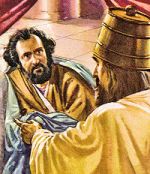
In the midst of an ensuing imperial persecution in Rome, Pope Liberius was arrested and taken to the emperor at Milan. He defied Constantius openly, offering to go into exile rather than consent to any false dealing against Athanasius and the orthodox faith. Theodoret of Cyrus, born about forty years after these events, preserved in his Ecclesiastical History (Book II, Chapter 13) a record of the debate between pope and emperor, which he says was written down at the time it occurred. I give an abridged version here:
Constantius .—We have judged it right, as you are a Christian and the bishop of our city, to send for you in order to admonish you to abjure all connection with the folly of the impious Athanasius. For when he was separated from the communion of the Church by the synod the whole world approved of the decision.
Liberius .—O Emperor, ecclesiastical sentences ought to be enacted with strictest justice: therefore, if it be pleasing to your piety, order the court to be assembled, and if it be seen that Athanasius deserves condemnation, then let sentence be passed upon him according to ecclesiastical forms. For it is not possible for us to condemn a man unheard and untried.
Constantius .—The whole world has condemned his impiety; but he, as he has done from the first, laughs at the danger.
Liberius .—Those who signed the condemnation were not eye-witnesses of anything that occurred; but were actuated by the desire of glory, and by the fear of disgrace at your hands.
The Emperor .—What do you mean by glory and fear and disgrace?
Liberius .—Those who love not the glory of God, but who attach greater value to your gifts, have condemned a man whom they have neither seen nor judged; this is very contrary to the principles of Christians.
The Emperor .—Athanasius was tried in person at the council of Tyre, and all the bishops of the world at that synod condemned him.
Liberius .—No judgment has ever been passed on him in his presence. Those who there assembled condemned him after he had retired.
…
Epictetus the Bishop .—O Emperor, it is not on behalf of the faith, nor in defense of ecclesiastical judgments that Liberius is pleading; but merely in order that he may boast before the Roman senators of having conquered the emperor in argument.
The Emperor (addressing Liberius).—What portion do you constitute of the universe, that you alone by yourself take part with an impious man, and are destroying the peace of the empire and of the whole world?
Liberius .—My standing alone does not make the truth a whit the weaker. According to the ancient story, there are found but three men resisting a decree. [He was alluding to the Three Holy Youths, Hananiah, Mishael, and Azariah, in the Book of Daniel.]
Eusebius the Eunuch .—You make our emperor a Nebuchadnezzar.
Liberius .—By no means. But you rashly condemn a man without any trial. [He asks that a new assembly of orthodox bishops be convened to judge Athanasius’s case. The Emperor expresses personal enmity towards St. Athanasius.]
…
Liberius .—Do not vindicate your own hatred and revenge, O Emperor, by the instrumentality of bishops; for their hands ought only to be raised for purposes of blessing and of sanctification. If it be consonant with your will, command the bishops to return to their own residences; and if it appear that they are of one mind with him who today maintains the true doctrines of the confession of faith signed at Nicaea, then let them come together and see to the peace of the world, in order that an innocent man may not serve as a mark for reproach.
The Emperor .—One question only requires to be made. I wish you to enter into communion with the churches, and to send you back to Rome. Consent therefore to peace, and sign your assent, and then you shall return to Rome.
Liberius .—I have already taken leave of the brethren who are in that city. The decrees of the Church are of greater importance than a residence in Rome.
The Emperor .—You have three days to consider whether you will sign the document and return to Rome; if not, you must choose the place of your banishment.
Liberius .—Neither three days nor three months can change my sentiments. Send me wherever you please.
[Theodoret writes:] After the lapse of two days the emperor sent for Liberius, and finding his opinions unchanged, he commanded him to be banished to Beroea, a city of Thrace. Upon the departure of Liberius, the emperor sent him five hundred pieces of gold to defray his expenses. Liberius said to the messenger who brought them, Go, and give them back to the emperor; he has need of them to pay his troops. The empress also sent him a sum of the same amount; he said, Take it to the emperor, for he may want it to pay his troops; but if not, let it be given to Auxentius and Epictetus, for they stand in need of it. Eusebius the eunuch brought him other sums of money, and he thus addressed him: You have turned all the churches of the world into a desert, and do you bring alms to me, as to a criminal? Begone, and become first a Christian. He was sent into exile three days afterwards, without having accepted anything that was offered him.
After Liberius’s exile, the archdeacon Felix was consecrated as antipope by an Arian bishop. In 357 Constantius visited the city of Rome for the first time, and could see that Felix was not being generally accepted as pope. Noble Roman ladies approached the emperor without fear to ask him to restore Liberius. By the end of the year, Constantius allowed Liberius to return to Rome.
There are several differing accounts of what motivated Constantius’s change of mind. It may just have been because Felix was rejected by the Roman people; some sources say the antipope was actually driven out of the city by a popular uprising.
But a variety of ancient sources, both Arian and non-Arian, claim that Liberius was restored simply because under threat of death, he had finally signed Arian documents. St. Jerome said that the pope had succumbed to boredom in exile, and St. Athanasius attested that Liberius condemned him after two years of pressure (though perhaps Athanasius had only heard rumor of this). The historian Sozomen, on the other hand, said that Liberius signed a moderate semi-Arian formula that was capable of an orthodox reading. The record of St. Hilary’s position on the matter is too complicated to go into here, but it involves some letters indicting Liberius which are now known to be forgeries.
According to Theodoret, Constantius wrote to the Roman Church proposing the compromise that Felix and Liberius could be bishops together, and when this letter was read in the circus, the Romans booed it and shouted, “One God, one Christ, one bishop”. But it is possible that for several years Rome was divided between two bishops, with the returned Liberius ruling from the Lateran Palace, and Felix, rejected by the people and much of the clergy, residing in the suburbs.
Yet, as Dom Chapman argues, the triumphant tenor of Liberius’s return to Rome indicates that if he had fallen, his own flock must have been unaware. Nor did he himself ever admit to such a lapse. Liberius continued to express opposition to Arianism in multiple decisions later in his papacy (at least after the death of Constantius in 361). Some saints, such as Pope St. Anastasius I and St. Ambrose, remembered him as a holy and courageous man. Dom Chapman:
But the strongest arguments for the innocence of Liberius are a priori. Had he really given in to the emperor during his exile, the emperor would have published his victory far and wide; there would have been no possible doubt about it…. But if he was released because the Romans demanded him back, because his deposition had been too uncanonical, because his resistance was too heroic, and because Felix was not generally recognized as pope, then we might be sure he would be suspected of having given some pledge to the emperor; the Arians and the Felicians [followers of antipope Felix] alike, and soon the Luciferians [rigorist schismatics led by Lucifer of Cagliari], would have no difficulty in spreading a report of his fall and in winning credence for it. It is hard to see how Hilary in banishment and Athanasius in hiding could disbelieve such a story, when they heard that Liberius had returned, though the other exiled bishops were still unrelieved.
…
It should be carefully noted that the question of the fall of Liberius is one that has been and can be freely debated among Catholics. No one pretends that, if Liberius signed the most Arian formulae in exile, he did it freely; so that no question of his infallibility is involved. It is admitted on all sides that his noble attitude of resistance before his exile and during his exile was not belied by any act of his after his return, that he was in no way sullied when so many failed at the Council of Rimini [359, in which many bishops signed an Arian formula which Pope Liberius then rejected], and that he acted vigorously for the healing of orthodoxy throughout the West from the grievous wound. If he really consorted with heretics, condemned Athanasius, or even denied the Son of God, it was a momentary human weakness which no more compromises the papacy than does that of St. Peter.
Ironically, though Eastern Orthodox apologists use Liberius as an argument against papal infallibility, it is they, and not Roman Catholics, who venerate him as a saint!
St. Athanasius, despite believing that Liberius had condemned him, always wrote of the pope charitably. I will conclude by quoting from the History of the Arians written by that great defender of orthodoxy:
Yet even this only shows their violent conduct, and the hatred of Liberius against the heresy, and his support of Athanasius, so long as he was suffered to exercise a free choice. For that which men are forced by torture to do contrary to their first judgment ought not to be considered the willing deed of those who are in fear, but rather of their tormentors.

Thomas V. Mirus is President of Trinity Communications and Editor-in-Chief for CatholicCulture.org, hosts both the Catholic Culture Podcast and Lives of the Popes, and co-hosts Criteria: The Catholic Film Podcast. See full bio.
All comments are moderated. To lighten our editing burden, only current donors are allowed to Sound Off. If you are a current donor, log in to see the comment form; otherwise please support our work, and Sound Off!