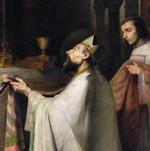
Pope St. Damasus, Patron of the Latin Bible
By Thomas V. Mirus ( bio - articles - email ) | Jun 23, 2026 | In Lives of the Popes
37—St. Damasus I (366-384)
St. Damasus I is best known as the pope who commissioned St. Jerome to make a new translation of the Bible—but that does not exhaust his importance.
He was born at Rome to Spanish parents around 305. His father, Antonius, may have been a priest at the basilica of St. Lawrence outside the walls, where Damasus began as a deacon. More was discovered about Damasus’s mother when his family tomb was discovered in the Catacomb of Callixtus, including an epitaph which revealed her name, Laurentia, and that she had served God as a pious widow for sixty years after her husband’s death, living until the age of eighty-nine.

It is said that as a deacon under Pope Liberius, St. Damasus accompanied him into exile, but then returned to Rome and served under the antipope Felix until Liberius’s return. After the death of Liberius in 366, Damasus was elected bishop of Rome; he was around sixty years old. The election, though not close to a tie, was highly contentious, as some supporters of the late Pope Liberius set up the deacon Ursinus as antipope, resorting to factional bloodshed until Emperor Valentinian recognized Damasus’s legitimacy and banished Ursinus to Cologne. The antipope would later set up in Milan, continuing to slander Damasus, including with an accusation of adultery, from which charge the pope was exonerated by Emperor Gratian and a synod of bishops.
Champion of the Church and the papacy
St. Damasus was a great defender against heresy throughout his pontificate. He condemned Apollinarianism (which denied that Christ had a human intellect and will) and Macedonianism (which denied that the Holy Spirit is God), both in person at Roman synods and via his legates at the Council of Constantinople in 381.
Pope St. Damasus contributed to the increasing predominance of the Catholic Faith throughout the Empire by appealing, along with the Christian part of the Roman Senate, for Emperor Gratian to remove the altar to the pagan deity Victory from the Senate house. Gratian acceded to this request against the protests of the pagan senators, and favored the Christian faith in other acts of legislation. In 380, towards the end of Damasus’s reign, Emperor Theodosius the Great made Christianity the official religion of the Roman state.
Damasus did much to promote the prestige and practical authority of the papacy. He asserted that the primacy of the Apostolic See (as he consistently called the bishopric of Rome) was not a matter of human custom but established by Christ Himself. At the Council of Rome, St. Damasus said:
Though all the catholic churches diffused throughout the world are but one bridal chamber of Christ, yet the holy Roman church has been set before the rest by no conciliar decrees, but has obtained the primacy by the voice of our Lord and Saviour in the gospel: “Thou art Peter, and upon this rock I shall build my Church; and the gates of hell shall not prevail against it. And I will give unto thee the keys of the kingdom of heaven, and whatsoever thou shalt bind on earth shall be bound in heaven, and whatsoever thou shalt loose on earth shall be loosed in heaven.”... The first see of the apostle Peter is therefore the Roman church, “not having spot or wrinkle or any such thing.”
On the rhetorical level, it was under Damasus that the popes began using the royal “we” and referring to other bishops as their “sons” rather than “brothers”.
When the Roman province of Illyricum ceased to be part of the Western Empire, Pope Damasus ensured the continuing jurisdiction of the Patriarch of the West (that is, himself) by appointing a vicar apostolic, a bishop charged to watch over this region on behalf of Rome.
St. Damasus, as bishop of Rome, was made the reference point for Catholic orthodoxy in statements by multiple emperors. Gratian’s criterion for judging the legitimacy of bishops was whether they agreed with Pope St. Damasus, while Theodosius I referred to the true religion as “that religion which the divine Peter the Apostle transmitted to the Romans”, “the religion that is followed by the Pontiff Damasus and by Peter, bishop of Alexandria”.

In addition to asserting its spiritual prerogatives, St. Damasus increased the material splendor of the papacy. He was close to the Roman aristocracy, and his “touch of class” rendered the pagan upper classes more sympathetic to Christianity. But the lavish resources of the Roman Church at this time also had the liability of tempting the Roman clergy to become more worldly. To the pope’s credit, when Emperor Valentinian sent him an edict forbidding clerics and monks from seeking gifts and inheritances from wealthy widows and orphans, Damasus enforced it strictly.
There exist ancient gold glass cups from this time bearing an image of Pope St. Damasus, though unfortunately I could not find a photograph online.
St. Jerome and the Bible
But of course, the most important thing about St. Damasus has to do with the Bible. Before we get to the question of translation, there is the question: What does the Bible contain in the first place? At the Council of Rome in 382, a decree was produced which later became part of the so-called “Gelasian Decree” (named after the later Pope St. Gelasius), but which many scholars now hold to be part of the authentic “Decree of Damasus” from the 382 synod. The first part deals with the seven gifts of the Holy Spirit, but the second part is a complete list of the books of the Old and New Testaments, identical with the list given at the Council of Trent over a millennium later.
Assisting at this synod was none other than St. Jerome. A few years earlier, Pope Damasus had written to Jerome, then living in the desert near Antioch, urging him to make a new Latin translation of the Gospels. We have Jerome’s letter in reply, in which he agrees to take on the task while expressing apprehension about the criticism he will receive for introducing a translation different from what people are used to:
Is there indeed any learned or unlearned man, who when he picks up the volume in his hand, and takes a single taste of it, and sees what he will have read to differ, might not instantly raise his voice, calling me a forger, proclaiming me now to be a sacrilegious man, that I might dare to add, to change, or to correct anything in the old books? Against such infamy I am consoled by two causes: that it is you, who are the highest priest, who so orders, and truth is not to be what might vary, as even now I am vindicated by the witness of slanderers. If indeed faith is administered by the Latin version, they might respond by which, for they are nearly as many as the books!
So in 382, Damasus summoned Jerome to Rome, where he not only assisted at the Council, but became the pope’s secretary and friend, closely collaborating with him until Damasus’s death in 384. Jerome would later refer to this period: “A great many years ago when I was helping Damasus bishop of Rome with his ecclesiastical correspondence, and writing his answers to the questions referred to him by the councils of the east and west...”
At this time, Pope Damasus commissioned Jerome to correct not only the old Latin translation of the Gospels, but to produce an entire new Latin Bible. This would, of course, be the Vulgate, eventually the standard Bible of the Roman Catholic Church for many centuries.

Unfortunately, after the death of his papal patron, St. Jerome was soon forced to leave Rome. His reputation as an outstanding man of the Church was envied by some, and his strong criticisms of the vanity, luxury, and immorality of the Roman clergy had made him many enemies, who stooped so low as to accuse him of illicit relationships with the ladies to whom he provided tutoring and spiritual direction. So St. Jerome left Rome, and took up his final residence in Bethlehem, where over the next two decades he completed his work on the Vulgate.
(As a tangent, it is rather unfair that St. Jerome has gained the reputation of having a terrible temper, given the kind of attacks against the Church or personal slanders he was often responding to in his letters. I have written elsewhere against the popular narrative about St. Jerome’s alleged “anger problem”.)
As a last note about the friendship between these two saints, I quote a letter from St. Jerome to St. Damasus, written before Jerome came to Rome, which illustrates his high view of the papacy:
Yet, though your greatness terrifies me, your kindness attracts me. From the priest I demand the safe-keeping of the victim, from the shepherd the protection due to the sheep. Away with all that is overweening; let the state of Roman majesty withdraw. My words are spoken to the successor of the fisherman, to the disciple of the cross. As I follow no leader save Christ, so I communicate with none but your blessedness, that is with the chair of Peter. For this, I know, is the rock on which the church is built! This is the house where alone the paschal lamb can be rightly eaten. This is the ark of Noah, and he who is not found in it shall perish when the flood prevails. But since by reason of my sins I have betaken myself to this desert which lies between Syria and the uncivilized waste, I cannot, owing to the great distance between us, always ask of your sanctity the holy thing of the Lord. Consequently I here follow the Egyptian confessors who share your faith, and anchor my frail craft under the shadow of their great argosies. I know nothing of Vitalis; I reject Meletius; I have nothing to do with Paulinus. He that gathers not with you scatters; he that is not of Christ is of Antichrist.
In this same letter St. Jerome suggests that Pope Damasus could, if he wished, unilaterally “Order a new creed to supersede the Nicene.”
Devotion to the martyrs
St. Damasus had another literary legacy besides commissioning the Vulgate—this one his own accomplishment. His great devotion to the Roman martyrs led him to write many epitaphs for their tombs in the catacombs (especially in the cemetery of Callixtus), some of which I have quoted in this series. Jerome says that Damasus “had a fine talent for making verses and published many brief works in heroic meter.”

Finally, this pope’s special devotion to St. Lawrence is illuminated by his connection to three of that saint’s Roman churches—the aforementioned San Lorenzo fuori le mura in which he began his career, San Lorenzo in Lucina in which he was elected pope, and San Lorenzo in Damaso which he is said to have built in his own house.

Thomas V. Mirus is President of Trinity Communications and Editor-in-Chief for CatholicCulture.org, hosts both the Catholic Culture Podcast and Lives of the Popes, and co-hosts Criteria: The Catholic Film Podcast. See full bio.
All comments are moderated. To lighten our editing burden, only current donors are allowed to Sound Off. If you are a current donor, log in to see the comment form; otherwise please support our work, and Sound Off!