Easter: May 9th
Saturday of the Fifth Week of Easter
Other Commemorations: St. Pachomius, Abbot (RM)
MASS READINGS
May 09, 2026 (Readings on USCCB website)
PROPERS [Show]
COLLECT PRAYER
Saturday of the Fifth Week of Easter: Almighty and eternal God, who through the regenerating power of Baptism have been pleased to confer on us heavenly life, grant, we pray, that those you render capable of immortality by justifying them may by your guidance attain the fullness of glory. Through our Lord Jesus Christ, your Son, who lives and reigns with you in the unity of the Holy Spirit, God, for ever and ever.
Recipes (2)
Activities (5)
Prayers (6)
Library (3)
Blog & Podcasts (0)
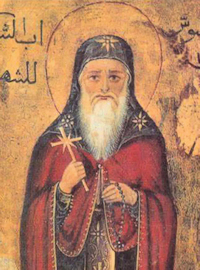
The Roman Martyrology commemorates St. Pachomius of Tabenna (290-346), founder of the cenobitical life, born near Esneh, Egypt; died at Phebôou around the year 346. After spending some time with the hermit Palemon, he withdrew to Tabennisi where he introduced community life among the hermits who gathered around him. Before he died he had established nine monasteries for men and two for women. His order continued until the 11th century. Represented in hermit's garb, or crossing the Nile on the back of a crocodile.
Meditation for Saturday of the Fifth Week of Easter:
Christ, our Head and the First-Fruits of our Resurrection
Christ is our Head; we form with Him a Mystical Body. If Christ is risen—and He is risen in His human nature—it is necessary that we, His members, should share in the same glory. For it is not only in our soul, it is likewise in our body, it is in our whole being that we are members of Christ. The most intimate union binds us to Jesus.
If then He is risen glorious, the faithful who, by grace, make part of His Mystical Body, will be united with Him even in His Resurrection.
Hear what St. Paul says on this subject: "Christ is risen from the dead, the first-fruits of them that sleep." He represents the first-fruits of a harvest; after Him, the rest of the harvest is to follow. "By a man came death, and by a Man the resurrection of the dead. And as in Adam all die, so also in Christ all shall be made alive."
God, he says still more energetically, hath raised us up in His Son. How can that be? By faith and grace.
—Dom Marmion, Christ in His Mysteries, p. 299
St. Pachomius
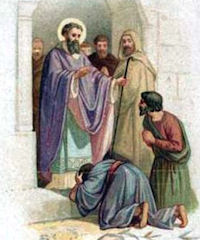 St. Pachomius can justifiably be called the founder of cenobitic monasticism (monks who live in community). Even though St. Antony the Great was the first to go into the desert to live a life of seclusion pursuing evangelical perfection, he lived an eremitic life, that is, a primarily solitary life.
Pachomius first started out as a hermit in the desert like many of the other men and women / in the third and fourth centuries who sought the most radical expression of Christian life and he developed a very strong bond of friendship with the hermit Palemon. One day he had a vision during prayer in which he was called to build a monastery, and was told in the vision that many people who are eager to live an ascetic life in the desert, but are not inclined to the solitude of the hermit, will come and join him. His hermit friend Palemon helped him to build the monastery and Pachomius insisted that his cenobites were to aspire to the austerity of the hermits.
However, he knew that his idea was a radical one, in that most of the men who came to live in his monastery had only ever conceived of the eremitic lifestyle; his great accomplishment was to reconcile this desire for austere perfection with an openness to fulfilling the mundane requirements of community life as an expression of Christian love and service. He spent most of his first years as a cenobitic doing all the menial work on his own, knowing that his brother monks needed to be gently inducted into serving their brothers in the same manner. He therefore allowed them to devote all their time to spiritual exercises in those first years. At his death, there were eleven Pachomian monasteries, nine for men and two for women.
The rule that Pachomius drew up was said to have been dictated to him by an angel, and it is this rule that both St. Benedict in the west and St. Basil in the east drew upon to develop their better known rules of cenobitic life.
— Catholic News Agency
Highlights and Things to Do:
- Read more about St. Pachomius:
- St. Pachomius is considered to be the father of cenobitic monasticism. What does cenobitic even mean? The first type monastic living was the life of a hermit, living solitarily, called eremitic. Cenobitic monasticism emphasizes community life. In Western monasticism the cenobitic monks join in a community of a religious order, regulated by a religious rule, a collection of precepts. St. Augustine and St. Benedict followed the example set by Pachomius for their religious orders.