Lent: March 13th
Friday of the Third Week of Lent
Other Commemorations: St. Roderick, Martyr (RM); St. Leander of Seville, Bishop (RM);
MASS READINGS
March 13, 2026 (Readings on USCCB website)
PROPERS [Show]
COLLECT PRAYER
Friday of the Third Week of Lent: Pour your grace into our hearts, we pray, O Lord, that we may be constantly drawn away from unruly desires and obey by your own gift the heavenly teaching you give us. Through our Lord Jesus Christ, your Son, who lives and reigns with you in the unity of the Holy Spirit, God, for ever and ever.
Recipes (1)
Activities (3)
Prayers (14)
Library (1)
Blog & Podcasts (0)
Good Friday is three weeks away. The conflict between Jesus and the religious leaders of his time continues to intensify as the Third Week of Lent draws to an end. In today’s gospel reading, one of the Temple scribes gives Jesus an orthodoxy check, asking him to name the greatest of the Commandments. The answer given (love of God and love of neighbor) suffices to end that line of theological attack on the unexpected Galilean preacher and miracle-worker: “And after that, no one dared to ask him any questions.” But the conflict will grow sharper in the weeks ahead. —George Weigel, Roman Pilgrimage: The Station Churches
The Roman Martyrology commemorates St. Roderick of Cordoba (d. 857), a priest and martyr who lived in Moorish Spain and beheaded in the 9th century. He was beheaded in 857.
St. Leander of Seville (534-600) is also commemorated today. He was bishop of Seville, preceding his brother St. Isidore of Seville. He fought against Arianism, presiding over the Council of Toledo and introduced the Nicene Creed to the Mass.
Meditation for Friday of the Third Week of Lent—Precious to God
If we attend to the passion of Christ we hear a voice insisting 'Someone died for you.' And of that someone dying it can with all truth be said that God is there, bearing the burden of our wrongdoing, the burden of our pain, loneliness and death. God is there loving us totally, holding back nothing. And because He died for us and lived for us, our lives in all their trivialities, their joys and burdens, have meaning in Him. They hold Him within them, through them we can surrender to Him.
How precious we must be to God! How momentous our life span! Yet we value ourselves so lightly, waste the precious content of our being, never reach fulfillment. We do not really live but allow life to pass us by.
God wants us to seize hold of life, hoard its unique opportunities for growth, grasps its chances to express our love and gratitude to Him who loved us first.
Every moment of our life can be filled with eternity, because at every moment, in every event and circumstance we can say or 'Yes' to God who wills us to live to capacity, wills us to act as full persons.
How many of us act from our inmost centre according to principles, not merely following the crowd, the line of least resistance, seeking immediate satisfactions and appreciation? Meanwhile the days and years pass by and we remain essentially undeveloped.
Yet Someone died for us that we might live with abundant life.
—Ruth Burrows, Through Him, With Him, In Him
Friday of the Third Week of Lent
Station with San Lorenzo in Lucina (St. Lawrence in Lucina):
The original church dedicated to the popular deacon martyr St. Lawrence was erected in the 4th century on the ruins of a house belonging to the Roman lady Lucina. Near the church was a well which was very dear to the Romans and which probably suggested the Epistle and Gospel of today's Mass. The church also contains a part of the gridiron on which St. Laurence was burned. The Introit and Gradual from the previous Missal (1962) refer to the prayers of the Saint while he was being tortured.
For more on San Lorenzo in Lucina, see:
- Churches of Rome
- The Station Churches in Rome
- Rome Art Lover
- Roman Churches
- PNAC
- Aleteia
- Station Church
- The Catholic Traveler
- Walks in Rome
- Roman Despatches
For further information on the Station Churches, see The Stational Church.
St. Roderick of Cordoba
 Jesus warned his disciples that they should expect no better treatment than Himself. They would be hauled before governors and kings on His account, and brothers would even hand brothers over for execution.
That prophecy was literally fulfilled in the case of St. Roderick, a Spanish martyr who died at the hands of the Muslim Moors in A.D. 857. His was a bitter case of the reverse of Christian love. We owe the account to eyewitness St. Elogius, who later on died for the faith himself.
It must be admitted that when the Mohammedans invaded Spain in A.D. 711, even they were sometimes shocked by the lack of religious principles among a large number of the Hispanic Christians. As the Moors swarmed in, the Catholics, far from presenting a strong front, became divided. Many, whether out of fear or lack of faith, voluntarily gave up their Christianity. Families thus split asunder and the members on either side railed at each other.
St. Roderick was to prove a sad victim of this sort of betrayal. He was a good priest of Cabra who had two irresponsible brothers. One of them was a bad Christian who had all but abandoned his faith. The other had gone still further and joined Islam. One night the two started to fight each other unmercifully. Roderick tried to break them up, but instead of yielding, they turned on him and beat him senseless. Then the Muslim brother had the priest put on a litter and carried half-conscious through the streets. The Muslim accompanied the bier, proclaiming that Father Roderick, too, had apostatized, and that he wanted it known publicly before he died. Eventually the victim did recover and went off to a safe place.
But Father Roderick had not yet seen the last of his renegade brother. The Muslim met the priest soon afterwards in the streets of Cordova. He had Roderick taken at once before the Mohammedan Kadi (judge), where he accused him of the crime of having returned to Christianity after public profession of his Muslimism.
Although Father Roderick protested that he had never denied his Christian faith, the kadi clapped him into the city's worst dungeon.
In that fetid jail, the priest at least had the comfort of finding one Solomon, another Christian prisoner who had been accused of the same "unforgiveable" crime. Both of them were given a long term of imprisonment, in the hope that they would convert. But each man encouraged the other, and they remained firm in their Christian convictions. Even when separated, they would not change their belief.
Eventually, the Kadi ordered the Catholic priest and the layman beheaded. St. Eulogius saw their headless bodies lying on the riverside. He noticed that the guards were careful to throw into the stream any stones stained with the men's blood, for fear the faithful might pick them up as relics.
The soldiers sought in vain to ward off veneration of SS. Roderick and Solomon. Spanish Christians would always honor them thereafter as martyrs. And they would also gradually learn from this heroism that the Faith is something really worth dying for.
—Father Robert F. McNamara, Excerpted from St. Kateri Tekakwitha Parish
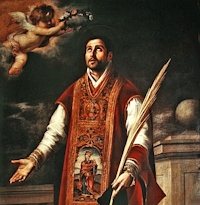
Symbols and Representation: priest in Mass vestments holding a palm of martyrdom as an angel brings him a wreath of roses
Highlights and Things to Do:
- Read more about St. Roderick:
- Read The Islamic Warriors' Destruction of a Nascent Civilization: the Catholic Kingdom of the Visigoths in Spain (A.D. 589–711) which appeared in the Winter-Spring 2011 issue of Modern Age to gain an understanding of the times in which St. Roderick lived.
St. Leander of Seville
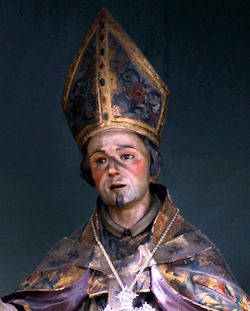 St. Leander was born of an illustrious family at Carthagena in Spain. He was the eldest of five brothers, several of whom are numbered among the Saints. He entered into a monastery very young, where he lived many years and attained to an eminent degree of virtue and sacred learning.
These qualities occasioned his being promoted to the see of Seville; but his change of condition made little or no alteration in his method of life, though it brought on him a great increase of care and solicitude.
Spain at that time was in possession of the Visigoths. These Goths, being infected with Arianism, established this heresy wherever they came; so that when St. Leander was made bishop it had reigned in Spain a hundred years. This was his great affliction; however, by his prayers to God, and by his most zealous and unwearied endeavors, he became the happy instrument of the conversion of that nation to the Catholic faith. Having converted, among others, Hermenegild, the king's eldest son and heir apparent, Leander was banished by King Leovigild. This pious prince was put to death by his unnatural father, the year following, for refusing to receive Communion from the hands of an Arian bishop. But, touched with remorse not long after, the king recalled our Saint; and falling sick and finding himself past hopes of recovery, he sent for St. Leander, and recommended to him his son Recared. This son, by listening to St. Leander, soon became a Catholic, and finally converted the whole nation of the Visigoths. He was no less successful with respect to the Suevi, a people of Spain, whom his father Leovigild had perverted.
St. Leander was no less zealous in the reformation of manners than in restoring the purity of faith; and he planted the seeds of that zeal and fervor which afterwards produced so many martyrs and Saints.
This holy doctor of Spain died about the year 596, on the 27th of February, as Mabillon proves from his epitaph.
The Church of Seville has been a metropolitan see ever since the third century. The cathedral is the most magnificent, both as to structure and ornament, of any in all Spain.
—Excerpted from Lives of the Saints, by Alban Butler, Benziger Bros. ed. [1894]
Patronage: Seville, Spain
Highlights and Things to Do:
- Read more about St. Leander:
- St. Leander was one of several saints in his family. He was the elder brother of Saint Isidore of Seville, Saint Fulgentius of Ecija, and Saint Florentina of Cartagena.
- The Cathedral of Murcia has a silver urn that contains the remains of the four sibling saints.