MASS READINGS
February 03, 2019 (Readings on USCCB website)
COLLECT PRAYER
Grant us, Lord our God, that we may honor you with all our mind, and love everyone in truth of heart. Through our Lord Jesus Christ, your Son, who lives and reigns with you in the unity of the Holy Spirit, God, for ever and ever.
Recipes (1)
Activities (3)
Prayers (3)
Library (0)
Blog & Podcasts (6)
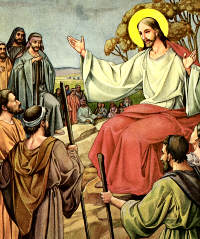
There is a shocking turnaround in today's Gospel. The people with whom Jesus grew up were assembled in the Nazareth synagogue. After they heard him read Sacred Scripture and give a one sentence homily "Today this Scripture has been fulfilled in your hearing" St. Luke tells us that "all spoke well of him and were AMAZED at the gracious words that came from his mouth." But that amazement soon turned into doubt and then into fury. — Fr. Roger J. Landry
The feasts of St. Blaise and St. Ansgar, which are ordinarily celebrated today, are superseded by the Sunday liturgy.
Click here for commentary on the readings in the Extraordinary Form of the Roman Rite.
Sunday Readings
The first reading is taken from the book of Jeremiah (Jer 1:4-5, 17-19). Jeremiah is the second of the four great prophets of Israel; a contemporary of Zephaniah, Nahum, and Habakkuk. He was born in the last part of the reign of Manasseh, about 645 years before the birth of Jesus and almost a century after Isaiah. Today's reading comes from the prologue which gives an account of Jeremiah's calling. It is a dialog between Yahweh and Jeremiah.
The second reading, taken from the first letter of Paul to the Corinthians (1 Cor 12:31-13:13), continues last week's comparison of the Church to the human body. Each part of the body is no greater than any other part; rather, all work together to serve the common good. The second reading also discusses the gifts of the Holy Spirit.
The Gospel reading is taken from St. Luke (Lk 4:21-30). This rejection of Jesus by his own townfolk must have sincerely grieved him. But it was only the beginning of similar rejections. Their attempt to murder him was an indication of what was yet to come. "To his own he came but his own did not accept him" as St. John says (1:11). The reason was that the Messiah they were looking for was a political leader who would make Israel a political power not only among the nations but over the other nations. Nearly all the messianic prophecies had references to the universality of the messianic kingdom–this universality they interpreted in a political, worldly sense. Their interest in things spiritual was then at a very low ebb and therefore the message of Christ had little interest for them. They did not want a spiritual kingdom.
For seventeen centuries they had been God's Chosen People, and they were proud of their superiority over the sinful Gentiles who did not know the true God. That very pride of theirs was their undoing. The Gentiles were God's children too, and they also were to share in the new kingdom which the Messiah would establish, but the very thought of this was abhorrent to the vast majority of the Jews.
In spite of all their opposition, however, Jesus spent his public life amongst them. He gave them the first offer of entering the new kingdom. They could still continue to be God's Chosen People together with, and alongside, the other nations of the earth. They refused. And their refusal went so far as to call in the aid of the hated Gentiles to crucify the One—their own fellow Jew—who had come to bring them the message of the true kingdom and the offer of being its first citizens.
There were exceptions, of course, and honorable exceptions at that. Christ founded his Church, the new kingdom of God on the Apostles, who were Jews, and through their noble sacrifices and efforts, the kingdom spread to all the Gentile nations of the earth. Because of their sacrifices, we are Christians, members of Christ's kingdom on earth and heirs to his eternal kingdom in heaven. Through our Christian teaching we have learned that our life on this earth is but a period of preparation, a period during which we can earn the true life as citizens of his eternal kingdom. How often do we, like the Jews of Christ's day, forget this and bend all our efforts to building for ourselves a kingdom of power or wealth in this world, a kingdom which we will have to leave so soon?
We would not, of course, openly deny Christ, much less try, like his neighbors in Nazareth, to throw him to his death over a cliff: but how often in our private actions, and in our dealings with our neighbors, do we push him and his doctrine quietly aside and act as if we knew him not. In this we are no better than Christ's neighbors of Nazareth and we grieve his loving heart as much as they did on that sad day. Am I one of those (each one of us can ask himself)? Do I really love Christ or, to put it in a more personal way, do I really love myself ? If I do, I will not risk losing my place in the eternal kingdom for the sake of some paltry pleasure or gain in this present life which will end for me so very soon.
Excerpted from The Sunday Readings by Fr. Kevin O'Sullivan, O.F.M.
Things to Do:
- Read or reread Pope John Paul II's Apostolic Letter, Dies Domini on Keeping the Lord's Day Holy
Commentary for the Readings in the Extraordinary Form:
Fourth Sunday after Epiphany
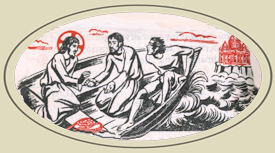 "'Why are you fearful, O you of little faith?' Then He arose and rebuked the wind and the sea, and there came a great calm" (Gospel).
This is a picture of both the human and the Divine in Jesus and in His Church (symbolized by the dome of St. Peter's at the right). Jesus, a tired Man, fell off to sleep during "a great storm." Jesus, the tireless, wide-awake God, "arose," as it were from the tomb of a dead sleep, to restore "a great calm."
Enemies of the Church are ever ready to gloat over our human "weakness" (Prayer, Secret), tossed about by the "waves" of human passion, by the "winds" of inhuman evil spirits.
The Divine Presence is within our baptized, absolved souls. Let us rise up "from the facination of earthly things" (Postcommunion).
— Excerpted from My Sunday Missal, Confraternity of the Precious Blood
Meditation: "Fasching"—Mardi Gras: The Ground of Our Freedom
Fasching—Mardi gras—is certainly not a Church festival. Yet on the other hand, it is unthinkable apart from the Church's calendar. Thus if we reflect on its origin and significance, it can contribute to our understanding of faith.
Fasching has many roots, Jewish, pagan and Christian, and all three point to something common to men of all times and places. It shows a certain correspondence to the feast of Purim in the Jewish calendar, which recalls Israel's deliverance from the menace of persecution of the Jews in the Persian empire, a deliverance brought about, in the biblical account, by Queen Esther. The joyful abandon with which this feast is celebrated is intended to express the feeling of liberation, and on this day it is not only a memory but also a promise: the person who is in the hands of the God of Israel is already, in anticipation, freed from the snares of his enemies.
But behind this exuberant, worldly feast, which had and still has a place in the religious calendar, there is also an awareness of that temporal rhythm which was given classical expression in the Book of Ecclesiastes: "For everything there is a season, and a time for every matter under heaven: a time to be born and a time to die; a time to plant and a time to pluck up what is planted;… a time to weep and a time to laugh; a time to mourn and a time to dance" (Qo 3: iff.). Not everything is appropriate at all times; the human being needs a rhythm, and the year gives him this rhythm, both through creation and through the history which faith sets forth in the yearly cycle.
This brings us to the Church's year, which enables man to go through the whole history of salvation in step with the rhythm of creation, simultaneously ordering and purifying the chaotic multiplicity of our nature. Nothing human is omitted from this cycle of creation and history, and only in this way can all human reality, its dark side and its light side, the world of sense and the world of spirit, be saved. Everything finds its place in the whole, which gives it meaning and delivers it from its isolation. So it is foolish to want to prolong Fasching when business and one's agenda seem to recommend it: such extra time, artificially created by ourselves, turns into boredom; man is left alone as his own creator and feels truly forsaken. Then time is no longer the varied gift of creation and history but the monster which devours itself, the empty preoccupation with sameness, whirling us round in a circle of meaninglessness, ultimately devouring us as well.
Let us go back to think about the roots of Fasching. As well as the Jewish, there is the pagan prehistory, whose fierce and menacing features still stare at us in the masks worn in Alpine, Swabian and Alemannic parts of Germany. What lie behind this are the rites for driving out winter and banishing demonic powers: the changes involved in times and seasons seemed to threaten the world's continuance; it was necessary to secure the earth and its fruitfulness against the void to which, in the sleep of winter, the world seemed to come perilously close.
At this point we can observe something of great significance: in the Christian world the demonic mask becomes a light-hearted masquerade, the life-and-death struggle with the demons becomes fun and merriment prior to the seriousness of Lent. This masquerade shows us something we can often see in the psalms and in the prophets: it becomes a mocking of the gods, who no longer need to be feared by those who know the true God. The masks of the gods have become an amusing show, expressing the high spirits of those who can laugh at what once brought terror. To that extent, Fasching actually does contain elements of Christian liberation, the freedom of the One God, perfecting that freedom commemorated in the Jewish feast of Purim.
In the end, however, we are faced with a question: Do we still enjoy this freedom? Or is it not a fact that, ultimately, we would like to free ourselves from God, from creation and from faith, in order to be totally free? And is not the consequence of this that we are once again handed over to the gods, to commercial forces, to greed, to public opinion? God is not the enemy of our freedom but its ground. That is something we ought to relearn in these days. Only love that is almighty can ground a joy that is free from anxiety.
—From Seek That Which Is Above by Joseph Cardinal Ratzinger (Pope Benedict XVI)