MASS READINGS
January 15, 2017 (Readings on USCCB website)
COLLECT PRAYER
Almighty ever-living God, who govern all things, both in heaven and on earth, mercifully hear the pleading of your people and bestow your peace on our times. Through our Lord Jesus Christ, your Son, who lives and reigns with you in the unity of the Holy Spirit, God, for ever and ever.
Recipes (7)
Activities (9)
Prayers (3)
Library (1)
Blog & Podcasts (6)
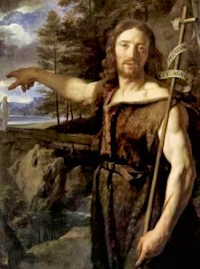
With the feast of the Baptism of the Lord we have entered into the liturgical time that we call “ordinary.” On this second Sunday, the Gospel presents to us the scene of the meeting between Jesus and John the Baptist at the Jordan River. The narrator is the eye witness, John the Evangelist, who, before he was a disciple of Jesus was a disciple of the Baptist, together with his brother James, with Simon and Andrew, all are from Galilee, all are fisherman. So, John the Baptist sees Jesus, who steps forward from the crowd and, inspired from above, sees in Jesus the one sent by God. For this reason he points him out with theses words: “Behold the lamb of God, he who takes away the sin of the world!” (John 1:29).
The word that is translated with “take away” literally means “to relieve,” “to take upon onself.” Jesus has come into the world with a precise mission: to free it from the slavery of sin, taking humanity’s faults upon himself. In what way? By loving. There is no other way to defeat evil and sin than with the love that moves one to give the gift of his life for others. In the testimony of John the Baptist, Jesus is given the traits of the Servant of the Lord, who “has borne our griefs and carried our sorrows” (Isaiah 53:4), to the point of dying on the cross. He is the true Passover lamb, who immerses himself in the river of our sin, to purify us.
The Baptist sees before him a man who gets in line with sinners to be baptized even though he does not need to. He is the man who God sent into the world as the sacrificial lamb. The word “lamb” appears several times in the New Testament and always in reference to Jesus. This image of the lamb might surprise us: an animal that is certainly not characterized by its strength and hardiness takes upon himself such an oppressive weight. The enormous mass of evil is removed and taken away by a weak and fragile creature, who is a symbol of obedience, docility and defenseless love, who goes to the point of sacrificing himself. The lamb is not an oppressor but is docile; he is not aggressive but peaceful; he does not show his claws or teeth in the face of an attack, but endures it and is submissive. And this is how Jesus is! This is how Jesus is! He is like a lamb.
What does it mean for the Church, for us, today to be disciples of Jesus the Lamb of God? It means putting innocence in the place of malice, love in the place of force, humility in the place of pride, service in the place of prestige. It is good work! We Christians must do this: put innocence in the place of malice, love in the place of force, humility in the place of pride, service in the place of prestige. Being disciples of the Lamb means that we must not live like a “city under siege,” but like a city on a hill, open, welcoming, solidary. It means not having an attitude of closedness, but proposing the Gospel to everyone, testifying with our life that following Jesus makes us more free and more joyful. — Pope Francis Angelus Address January 19, 2014
Click here for commentary on the readings in the 1962 Missal of the Roman Rite.
The Week of Prayer for Christian Unity
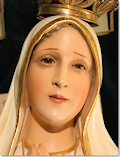
Indulgence for the 100-Year Fatima Anniversary
For the 100th anniversary of the apparitions of Our Lady of Fatima in Portugal, Pope Francis has decided to grant a plenary indulgence opportunity throughout the entire anniversary year, which began Nov. 27, 2016, and will end Nov. 26, 2017.
Sunday Readings
The first reading is taken from the Book of the Prophet Isaiah 49:3, 5-6 and is the second of the "suffering servant" prophecies, found in Isaiah. These were prophecies uttered during the Babylonian exile to encourage the Jewish exiles to persevere in their trust in Yahweh, who would soon liberate them from Babylon, and eventually send them the long-expected Messiah, promised to Abraham.
The second reading is from the first Letter of Saint Paul to the Corinthians 1:1-3. The opening verses of this letter have been chosen for the reading because they show the prophecy, read in the first lesson, as fulfilled among the pagans, as well as emphasizing the purpose of the Messiah's coming: the sanctification and true enlightenment of all nations.
The Gospel is from St. John 1:29-34. The pages of the Gospel present John the Baptist as a symbolic example of a ‘bridegroom’s friend’, as Christ’s excellent and exemplary witness. The Baptist’s pre-eminent witness was affirmed in two ways: firstly with regard to the content of his testimony and secondly with respect to its style.
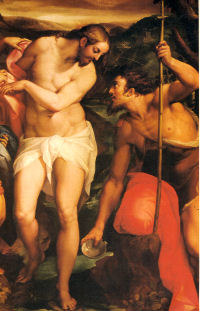 With regard to the content of his testimony, the Baptist identified Jesus as ‘the Lamb of God who takes away the sins of the world’ (Jn 1:29). Anticipating Jesus’ messianic and salvific role, each of the four evangelists start their Gospels with the Baptist’s words. The Lamb refers to the idea of salvation. The Lamb is the gift of liberation that, following the flight from Egypt, the Israelites sacrificed to the Lord. The Lamb recalls the servant of the Lord, the messianic image described by the Prophet Isaiah, ‘like a lamb led to the slaughter-house, like a sheep dumb before its shearers’ (Is 53:7). The Lamb recalls the image of the Victorious Lamb in the Book of the Apocalypse who at the end of time will definitively destroy evil and sin. John the Baptist is therefore, an authoritative witness who knew Jesus’ exact identity and why He came amongst men.
With regard to John the Baptist’s style, St John’s Gospel (cfr Jn 3:28-29) presents St John the Baptist through the image of the ‘bridegroom’s friend’. He gives witness, yet is not positioned central to the events that are unfolding. His testimony is totally centralised on Christ. John indicates the presence of the Lord and then steps into the margins. ‘I am not the Christ’ and he goes on to affirm ‘I am the one who has been sent to go in front of him. 'It is the bridegroom who has the bride; and yet the bridegroom's friend, who stands there and listens to him, is filled with joy at the bridegroom's voice. This is the joy I feel, and it is complete. He must grow greater, I must grow less.’(Jn 3:28-30)
Today’s Gospel offers us an eloquent example to imitate, so that we can also become Christ’s authoritative witnesses. A believer can only give an authoritative witness if it coexists in perfect harmony with two of the Baptist’s evangelical qualities. Firstly, knowledge of Christ that is cultivated through prayer, the sacramental and ecclesial life, reading good books and edifying friendships. Secondly, the constant attributes of a ‘bridegroom’s friend’ who goes in search of the Groom through the virtue of humility because always, in everyone’s life, Christ must increase and we must decrease!
—From the Congregation for the Clergy
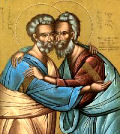
The Week of Prayer for Christian Unity
Day Two: Together... we give thanks for God’s grace in one another
Gratitude, in Deuteronomy, is a way of living life with a deep awareness of God’s presence within us and around us. It is the ability to recognize God’s grace active and alive in one another and in all people everywhere and to give God thanks. The joy that flows from this grace is so great that it embraces even "the aliens who reside among you".
Gratitude, in the ecumenical context, means being able to rejoice in the gifts of God’s grace present in other Christian communities, an attitude that opens the door to ecumenical sharing of gifts and to learning from one another.
All of life is a gift from God: from the moment of creation to the moment God became flesh in the life and work of Jesus, to this moment in which we are living. Let us thank God for the gifts of grace and truth given in Jesus Christ, and manifest in one another and our churches.
Commentary for the Readings in the 1962 Roman Missal:
Second Sunday after Epiphany
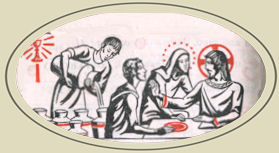 "A wedding took place . . . (Mary) said to Jesus, 'They have no wine.' . . . Jesus said to (the attendants), 'Fill the jars with water . . . Draw out now' . . . When the chief steward had tasted the water . . . become wine . . . (he said to the bridegroom), 'Thou hast kept the good wine until now'" (Gospel).
A lesson to our young married couples of today! Believe and trust in Him to keep your family if you keep His Word! A spiritual change also took place, since "His disciples believed in Him" (Gospel).
Consider the daily miracle of God's "grace that has been given us" (Epistle), to change from evil to good in both single and married life. Jesus "kept the good wine" of Divine Life for us (symbolized by Chalice at left in the picture). We must "fill the jars . . . (of our good will) to the brim" (Gospel).
Let us recognize the "great things" (Offertory) done for our soul through Mary's prayers to Jesus. Like the disciples, let us "believe" and "do whatever He tells" us (Gospel).
—Excerpted from My Sunday Missal, Confraternity of the Precious Blood