The best books Catholic Culture staff read in 2025
By Thomas V. Mirus ( bio - articles - email ) | Jan 13, 2026 | In Reviews
It’s time for the Catholic Culture staff’s roundup of our favorite things we read in the past year! This year we have lists by Phil Lawler, Dr. Jeff Mirus, Peter Wolfgang, and Thomas Mirus.
Phil Lawler
NON-FICTION
With St. John Henry Newman being acclaimed as a Doctor of the Church this year, what better time to reread his Grammar of Assent? Cardinal Newman is brilliant in his discussion of what it means to know and what it means to believe. While rigorously logical in his own reasoning, he also recognizes the limitations of abstract logic, saying that it is “loose at both ends.” This book demonstrates the failings of Enlightenment thought, and the need to balance the claims of reason with the claims of faith.
“Science is much closer to myth than a scientific philosophy is prepared to admit,” wrote the late Paul Feyerabend in his deliberately provocative book, Against Method. The “method” that he opposed was the scientific method—or to be more accurate, the popular understanding of the scientific method. A brilliant iconoclast in the history of science, Feyerabend said that authentic science is “conspicuous, noisy, and impudent.” (He might have been describing himself.) Drawn to this book because Pope Benedict XVI alluded to it, I found it fascinating, frustrating, and challenging—which is no doubt what the author would have wanted. His own views are anarchic, but at a time when the authority claimed by scientists is under attack—and rightly so—he asks the right questions.
Readers of Dante’s Divine Comedy know that he had very strong opinions about the rights and duties of kings and their subjects. In De Monarchia, Dante the poet becomes Dante the political theorist, with an essay that presents an unusual argument about the origin of political legitimacy, and the proper distinction between temporal and spiritual authority. His nostalgia for the Roman Empire will not win many followers today, but his stern rebukes to prelates who involve themselves in partisan politics, and politicians who dabble in ecclesial affairs, are clear and refreshing.
Donald Trump is not the first American president who leaves his critics (and sometimes also his friends) aghast, wondering if our political discourse has been irreparably damaged. When Andrew Jackson was inaugurated, his many opponents thought the nation’s capital was besieged by his ruffian supporters. In Andrew Jackson: His Life and Times, H.W. Brands provides a vivid portrait of another political leader whose massive personal popularity his rivals could not understand, a man who quite literally grew depressed on those rare occasions when he was not actively involved in a fight.
FICTION
The First Circle, by Aleksandr Solzhenitsyn, is a wonderful novel, combining a searing indictment of the Soviet system with an interesting reflection on the meaning of freedom. But in order to publish that book, Solzhenitsyn engaged in self-censorship, partially blunting his critique. After the fall of the Soviet regime he restored the book to his original conception. The new version, with the slightly different title, In the First Circle, is only a bit longer, but quite a bit more powerful.
Great Expectations is classic Charles Dickens. Outsized characters, a complicated plot, and biting social commentary seasoned with humor. Dickens puts his heroes through the extremes of suffering and danger, yet his ever-present wit saves the works from sliding into melodrama.
Children of Men, by P.D. James, is a dystopian novel, written by an author more famous for her mysteries. The premise is that the entire human race has become barren, and as the last generation born reaches adulthood, there are no children, there is no future, and an increasingly authoritarian government concentrates on managing shortages and keeping a docile population comfortable while waiting for the end. The plot follows a small group of young people who refuse to accept what seems inevitable.
Right Ho, Jeeves, is perhaps the best full-length novel b y P. G. Wodehouse. Some people scoff at Wodehouse, saying that he is not serious. Well, he certainly is not. If you prefer to read books with a furrowed brow, skip this one. But if you want to relaxation and enjoyment, furnished by the greatest English prose stylist of the 20th century, here it is. If you know anyone who can read the account of Gussie Fink-Nottle’s address to the Market Snodsbury grammar school without laughing out loud, please don’t introduce him to me; we wouldn’t get along.
Dr. Jeff Mirus
One of the most important books published in 2025 is undoubtedly Thomas B. Fowler’s Artificial Intelligence: Foundations, Limitations, Benefits and Dangers, a book I had the privilege of proofreading when it was in preparation. Tom Fowler is both a philosopher and a scientist who has tackled a number of critical issues over the years from an authentically Catholic and scientific position which is, obviously, well beyond the mainstream.
While he was working on the book in 2024, Tom published a series of four AI overview articles on CatholicCulture.org:
- AI, its capabilities and threats
- The AI paradigm of knowing and its problems
- The human paradigm of knowing, how it is different, why it is not replicable with AI
- Artificial Intelligence: Summary and Conclusions
But now the entire book is available. It is the definitive treatment of a complex and massively misunderstood issue.
For a young woman conflicted over an unwanted pregnancy, perhaps the most critical book published in 2025 was Dr. George Delgado’s Abortion Pill Reversal: A Second Chance at Choice from Ignatius Press. With more and more women turning to chemical abortion in the privacy of their own homes—and with at least some of those women suffering last-minute regrets—it is vital to get the word out that the effects of the abortion pill can often be reversed if the pregnant woman regrets her decision early enough in the process. I emphasize that such second thoughts are not rare. See the review I posted in December.
The most remarkable Catholic essayist I discovered in 2025 was the Bohemian Ida Friederike Görres (1901-1971), who wrote about the problems of the Church in the West besieged by secularism in the period immediately following the Second Vatican Council. Faithful, creative, insightful and right on target, this impressive writer even merited a eulogy by the future Pope Benedict XVI. Her writings have helped many readers throughout the West maintain their spiritual balance among the controversies which so often have torn the Church apart. Now Ignatius has published some of her most brilliant essays in a collection entitled Bread Grows in Winter (translated by Jennifer Bryson), and each one is a unique spiritual gem. See my review, also posted in December.
Late last summer I discovered two new books which challenged me to improve my spiritual focus and learn better to see things as they really are. The first, by Fr. Gregory Pine, faces the quintessential modern problem head on—namely, that so many men and women today do not feel rooted in a genuine identity, but rather keep trying to craft their own identity by picking and choosing from among the offerings of our modern secular culture. The result is moral, spiritual and personal chaos—the very situation that positions us farthest from understanding and finding joy and fulfillment in who we really are, as sons and daughters of God. Right from the first, then, Fr. Pine emphasizes that we cannot craft our identity; rather, we must receive our identity—and we can receive it only from our loving Father. The book is Your Eucharistic Identity: A Sacramental Guide to the Fullness of Life. My review: Who are you? Who do others say that you are?
Another writer uniquely capable of startling perspectives that force us to rethink everything is Michael Pakaluk, who recently published a collection of reflections entitled The Shock of Holiness: Finding the Romance of Everyday Life. Pakaluk’s genius is to enable us to see just about everything with fresh eyes—in some ways, perhaps, reminiscent of G. K. Chesterton, though perhaps not quite as flamboyant. But Pakaluk does cause us to perceive reality in fresh and invigorating ways. He is well worth reading, so check out my review, Michael Pakaluk: Seeing with fresh eyes.
Also in 2025, we were treated to the rebirth of G. K. Chesterton himself. Chesterton scholar Dale Ahlquist, who has spent a lifetime collecting and studying the great English apologist’s writings, did us the favor of organizing into a single narrative nearly everything that GKC ever wrote about himself but never bothered to put into his own autobiography—which, after all, was mostly not about him. The result was the publication by Ignatius Press of I Also Had My Hour: An Alternative Autobiography of G. K. Chesterton, which I reviewed last October. The entire work is extraordinarily well done. It is like meeting and reading Chesterton all over again, and this time learning far more not only about his ideas, but about himself.
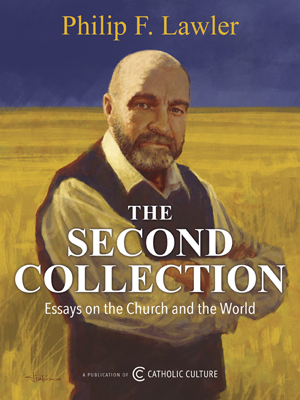
Finally, it was also this past year, in May, that Phil Lawler gathered together about fifty of the most enduringly relevant commentaries he had written on CatholicCulture.org over the past several years, and published them as a collection in one of our free ebooks. If you haven’t downloaded it yet, do not miss out on The Second Collection.
As I have always enjoyed good mysteries, I usually like to round out my more serious reviews in this annual collection with a recommended mystery author. This year I nominate the New Zealander Ngaio Marsh, creator of the aristocratic Scotland Yard detective Roderick Alleyn. Marsh wrote (I believe) 33 mystery novels featuring her favorite character between roughly 1934 and 1982. Eight of these were turned into a series of 99-minute television adaptations in the early 1990s, extraordinarily well done in the BBC tradition, and currently available on Amazon Prime, starring Patrick Malahide, William Simons, and Belinda Lang.
Peter Wolfgang
Shepherds for Sale: How Evangelical Leaders Traded the Truth for a Leftist Agenda by Megan Basham. Reading this book as a Catholic, I get what Casey Chalk said in his review of it. The Protestant doctrine of perspicuity, in this case Megan Basham’s certainty about what Scripture “clearly teaches” on every political topic under the sun, gets in the way. Otherwise, it’s a marvelous read. I was particularly struck by Basham’s mention of Kirsten Powers. A left-wing cable news talking head who converted to Evangelicalism under the influence of Timothy Keller, Powers left Christianity altogether when she realized it really is opposed to abortion and same-sex relations. Basham points to Powers’ post about Keller’s death as evidence that Timothy Keller’s “seeker-friendly” approach fails in the long run.
The Two Jerusalems: My Conversion from the Messianic Movement to the Catholic Church by Matthew Wiseman. I mistakenly went into this book thinking it would explain all the things I heard a few years ago from a Messianic Rabbi on the origins of Rabbinical Judaism vis a vis Christianity. The book is not about that. It’s about the Hebrew Roots movement, with which I was overall unfamiliar, and one man’s journey from that to, eventually, Catholicism. I’ll have to get around to reading Roy Schoeman someday for the other stuff.
A Retreat for Lay People by Ronald Knox. I’m embarrassed to say I didn’t crack open a book by Monsignor Ronald Knox until my mid 50s. I’ve seen references to him all my adult life and now I know why. Amazing writer. Imagine mixing St. Josemaría Escrivá with St. John Henry Newman and getting this guy. At least in this book, anyway. And this isn’t even one of his better-known books.
Catechetical Lectures by St. Cyril of Jerusalem. A remarkable book. St. Cyril gave these talks to catechumens in the 4th century. I was unaware, until I read it, of how much of what we know about the era (and earlier) can be traced back to these lectures. The story about the Septuagint’s origins? It’s here. That thing modern liturgists rip out of context, about receiving communion in the hand being an ancient practice (your left hand a throne for your right)? The full context is here. The various heresies of the era? All here, all being batted down by this great Doctor of the Church. And the eloquence! They knew how to write back then. Highly recommended. [Editor’s note: A number of St. Cyril’s Catechetical Lectures are available for listening in three episodes of our Catholic Culture Audiobooks podcast.]
The Camp of the Saints by Jean Raspail. You think the weird combination of old classics and modern garbage that your local library puts out there during “Banned Books Week” are books that are actually banned? They’ve got nothing on The Camp of the Saints. Until recently it was impossible to find, unless you were willing to pay a small fortune. (I read a version I found online, but since then, Vauban Books has published a better translation.) And honestly, I can’t say the book’s not racist. Jean Raspail is brutally unsympathetic to the Third World. What I can say is that that was not his point. His target was not the Third World. It was the First World. Camp of the Saints is about a West that is so guilt-ridden that it willingly acquiesces in its own destruction. Raspail’s novel is a good warning about the treacly sentimentality that got us to this place. A good plot, a flawed execution. I wish someone else had written this novel, with a scalpel instead of a bludgeon.
Thomas Mirus
As usual, for books whose authors I interviewed on the Catholic Culture Podcast, I link to the relevant episode.
NEW BOOKS
Fr. Donald Haggerty, The Hour of Testing: Spiritual Depth and Insight in a Time of Ecclesial Uncertainty. The best new book of the year. One of the great spiritual writers today, Fr. Haggerty offers profound reflections on the ongoing, and perhaps future, crisis within the Church, with an eye to arousing an appetite for the greater spiritual intensity God desires his faithful to live out in this time. It is essential that we see that our Lord Himself is reliving His Passion in His Mystical Body, when the Church suffers betrayal and humiliation at a high institutional level. It is also essential that we see the high stakes in the great loss of souls occurring today, so that we may be spurred to a deeper and more sacrificial prayer life. Fr. Haggerty offers spiritual sobriety and counsels for holiness that should not be missed.
Eamonn Clark, New Questions, Old Answers: Catholic Morals and Natural Family Planning. The way Natural Family Planning is commonly taught does not adequately reflect the Church’s perennial teachings on the purpose of marital relations, on sexual asceticism, and the good of continence. The result is often that couples are encouraged, in practice, to commit habitual venial sin. Moral theologian Eamonn Clark has written the first serious study of ethical issues related to NPF since the 1940s. I highly recommend it to anyone involved in marriage prep. The book is available for free as a PDF.
Cheryl C.D. Hughes, Archbishop Fulton J. Sheen: Convert Maker. This new biography focuses in particular on some of Ven. Fulton Sheen’s high-profile converts. Most inspiring to me was the sometimes shocking directness of his evangelization methods; in this time when we emphasize apologetics, natural law, or the fake St. Francis quote about “using words when necessary”—anything but speaking about Jesus Christ directly—it made me want to be more bold in using words to invite people to meet Him. I also appreciated the author’s discussion of Sheen’s lifelong struggle with vanity and ambition, and her analysis of his screen presence and rhetorical techniques.
Élisabeth Nguyen Thi Thu Hong and Fr. Stefaan Lecleir, Cardinal Nguyen Van Thuan: Man of Joy and Hope. Madame Hong recounts the inspiring story of her older brother, Venerable Francis-Xavier Nguyen Van Thuan, the heroic Vietnamese Cardinal who was imprisoned by the Communists for 13 years, 8 of those in solitary confinement.
SPIRITUAL READING
Johann von den Driesch, S.J., Perfect Contrition: A Golden Key of Heaven. This excellent 30-page booklet from 1904 (various translations available online) lucidly explains the Church’s teaching on a subject which could make the difference between heaven and hell for the reader: perfect contrition, its importance, and the graces it obtains.
William of Tocco, The Life of St. Thomas Aquinas, trans. David Foley. It’s crucial to remember Thomas Aquinas as a saint, not just as a walking brain, so that we imitate what was most important about his life. This hagiography by a fellow friar who knew him is highly edifying and, I think, essential reading for any student of St. Thomas.
Andrew Comiskey, Rediscovering Our Lost Fullness: A Guide to Sexual Integration. Even among Catholics who uphold the Church’s teachings against gay marriage, there is a lot of confusion about how to minister to people with same-sex attraction. Comiskey, the founder of Living Waters and Desert Stream Ministries, overcame homosexual tendencies to be happily married with children. Especially valuable, because of his experience working with groups dedicated to healing sexual disorders, are his insights about how the Church can avoid reinforcing aberrant sexual identities in the course of ministering to people struggling with disordered tendencies.
St. Gregory of Nazianzus, Oration 27. Everyone who debates theology online should read this.
Two short devotional books by Mark Christopher Brandt: One Hundred Our Fathers: A Simple Guide to Repairing Your Past (a beautiful path for those feeling weighed down by both their own past sins and sins committed against them by others); The Stations of the Cross: Thirty-Three Days for the Holy Souls (pointed Purgatory-themed meditations for the Stations).
THEOLOGY
St. Thomas Aquinas, Summa Contra Gentiles. In this work St. Thomas argued for the truths of the faith using primarily reason, rather than revelation, in order to convince non-Christian interlocutors. Just a quarter of the length of the famous Summa Theologiae (though still a formidable work in itself), the SCG is a great induction into St. Thomas’s metaphysical system and his whole way of thinking and arguing, which can’t help but rub off on you after you’ve spent eight months or so going through it. I ordered the beautiful Aquinas Institute Latin-English edition, and will gladly buy more from them in the future (they are publishing the complete works of St. Thomas and St. Augustine).
Pseudo-Dionysius: The Complete Works (Classics of Western Spirituality). One of the greatest influences on medieval Catholic theology and the whole mystical tradition, Pseudo-Dionysius developed the idea of “negative theology”, coined the word “hierarchy”, and gave us the traditional breakdown of the nine choirs of angels. His works are surprisingly easy to read given their profundity. One more thing: don’t miss the letters, as they show the author to be not only a genius but a man of deep charity.
Philipp W. Rosemann, Peter Lombard and The Story of a Great Medieval Book: Peter Lombard’s Sentences. Peter Lombard (1095-1160), bishop of Paris, wrote a compilation of the opinions of the Fathers of the Church (especially St. Augustine), systematically organized into a structure of Catholic doctrine. The Sentences may be the most influential book that nobody reads anymore—it was the standard university theology textbook for four centuries, not replaced by St. Thomas’s Summa until the 16th century. Not only that, but this compilation of past authorities became the vehicle for new theological developments, as writing a commentary on the Sentences became the standard format for a general treatise on theology. St. Albert, St. Thomas, St. Bonaventure, William of Ockham, Bl. Duns Scotus, Denys the Carthusian, and Martin Luther all wrote commentaries on Lombard’s Sentences.
Rosemann has written two excellent books on the Sentences. Peter Lombard focuses on the original book and its content, while The Story of a Great Medieval Book follows the tradition of commentary on the Sentences. They go well together, but if you only read one I’d recommend the latter. Both illuminate a significant shift in how theology was defined, from commentary on the Scriptures themselves in the first millennium (with narrative and metaphor predominant) to the professionalized/academic elaboration of a system of doctrine drawn from the Scriptures in the second (with philosophy becoming an integral part of theology).
HISTORY
Two books about the evangelization of Northern Europe: St. Gregory of Tours, The History of the Franks (Penguin) and St. Bede’s Ecclesiastical History of the English People (Oxford World Classics). Both of these are easy, engaging reads with short chapters, and both offer a fascinating window into the Church’s evangelization of the barbarian nations of Northern Europe. Gregory lived in the 6th century; Bede died in 735. Gregory’s features lots of violent upheaval, torture, and political scheming. I enjoyed Bede’s history a bit more—I would certainly rather live in the times he describes, less unrelentingly cruel and more civilized, not to mention I feel more connected to England than to Gaul. Bede also includes more contemporary documents—letters from Pope St. Gregory the Great to St. Augustine of Canterbury, etc. But both books are full of holy bishops and hermits and miracle stories.
Xenophon, The Education of Cyrus, trans. Wayne Ambler. One of the most enjoyable pieces of ancient literature I’ve ever read. Xenophon was a student of Socrates, a philosopher, general, and historian. In this book, almost a novel, he presents the ideal ruler in the form of Cyrus the Great, who established the Persian Empire, conquered Babylon, and liberated the Jews from their Babylonian captivity (though the latter achievement, detailed in Scripture, is not mentioned by Xenophon). Cyrus is portrayed as a man of unparalleled wit, cunning, moderation, and generosity—the last reflecting his belief that “trustworthy friends are the truest and safest scepter for kings”.
ROMANITAS
Hans H. Ørberg, Lingua Latina per se illustrata, Pars I: Familia Romana (and supplemental books). Many would say this is the greatest textbook for any language ever written. I can’t recommend it highly enough if you want to learn Latin. I wrote a lot more about it in this article.
Before and during a month-long stay in Rome, I read a few books on the development of the city. Rome: Profile of a City, 312-1308 by Richard Krautheimer has some good chapters on the building works of Constantine and St. Gregory the Great, but its descriptions of art and architecture are dry. I’d give a stronger recommendation to The Art of the Renaissance in Rome, 1400-1600 by Loren Partridge—its explanations of buildings and paintings illuminate the symbolism of architectural style very well. For a more dramatic story about the creation of Rome as we know it, read Jake Morrissey’s The Genius in the Design: Bernini, Borromini, and the Rivalry That Transformed Rome.
For a guidebook to many of Rome’s most important churches, our own Jim Papandrea’s Rome: A Pilgrim’s Guide to the Eternal City is quite useful; and for details on just about every site in Rome, Blue Guide: Rome is the best general guidebook I can recommend.
FICTION/POETRY
Leo Tolstoy, War and Peace, trans. Rosemary Edmonds. Both entertaining and profound, reminding me that as much as it’s held up as intimidating, novels prior to the 20th century were written in order to delight the reader. And anyway it’s shorter than The Lord of the Rings. Actually, what strikes me is that for such a long book, it can be remarkably efficient, with Tolstoy vividly conveying a character’s essence in just a sentence or two. His range is also astonishing. If you go for the out-of-print Edmonds translation, get the revised version published by Penguin in two volumes in 1978 or one volume in 1982.
Shakespeare’s Coriolanus is an underrated and action-packed drama about a Roman general bred for war who finds himself ill at ease in the suave world of politics—watch Ralph Fiennes’ 2011 film adaptation. The Winter’s Tale is a strange fairy tale of a play that contains perhaps Shakespeare’s most powerful eucatastrophe. Henry V is, of course, essential male reading/viewing in Kenneth Branagh’s 1989 adaptation. And while I prefer Shakespeare’s tragedies and histories to his comedies, Twelfth Night is one of the funniest and most satisfying of the latter genre.
To Heaven’s Rim: The Kingdom Poets Books of World Christian Poetry, Beginnings to 1800, in English Translation, ed. Burl Horniachek. The first global anthology of classic non-English Christian poetry. Includes many interesting works in languages such as Syriac, Greek, Latin, Armenian, Irish, French, Italian, Dutch, Tagalog, Chinese, etc.
ESSAYS
Margaret McCarthy, “The Case for (Just) Sex Discrimination”. A brilliant essay in New Polity on how the current workplace anti-discrimination law discriminates against reality by treating fathers and mothers as interchangeable, and thus harms fathers, mothers, children, and work itself. I interviewed McCarthy on this topic.
Elizabeth Anscombe, “War and Murder”. A short, tasty essay by the 20th-century Catholic philosopher on the legitimate use of violence by the state, and why pacifism actually encourages murder. James Majewski recorded this on Catholic Culture Audiobooks.
Daniel Mitsui, “Why You’re Wrong About Medieval Art”. A fascinating, provocative piece in Dappled Things about the principles of sacred art.
Micah Meadowcroft’s short history of the modern classical education movement, “Classical Education’s Aristocracy of Anyone”.
The traditionalist website OnePeterFive engaged in some healthy self-examination of the traditionalist movement by publishing an insightful three-part essay, “Traditionalism and its Dangers: Reflections of a Parish Priest”.
Gideon Lazar, “Rex Iudaeorum: St. John the Evangelist and ‘the Jews’”. Anyone interested in Catholic-Jewish relations should subscribe to Lazar’s Substack.

Thomas V. Mirus is President of Trinity Communications and Editor-in-Chief for CatholicCulture.org, hosts both the Catholic Culture Podcast and Lives of the Popes, and co-hosts Criteria: The Catholic Film Podcast. See full bio.
All comments are moderated. To lighten our editing burden, only current donors are allowed to Sound Off. If you are a current donor, log in to see the comment form; otherwise please support our work, and Sound Off!