Easter: May 18th
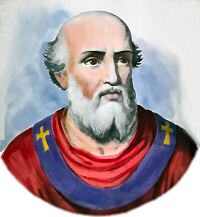
Monday of the Seventh Week of Easter; Opt. Mem. of St. John I, Pope & Martyr
MASS READINGS
May 18, 2026 (Readings on USCCB website)
PROPERS [Show]
COLLECT PRAYER
Monday of the Seventh Week of Easter: May the power of the Holy Spirit come to us, we pray, O Lord, that we may keep your will faithfully in mind and express it in a devout way of life. Through our Lord Jesus Christ, your Son, who lives and reigns with you in the unity of the Holy Spirit, God, for ever and ever.
Optional Memorial of St. John I: O God, who reward faithful souls and who have consecrated this day by the martyrdom of Pope Saint John the First, graciously hear the prayers of your people and grant that we, who venerate his merits, may imitate his constancy in the faith. Through our Lord Jesus Christ, your Son, who lives and reigns with you in the unity of the Holy Spirit, God, for ever and ever.
Recipes (1)
Activities (6)
Prayers (4)
Library (0)
Blog & Podcasts (0)
The Church celebrates the Optional Memorial of Pope St. John I (d. 526), who was elected Pope in 523. The Arian King Theodoric sent him as his ambassador to Emperor Justin in Constantinople. On John I's return, he was captured by the king, who was displeased at the outcome of the embassy and cast him into prison at Ravenna where he died a few days later. As pope he was responsible for introducing the Alexandrian computation of the date of Easter; it came to be accepted throughout the West.
Today is Day 5 of the Pentecost Novena to the Holy Spirit.
Meditation for Monday of the Seventh Week of Easter
Joys of the Ascension
Our Lord said to His Apostles before leaving them: "If you loved Me, you would indeed be glad, because I go to the Father." To us, too, Christ repeats these words. If we love Him, we shall rejoice in His glorification; we shall rejoice in that, having finished His course, He ascends to His Father's right hand, to be there exalted to the highest heaven, there to taste, after His labours, sufferings, and death, eternal repose in incommensurable glory. Bliss, such as is incomprehensible to us, envelops and penetrates Him for ever in the bosom of the Divinity. Supreme power is given to Him over every creature.
How can we fail to rejoice in that justice is rendered in all fulness to Jesus, by His Father?
Yes, let us rejoice! Those who love Jesus experience a deep and intense joy in contemplating Him in the mystery of His Ascension, in thanking the Father for having given such glory to His Son. See how the Church invites us, in her liturgy, to celebrate with gladness this exaltation of her Bridegroom, our God and our Redeemer.
—Dom Columba Marmion, Christ in His Mysteries, p. 313
St. John I
This Tuscan was destined to be glorified not only during his lifetime but after his death as well. Although peace with the East had been restored, a suspicious Theodoric grumbled in his castle at Ravenna. An Arian, the king saw the new friendliness between East and West as a serious threat to his reign. To further alarm him, Emperor Justin had reinstated the laws against heretics, Arians included, and had embarked on a campaign of confiscating churches and excluding heretics from public office, causing many Arians to abandon their faith. Infuriated, Theodoric summoned John to Ravenna and ordered him to head a delegation to the orthodox emperor to ask that the persecution stop and allow forced converts to return to Arianism. At first John refused, then fearing that the king's wrath would be taken out on Western Catholics, he agreed to do Theodoric's bidding on every count save one. He boldly told the king that he would not ask the emperor to allow converts to return to heresy.
The pope arrived in Constantinople shortly before Easter in 526, and since he was the first pope to leave Italy, his reception was more than he could have dreamed. He had been met by the entire city at the twelfth milestone, where the clergy led the procession carrying candles and crosses, and even the emperor prostrated himself before the Holy Father. 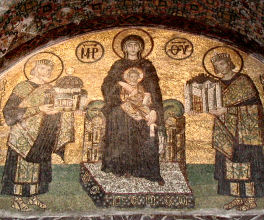 The day of Easter, John was seated in a throne higher than the one occupied by the patriarch, in the church of Sancta Sophia, where he celebrated Mass in the Latin tradition. John was accorded the highest honor when he placed the customary Easter crown on the head of Emperor Justin.
After meeting with Justin on Theodoric's behalf, the pope made the exhausting trip back to Ravenna. The king's fury raged. Jealous of the pope's grand reception in the East, Theodoric accused the pope of failing his mission by not securing all of the demands put to Justin. The king then ordered John to remain in Ravenna at his disposal. The aged pope was spent; the prospects before him were dismal. Already ailing, Pope John died and was hastily buried outside the castle walls. Pope John's body was exhumed and on May 27, 526, was returned to Rome and placed in the nave of St. Peter's.
—Excerpted from The Popes: A Papal History, J.V. Bartlett
Highlights and Things to Do:
- The Church has had a long, unbroken line of popes. Have your children answer the following questions: How many popes has the Church had? How many popes are honored with the title of saint, blessed or venerable? Which pope reigned longest? Which three names have been chosen most frequently by popes? You can check this page to help get the answers.
- Listen along to Catholic Culture's newest podcast on the Lives of the Popes by Thomas Mirus.
- Pray especially for the Holy Father today. Pray a type of the Morning Offering in which we pray for the Holy Father's intentions.
- Read more about Pope St. John I:
- Pope John is buried in St. Peter's Basilica.