Lent: March 24th
Tuesday of the Fifth Week of Lent
Other Commemorations: St. Catherine of Sweden, Virgin (RM)
MASS READINGS
March 24, 2026 (Readings on USCCB website)
PROPERS [Show]
COLLECT PRAYER
Tuesday of the Fifth Week of Lent: Grant us, we pray, O Lord, perseverance in obeying your will, that in our days the people dedicated to your service may grow in both merit and number. Through our Lord Jesus Christ, your Son, who lives and reigns with you in the unity of the Holy Spirit, God, for ever and ever.
Recipes (4)
Activities (3)
Prayers (14)
Library (0)
Blog & Podcasts (0)
We have another ancient beautiful Lenten lesson. The division between Jesus and His enemies becomes more critical, more sharp. There are references in both readings to “being lifted up.” This reminds us of the crucifixion on Calvary and of events coming ten days from now. —The Vatican II Weekday Missal
The Roman Martyrology commemorates St. Catherine of Sweden (1331-1381), the fourth child of St. Bridget of Sweden. She married at the age of fourteen with a mutual vow of chastity. After being widowed, she remained as her mother's constant companion in Rome for 25 years. When St. Bridget died, Catherine returned to Sweden and became superior of the Brigittine Order, and served as abbess until her death.
Meditation for Tuesday of the Fifth Week of Lent—Necessity of Faith in Christ’s Divinity
During the mortal life of Jesus, His Divinity as hidden under the veil of His Humanity; even for those who lived with Him, His Divinity was an object of faith.
Doubtless, the Jews were aware of the sublimity of His doctrine. “Never did man speak like this man,” they repeated. They were the witnesses of works, which, as they acknowledged, God alone could do. But they saw too that Christ was man; it is said that even His near acquaintances who had only known Him in the workshop of Nazareth did not believe in Him in spite of His miracles.
Faith in the Divinity of Christ Jesus constitutes the first step towards the divine life for us as well as for the Jews of His time. To believe that Jesus is the Son of God, God Himself, is the first condition that is necessary in order to be numbered among His sheep and be pleasing to His Father. Hoc est opus Dei ut credatis in eum quem misit ille. “This is the work of God, that you believe in Him Whom He hath sent.” We are not truly God’s children unless our life is based on this faith.
—Dom Columba Marmion, Christ the Life of the Soul

Tuesday of the Fifth Week of Lent
Station with Santa Maria in via Lata al Corso (Our Lady at Via Lata):
The Station in Rome was formerly the church of the martyr St. Cyriacus, and as such it is still given in the Roman missal; but this holy sanctuary having been destroyed, and the relics of the holy deacon translated to the church of St. Mary in Via lata, it is here that the Station is now held.
For more on Santa Maria in via Lata al Corso, see:
- Churches of Rome
- Rome Art Lover
- Roman Churches
- PNAC
- Aleteia
- Station Church
- The Catholic Traveler
- Walks in Rome
- Roman Despatches
For further information on the Station Churches, see The Stational Church.
St. Catherine of Sweden
Catherine of Sweden, Saint, the fourth child of Saint Bridget of Sweden (q.v.) and her husband, Ulf Gudmarsson, b. 1331 or 1332; d. March 24, 1381. At the time of her death St. Catherine was head of the convent of Wadstena, founded by her mother; hence the name, Catherine Vastanensis, by which she is occasionally called. At the age of seven she was sent to the abbess of the convent of Riseberg to be educated and soon showed, like her mother, a desire for a life of self-mortification and devotion to spiritual things. At the command of her father, when about thirteen or fourteen years old, she married a noble of German descent, Eggart von Kürnen. She at once persuaded her husband, who was a very religious man, to join her in a vow of chastity. Both lived in a state of virginity and devoted themselves to the exercise of Christian perfection and active charity. In spite of her deep love for her husband, Catherine accompanied her mother to Rome, where St. Bridget went in 1349.
 Soon after her arrival in that city Catherine received news of the death of her husband in Sweden. She now lived constantly with her mother, took an active part in St. Bridget's fruitful labors, and zealously imitated her mother's ascetic life. Although the distinguished and beautiful young widow was surrounded by suitors, she steadily refused all offers of marriage. In 1372 St. Catherine and her brother, Birger, accompanied their mother on a pilgrimage to the Holy Land; after their return to Rome St. Catherine was with her mother in the latter's last illness and death.
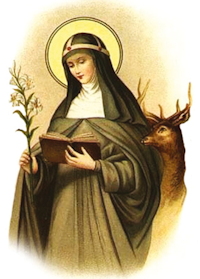
In 1374, in obedience to St. Bridget's wish, Catherine brought back her mother's body to Sweden for burial at Wadstena, of which foundation she now became the head. It was the mother-house of the Brigittine Order, also called the Order of St. Savior. Catherine managed the convent with great skill and made the life there one in harmony with the principles laid down by its founder. The following year she went again to Rome in order to promote the canonization of St. Bridget, and to obtain a new papal confirmation of the order. She secured another confirmation both from Gregory XI (1377) and from Urban VI (1379), but was unable to gain at the time the canonization of her mother, as the confusion caused by the Schism delayed the process. When this sorrowful division appeared she showed herself, like St. Catherine of Siena, a steadfast adherent of the party of the Roman Pope, Urban VI, in whose favor she testified before a judicial commission. Catherine stayed five years in Italy and then returned home, bearing a special letter of commendation from the pope. Not long after her arrival in Sweden she was taken ill and died. In 1484 Innocent VIII gave permission for her veneration as a saint and her feast was assigned to March 22 in the Roman Martyrology. Catherine wrote a devotional work entitled "Consolation of the Soul" (Sielinna Troest), largely composed of citations from the Scriptures and from early religious books; no copy is known to exist. Generally she is represented with a hind at her side, which is said to have come to her aid when unchaste youths sought to ensnare her.
—Excerpted from The Catholic Encyclopedia, J.P. Kirsch
Patronage: Vadstena, Sweden; against abortion; for healing and protection from miscarriage
Symbols and Representations: Brigittine abbess with a hind at her side; Brigittine holding a lily; Brigittine dressing a poor man’s wounds; Brigittine being brought Communion on her death bed.
Highlights and Things to Do:
- Read more about St. Catherine of Sweden:
- Visit the Brigidine Sisters website and read about St. Catherine.