Make your gift today!
Help keep Catholics around the world educated and informed.
Already donated? Log in to stop seeing these donation pop-ups.
Lent: March 20th
Friday of the Fourth Week of Lent
Other Commemorations: St. John Nepomucene, Priest and Martyr (RM)
MASS READINGS
March 20, 2026 (Readings on USCCB website)
PROPERS [Show]
COLLECT PRAYER
Friday of the Fourth Week of Lent: O God, who have prepared fitting helps for us in our weakness, grant, we pray, that we may receive their healing effects with joy and reflect them in a holy way of life. Through our Lord Jesus Christ, your Son, who lives and reigns with you in the unity of the Holy Spirit, God, for ever and ever.
Recipes (8)
Activities (2)
Prayers (9)
Library (0)
Blog & Podcasts (0)
The hostility of the enemies of Jesus becomes increasingly clear, and the agitation around His person continues with greater intensity; but He awaits His "hour." Satan and the forces of evil will appear to triumph, but the real victory will come and that is God's. —St. Andrew Missal
The Roman Martyrology commemorates today St. John Nepomucene (1340-1393), priest of Bohemia, martyred by King Wenceslaus IV because St. John refused to break the seal of confession. He was tortured and thrown into the Moldau River. It is said that a strange brightness is said to have appeared above the spot where he drowned, so his body was found and withdrawn from the water and interred.
Meditation for Friday of the Fourth Week of Lent
As Jesus neared the end of His public life, the opposition of the Jewish leaders became more violent and their desire to kill Him more determined. Our Lord, however, continued to teach in the temple, where large crowds came to hear Him. The admiration of the people intensified the hatred of the priests, and they planned to ensnare Jesus in His speech that they might have grounds for condemnation. While His enemies plotted His downfall, Our Lord spent the night in prayer on the Mount of Olives.
The contrast between the character of Christ and that of His enemies could not be more pronounced. Yielding to base passion, they were openly seeking the death of the Messiah. Jesus, on the contrary, in the spirit of generous charity, was spending His days in teaching and His nights in prayer. Does our conduct in difficult circumstances resemble that of Christ? When we are unjustly accused, criticized, or condemned, do we calmly continue our work and have recourse to God in prayer? Perhaps we seek vengeance upon those who oppose us by wishing them evil or persuading others to despise and condemn them. Let us leave our reputation in the hands of God and imitate Christ's efforts to benefit those who hated and condemned Him.
"The Lord is the protector of my life: of whom shall I be afraid?"
—Excerpted from Liturgical Reflections, Sisters of St. Dominic
Highlights and Things to Do:
- If you wish to gain the courage to embrace the small crosses in your life with joy, pray the Stations of the Cross. This is an excellent practice that should not only be confined to Lent but can be prayed on Fridays throughout the year. An excellent version with beautiful meditations composed by Pope John Paul II is his Stations of the Cross at the Colosseum. Some recommended versions are: Eucharistic Stations of the Cross, and the more traditional Stations of the Cross written by Saint Alphonsus Liguori can be found in most Catholic bookstores. Here are some guidelines for praying the Stations of the Cross in your home.
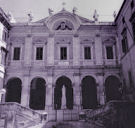
Friday of the Fourth Week of Lent
Station with Sant'Eusebio all'Esquilino (St. Eusebius in Esquiline):
Today's Station Church is the ancient church dedicated to St. Eusebius of Vercelli, 4th century bishop. The church was financed by St. Eusebius of Bologna, and is first mentioned in 474. It is one of the oldest churches in Rome, being one of the first parish churches known as the Titulus Eusebi.
For more on Sant'Eusebio all'Esquilino, see:
- Churches of Rome
- Rome Art Lover
- Roman Churches
- PNAC
- Aleteia
- Station Church
- The Catholic Traveler
- Walks in Rome
- Roman Despatches
For further information on the Station Churches, see The Stational Church.
St. John Nepomucene (Nepomuk)
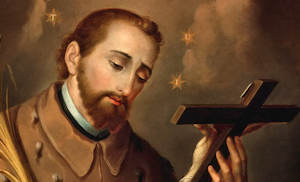 Born at Nepomuk, Bohemia, 1340; died in Prague, March 20, 1393; canonized in 1729. Saint John used the name of his native town for his surname instead of his family name of Woelflein or Welflin. He studied at the University of Prague, was ordained, and became a canon. In time, he became vicar general of Archbishop John of Genzenstein at Prague and according to tradition incurred the enmity of dissolute King Wenceslaus IV when he refused to reveal what Queen Sophie, Wenceslaus’ second wife, had told him in confession. Of a retiring disposition, Father John repeatedly refused bishoprics which were offered to him.
In 1393 (or 1383 according to some), he became involved in a dispute between Wenceslaus and the archbishop when the king sought to convert a Benedictine abbey into a cathedral for a new diocese he proposed to create for a favorite when the aged abbot died. The archbishop and John thwarted him by approving the election of a new abbot immediately on the death of the old abbot. At a meeting with John and other clerics, Wenceslaus flew into a rage, tortured them so that John was seriously injured, and then had him murdered and thrown into the Moldau River at Prague (Attwater, Benedictines, Delaney).
Saint John is portrayed in art as an Augustinian canon with a fur almuce and a bridge near him. He may hold his finger to his lips and have seven stars around his head, or wear a padlock on his lips (in Austria and Bohemia). John, patron of confessors and bridges, is venerated in Austria and Spain (Roeder).
—by Katherine Rabenstein, Saints of the Day
Patronage: against calumnies; against floods; against indiscretions; against slander; bridge builders; bridges; canons; confessors; for discretion; for good confession; mariners, sailors, boatmen, watermen; running water; silence; spiritual directors; Bohemia; Czech Republic; archdiocese of Prague, Czech Republic; Slovakia; Venice, Italy
Symbols and Representation: halo with five stars; cross; bridge; angel indicating silence by a finger over the lips; priest's biretta
Highlights and Things to Do:
- Read more about St. John Nepomucene:
- Read about the location of Saint John of Nepomuk's Martyrdom.
- The Statue of St. John of Nepomuk on Charles Bridge in Prague.
- See Christian Iconnography for depictions of St. John.
- Learn more about Prague and the Czech Republic and St. Vitus Cathedral, supposedly started by St. Wenceslas in the 10th century as a small chapel to house relics of St. Vitus and were in the 14th century St. John Nepomucene was buried after being executed for refusing to violate the seal of the confessional.
- Read about the Infant Jesus of Prague and pray the chaplet.
- Bake a loaf of bread for dinner and serve Pilsner beer in honor of St. Wenceslas. See also Catholic Cuisine for other ideas.