Lent: March 16th
Monday of the Fourth Week of Lent
Other Commemorations: St. Heribert, Archbishop (RM); St. Jean Brebeuf, Priest and Martyr (RM)
MASS READINGS
March 16, 2026 (Readings on USCCB website)
PROPERS [Show]
COLLECT PRAYER
Monday of the Fourth Week of Lent: O God, who renew the world through mysteries beyond all telling, grant, we pray, that your Church may be guided by your eternal design and not be deprived of your help in this present age. Through our Lord Jesus Christ, your Son, who lives and reigns with you in the unity of the Holy Spirit, God, for ever and ever.
Recipes (1)
Activities (2)
Prayers (14)
Library (0)
Blog & Podcasts (0)
During the next two weeks the Gospel for each Lenten weekday Mass is from St. John. We shall read, day after day, about the growing hostility against Jesus that climaxed in the horror of Good Friday. The tragedy begins today on a happy note—a continuation of yesterday’s Laetare Sunday spirit. —The Vatican II Weekday Missal
The Roman Martyrology commemorates St. Heribert (970-1021), who was Archbishop of Cologne and Chancellor of Holy Roman Emperor Otto III, and was canonized in 1074. St. Jean Brebeuf (1593-1649) is also commemorated today, but in the United States is celebrated on October 19.
Meditation for Monday of the Fourth Week of Lent
In the first reading of today's Mass, the prophet Isaiah offers a vision of the Messianic Age, which Jesus proclaimed to have begun in himself and by his ministry. The Easter "surprise" toward which the Forty Days leads pilgrims is that this Messianic Age, the Kingdom or Reign of God, will break into history in a wholly unexpected, even counterintuitive, way: it will be established through a new Passover marked by the Cross, the Resurrection, the Ascension, and the sending of the Holy Spirit at Pentecost. And as a result, a new People of God that embraces both Jews and Gentiles will be born into history. For now, Jesus gives another sign of the inbreaking of the Kingdom in today's gospel reading, the cure of the royal official's son. The official, like all disciples, must abandon himself to the divine will: As Father Benedict Bro, a Dominican, put it, "God is God only when I accept the fact that I need him."
Another Dominican, Bede Jarrett, developed the same theme in a way that sheds more light on the imitation of Christ, the obedient Son, to which this phase of the Forty Days calls us:
This life of ours…is a gift from God. It is not of our choosing. It comes to us by his choice. Since it is of his choosing, it is of his designing. We neither made ourselves nor can we manage ourselves as we like, nor manage the life that comes to us. For that reason we can take a most helpful view of life….[For] the thought that it is his gift and after his design gives us courage. If to this remembrance of God's creatorship we add the mystery of the Resurrection, we shall take even larger draughts of hope; for not only life but life's triumph lies entirely in the hands of God—George Weigel, Roman Pilgrimage
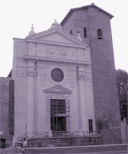
Monday of the Fourth Week of Lent
Station with Santi Quattro Coronati (the Four Crowned Saints):
Approaching the medieval gateway of this ancient church, dedicated to the Four Crowned Saints, one immediately gathers that this is a unique place. Indeed it is, for though it stands only a few blocks from some of the busiest areas of the city, this oft-forgotten church holds centuries of tradition within its scarred walls. The title of this church is actually in reference to two groups of martyrs from the Roman persecutions. The first group were four soldiers, Severus, Victorinus, Carpophorus, and Severinus, who refused to take part in pagan worship, and were killed for this in the persecutions of Diocletian. The name of this church may be derived from a military decoration of a small crown, which the four soldier saints may have earned during their service. The second group were a group of five stonemasons, Claudius, Nicostratus, Sempronianus, Castor, and Simplicius, who were put to death for their refusal to carve a statue of Asclepius which would be used for pagan worship. (See PNAC for more details.)
For more on Santi Quattro Coronati, see:
- Churches of Rome
- Rome Art Lover
- Roman Churches
- PNAC
- Aleteia
- Station Church
- The Catholic Traveler
- Roman Despatches
- Walks in Rome
For further information on the Station Churches, see The Stational Church.
Saint Heribert
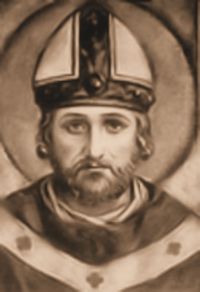 Heribert was born in Worms and he was the son of Hugo, count of Worms. He was educated in the school of Worms Cathedral and at the Benedictine Gorze Abbey in Lorraine, France. He returned to Worms Cathedral to be provost and was ordained a priest in 994.
In the same year, Otto III appointed him chancellor for Italy and four years later also for Germany, a position which he held until Otto's death on 23 January 1002. Heribert was made an archbishop of Cologne on 998. Then, he also served Emperor St. Henry.
Heribert built the monastery of Deutz, on the Rhine and performed miracles, including ending a drought. He is thus invoked for rains.
He died in Cologne on March 16, 1021 and was buried at Deutz.
He was already honored as a saint during his lifetime and was canonized by Pope St. Gregory VII about 1074.
—©Evangelizo.org
Patronage: against drought; for rain; Deutz, Germany
Symbols and Representation: archbishop calling down rain by his prayers; man kneeling before Saint Henry II; episcopal attire
Highlights and Things to Do:
- Read more about St. Heribert:
- Watch this short video from gloria.tv on St. Heribert of Cologne.
- His relics were relocated from Old St. Heribert to the Neu-St.Heribert church in Köln-Deutz.