Make your gift today!
Help keep Catholics around the world educated and informed.
Already donated? Log in to stop seeing these donation pop-ups.
Lent: March 11th
Wednesday of the Third Week of Lent
Other Commemorations: St. Eulogius, Priest and Martyr (RM); St. Sophronius, Bishop (RM)
MASS READINGS
March 11, 2026 (Readings on USCCB website)
PROPERS [Show]
COLLECT PRAYER
Wednesday of the Third Week of Lent: Grant, we pray, O Lord, that, schooled through Lenten observance and nourished by your word, through holy restraint we may be devoted to you with all our heart and be ever united in prayer. Through our Lord Jesus Christ, your Son, who lives and reigns with you in the unity of the Holy Spirit, God, for ever and ever.
Recipes (1)
Activities (3)
Prayers (16)
Library (2)
Blog & Podcasts (0)
Today we have a venerable Lenten Mass. This Mass is best understood by remembering that the ancient catechumens (or prospective converts) used to come for instructions to the first part of Lenten Masses. The catechumens heard the readings and homily, and then left the church. The offertory procession and remainder of the Mass were for the faithful. This Wednesday was the first “scrutiny,” or test, for the catechumens. That test was on the Commandments of God. Both readings, consequently, are about the Commandments. —The Vatican II Weekday Missal
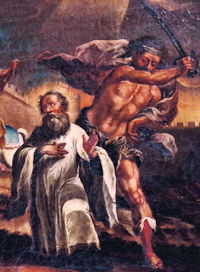
The Roman Martyrology today commemorates the martyred priest, St. Eulogius of Cordoba, Spain (d. 859), who was slain by the Moors. A noted scholar of Scripture, Eulogius was arrested in 850 after writing Exhortation of Martyrdom for two young virgin martyrs, Flora and Mary, who were beheaded after refusing to abjure the faith. Released after a time Eulogius was named archbishop of Cordoba or Toledo. Before he could be consecrated, he aided Leocritia, a young Moorish woman who had converted to Christianity. They were caught and beheaded. Eulogius also wrote The Memorial of the Saints and an Apologia.
St. Sophronius (d. 638) is also included in today's Roman Martyrology. He was a simple monk who pursued a life of prayer and sacrifice first in the desert of Egypt, then near the Jordan River, then finally in the Holy City of Jerusalem. He was ultimately chosen to be bishop and Patriarch of Jerusalem in the early 7th century. He valiantly defended the true and full humanity of Christ in the face of the heresy of Monothelitism, which denied that Jesus had a human as well as a divine will. The year before his death in 638, he witnessed the capture of Jerusalem by the Muslims under the Caliph Omar. Several of his sermons and poems have survived until this day. St. Sophronius is one of the Fathers of the Church.
Meditation for Wednesday of the Third Week of Lent—Obedient Unto Death
This we have frequently heard and have often meditated upon — but have we conformed our lives to this model so worthy of imitation? Must we not confess that we strive often to appear superior in our natural and spiritual talents? Do we not all too frequently boast of our accomplishment as if no one had ever equalled us? Does not history show how man in his pride has exceeded al bounds, seeking to place himself on a level with — and at times even above — Almighty God?
Yet Christ, Who was true God, "emptied Himself, taking the nature of a slave and being made like unto men, and appearing in the form of man, He humbled Himself, becoming obedient to death, even to the death of the Cross" (Phil. 2:7). It is precisely in this deep humiliation that He wishes to continue dwelling among us. Every Crucifix tells us this: "Learn of Me, for I am meek and humble of heart…I have been obedient unto death. . . I am full of love and patience."
Most of us will go to any lengths to cancel our degradation from our fellow men, while trying to give others the most favorable possible impression of ourselves. King Agesilaus of Sparta was a most excellent ruler, celebrated for his justice and wisdom, but he was most unattractive physically. At his death, he strictly forbade any portrait to be made of himself, whether painted or sculptured. The king feared lest such a visible remembrance of him might lessen the love and esteems which he had gained among his people during his lifetime because of his just and wise rule.
But the Son of God did not fear to approach us in His deepest humiliation and ignominy. He displays Himself to us in all His woe, summoning us to contemplate Him as the Man of Sorrows, asking that we grow in humility and patience by studying His own resignation to the Will of His Heavenly Father. In the gripping words of the prophet Isaias: "There is no beauty in him, nor comeliness; and we have seen him, and there was no sightliness that we should be desirous of him: Despised, and the most abject of men, a man of sorrows, and acquainted with infirmity; and his look was as it were hidden and despised, whereupon we esteemed him not" (Is. 63:2-4).
By means of these liturgical texts, let us penetrate the portrait of our sorrowful Redeemer, learning from Him all the virtues necessary that, in St. Paul's words, "Christ may be formed in us" (Gal. 4:19). This portrait of the patient, loving crucified Savior, Who out of deference to the Will of His Heavenly Father freely went forth to death for us, must stand out vividly before our souls' eyes before we can really conform our life, sacrifice, sufferings and death to His. Then "from glory to glory" His portrait will gradually take form in us in transcending beauty, and having suffered with Christ, we shall, according to God's own promise, "participate in His resurrection."
What better prayer during Lent could rise form the depths of our hearts than that of St. Gertrude, kneeling before her Crucifix: "Accept, O compassionate Jesus, this my prayer with that exceeding love wherewith Thou didst endure a bitter death and didst offer it, together with all the fruit of Thy most sacred Humanity, to God the Father on the day of Thine Ascension; and by the depth of those wounds which scarred Thy Flesh and pierced Thy Hands and Feet and Heart, I beseech Thee, raise me up, who am steeped and sunk in sin, and render me well pleasing to Thee in all things."
—Bernard Strasser, The Dews of Tabor
Wednesday of the Third Week of Lent
Station with San Sisto il vecchio (St. Sisto):
Replacement Station: Santa Maria dell'Anima
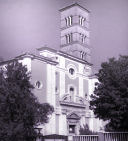
This church was called "San Sisto il vecchio" because it is the oldest convent in Rome of the sons of the Saint of Callaroca. The current construction is quite recent; in fact it was built in 1700 by the Dominican Pope Benedict XIII (1724-1730). He certainly did it to honor the memory of the Founder of the Order, San Domenico, who had his first Roman residence here; Honorius III, after having approved the Order of Preachers, gave him this temple. Tradition has it that at this church Pope Sixtus II met with San Lorenzo to whom he predicted the martyrdom which, moreover, happened after three days. NOTE: San Sisto il Vecchio has been closed since 2013 for repairs, so a replacement station church for 2026 is Santa Maria dell'Anima.
For more on San Sisto il vecchio, see:
- The Station Churches of Rome
- Rome Art Lover
- Roman Churches
- PNAC
- Station Church
- The Catholic Traveler
- Roman Despatches
- Walks in Rome
2026 Replacement Station:
Station with Santa Maria dell'Anima
The Church of Santa Maria dell'Anima (St. Mary of the Souls) is a is a 16th century national church of Germany at Via Santa Maria dell'Anima 64 in the rione Ponte. Dedicated to the Blessed Virgin Mary, the full title of the dedication is Our Lady of the Souls in Purgatory. In 1859 the seminary was established next to the church, and the foundation (it was Innocent VII in 1406 to establish it, placing the hospice of the Germanic pilgrims under the papal protection) is still today a pontifical institution, or seminary, for about 20 priests from the German-speaking world or the countries of the former Holy Roman Empire of the German Nation, who are sent to Rome by their bishops or superiors for further studies. Priests from other (Central) European countries who have basic knowledge of the German language are also admitted.
For more on Santa Maria dell'Anima, see:
For further information on the Station Churches, see The Stational Church.
St. Eulogius
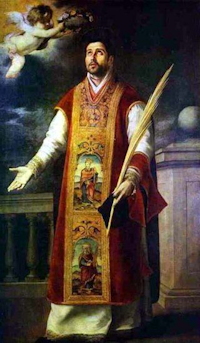 St. Eulogius was of a senatorian family of Cordova, at that time the capital of the Moors in Spain. Our Saint was educated among the clergy of the Church of St. Zoilus, a martyr who suffered with nineteen others under Diocletian. Here he distinguished himself, by his virtue and learning, and, being made priest, was placed at the head of the chief ecclesiastical school at Cordova. He joined assiduous watching, fasting, and prayer to his studies, and his humility, mildness, and charity gained him the affection and respect of every one.
During the persecution raised against the Christians in the year 850, St. Eulogius was thrown into prison and there wrote his Exhortation to Martyrdom, addressed to the virgins Flora and Mary, who were beheaded the 24th of November, 851. Six days after their death Eulogius was set at liberty. In the year 852 several others suffered the like martyrdom. St. Eulogius encouraged all these martyrs to their triumphs, and was the support of that distressed flock.
The Archbishop of Toledo dying in 858. St. Eulogius was elected to succeed him; but there was some obstacle that hindered him from being consecrated, though he did not outlive his election two months.
A virgin, by name Leocritia, of a noble family among the Moors, had been instructed from her infancy in the Christian religion by one of her relatives, and privately baptized. Her father and mother used her very ill, and scourged her day and night to compel her to renounce the Faith. Having made her condition known to St. Eulogius and his sister Anulona, intimating that she desired to go where she might freely exercise her religion, they secretly procured her the means of getting away, and concealed her for some time among faithful friends.
But the matter was at length discovered, and they were all brought before the cadi, who threatened to have Eulogius scourged to death. The Saint told him that his torments would be of no avail, for he would never change his religion. Whereupon the cadi gave orders that he should be carried to the palace and be presented before the king's council. Eulogius began boldly to propose the truths of the Gospel to them. But, to prevent their hearing him, the council condemned him immediately to lose his head. As they were leading him to execution, one of the guards gave him a blow on the face, for having spoken against Mahomet; he turned the other cheek, and patiently received a second.
He received the stroke of death with great cheerfulness, on the 11th of March, 859. St. Leocritia was beheaded four days after him, and her body thrown into the river Guadalquivir, but taken out by the Christians.
—Excerpted from Lives of the Saints, by Alban Butler, Benziger Bros. ed. [1894]
Patronage: carpenters; coppersmiths
Highlights and Things to Do:
- Read more about St. Eulogius of Cordoba:
- Read He Chose to Die for Christ in Crisis Magazine.
- His relics are enshrined in the Oviedo Cathedral in Spain.
St. Sophronius
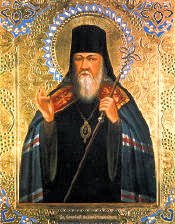 Patriarch St. Sophronius of Jerusalem was called the Sophist because of his knowledge of Greek. He was an ardent opponent of monothelitism. Many of his writings, including the Florilegium and the Life of St. John the Almsgiver, are no longer extant. He wrote an encomium on John of Cyrus and composed 23 anacreontic odes on the feasts of the church. His Christmas homily of 634 suggests that the Saracens held Bethlehem at that time. (Historians had dated the event later). The Orthodox remember St. Sophronius chiefly as the author of the life of St. Mary of Egypt. Sophronius was born in Damascus around 560. He and his friend John Moschus became ascetics together while they were in their late teens or early twenties. Some say they lived near the Jordan; some say they lived in Egypt. In 605, Sophronius fled to Alexandria in the wake of Persian invaders, and when the Persians invaded Alexandria in 616, he fled to Rome. In 619, he returned to Palestine and lived in the Theodosius monastery in Jerusalem. When Patriarch Cyrus of Alexandria began to preach monothelitism, St. Sophronius traveled to that city to argue against him; in 633, when Patriarch Sergius of Constantinople began to preach monothelitism, St. Sophronius traveled to that city to argue against him. Neither visit was successful. After Sophronius was elected Patriarch of Jerusalem in 634, he wrote the Synodical Letter to teach the two wills of Christ. In 637, the Muslims captured Jerusalem; St. Sophronius died a year later of grief at the fall of his city.
Symbols and Representation: Vested as a bishop, with right hand upheld in blessing, holding a Gospel Book or scroll
Highlights and Things to Do:
- Read more about this Father of the Church: