Lent: February 23rd
Monday of the First Week of Lent; Opt Mem of St. Polycarp
MASS READINGS
February 23, 2026 (Readings on USCCB website)
PROPERS [Show]
COLLECT PRAYER
Monday of the First Week of Lent: Convert us, O God our Savior, and instruct our minds by heavenly teaching, that we may benefit from the works of Lent. Through our Lord Jesus Christ, your Son, who lives and reigns with you in the unity of the Holy Spirit, God, for ever and ever.
Optional Memorial of St. Polycarp: God of all creation, who were pleased to give the Bishop Saint Polycarp a place in the company of the Martyrs, grant, through his intercession, that sharing with him in the chalice of Christ, we may rise through the Holy Spirit to eternal life. Through our Lord Jesus Christ, your Son, who lives and reigns with you in the unity of the Holy Spirit, God, for ever and ever.
Recipes (3)
Activities (9)
Prayers (7)
Library (6)
Blog & Podcasts (5)
» Enjoy our Liturgical Seasons series of e-books!
The great themes—the annual catechumenate by which all the people of the Church are renewed in the baptismal promises they repeat at the Easter Vigil; the adventure of God in salvation history and in the coming of the Kingdom in the person of Jesus; and the invitation to deeper friendship with Christ through a more intimate embrace of His Passion and Death—shape the liturgical rhythm of Lent.
Ash Wednesday, the days immediately following, and the first two weeks of Lent are penitential in character. The prayers and readings of daily Mass and the Liturgy of the Hours calls us to an extended examination of conscience: How am I living as a witness to the Kingdom? Have I been the missionary of the Gospel I am called to be? What is there in me that needs purification, if I am to deepen my friendship with Jesus? —George Weigel, Roman Pilgrimage: Station Churches
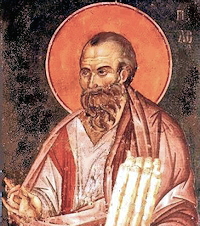
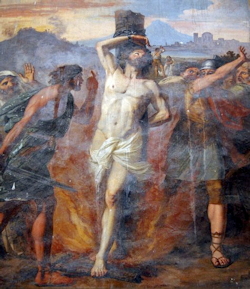
Today is the Optional Memorial of St. Polycarp of Smyrna (69-155), who was converted to Christianity by St. John the Evangelist. He was a disciple of the apostles and friend of St. Ignatius of Antioch. He was ordained bishop of Smyrna (now Izmir, Turkey) and was about eighty-six when the Roman pro-consul urged him to renounce Christ and save his life. St. Polycarp said, "For eighty-six years I have served Him and he has never wronged me. How can I renounce the King who has saved me?" He suffered martyrdom in 155 by burning at the stake in the amphitheater of Smyrna.
Meditation for Monday of the First Week of Lent:
This is also the Ember week of Lent: the spring Embertide. The first week of Lent continues the subject introduced on Sunday: temptation. The lessons of the principal and most ancient Masses this week show that every Lenten effort brings results from the Lord: healing, strengthening, conversion. But the effort itself is not the most important thing; it is God's reaction and acceptance. We are like the grain of wheat which must die to become productive. We must die before we grow into glory.
The Mass of today is filled with thought of the last Messianic times, when Christ will gather all those he has redeemed and lead them into his eternal Kingdom. What a wonderful encouragement to those who, with Christ and the Church, have truly entered into the Lenten effort.
Today's Gospel tells us that we must practice charity and do works of mercy to all without distinction and in the name of Christ. When our Blessed Lord comes to us in the Eucharist today he will give us the joy of hearing his invitation to possess the kingdom prepared for us by his Father form the foundation of the world.—St. Andrew Bible Missal
Monday after Pentecost
Station with San Pietro in Vincoli (St. Peter in Chains):
In spirit we are today in the Basilica in which are preserved the blessed chains worn by St. Peter because, true to his Pentecostal mission, he had proclaimed the glad tidings of redemption. Hail venerable chains! (Msgr Martin Hellriegel).
This church was one of the tituli, Rome's first parish churches, known as the Titulus Eudoxiae or the Eudoxiana. It was built over the ruins of an Imperial villa in 442 (or possibly 439), to house the chains that had bound St. Peter in prison in Jerusalem.
For more on San Pietro in Vincoli, see:
For further information on the Station Churches, see The Stational Church.
Saint Polycarp of Smyrna
 Polycarp had known those who had known Jesus, and was a disciple of St. John the Apostle, who had converted him around the year 80 AD. He taught, says his own pupil Irenaeus of Lyons, the things that he learned from the Apostles, which the Church hands down, which are true. Irenaeus, who as a young boy knew Polycarp, praised his gravity, holiness, and majesty of countenance. He had lived near Jerusalem and was proud of his early associations with the Apostles.
Polycarp became bishop of Smyrna and held the see for about 70 years. He was a staunch defender of orthodoxy and an energetic opponent of heresy, especially Marcionism and Valentinianism (the most influential of the Gnostic sects). Toward the end of his life he visited Pope St. Anicetus in Rome and, when they could not agree on a date for Easter, decided each would observe his own date. To testify his respect and ensure that the bonds of charity were unbroken, Anicetus invited Polycarp to celebrate the Eucharist in the papal chapel on this occasion. Polycarp suffered martyrdom with 12 others of his flock around the year 156.
—Excerpted from St. Polycarp, Bishop and Martyr by Fr. Paul Haffner (Inside the Vatican, February 2004)
Among the select few from apostolic times about whom we have some historical information is Polycarp, bishop of Smyrna and one of the most glorious martyrs of Christian antiquity. His life and death are attested by the authentic "Acts" of his martyrdom (no similar account is older), as well as by other contemporary writings. It moves us deeply when, for example, we find in St. Irenaeus, a disciple of Polycarp, the passage in which he reminisces:
"The memory of that time when as a youth I was with Polycarp in Asia Minor is as fresh in my mind as the present. Even now I could point to the place where he sat and taught, and describe his coming and going, his every action, his outward appearance, and his manner of discourse to the people. It seems as though I still heard him tell of his association with the apostle John and with others who saw the Lord, and as though he were still relating to me their words and what he heard from them about the Lord and His miracles. . . ."
On the day of his death (February 23) the Martyrology recounts with deep reverence:
—Excerpted from The Church's Year of Grace, Pius Parsch."At Smyrna, the death of St. Polycarp. He was a disciple of the holy apostle John, who consecrated him bishop of that city; and there he acted as the primate of all Asia Minor. Later, under Marcus Antoninus and Lucius Aurelius Commodus, he was brought before the tribunal of the proconsul; and when all the people in the amphitheater cried out against him, he was handed over to be burned to death. But since the fire caused him no harm, he was put to death by the sword. Thus he gained the crown of martyrdom. With him, twelve other Christians, who came from Philadelphia, met death by martyrdom in the same city."
Patronage: Against earache; against dysentery
Symbols and Representation: Wearing the pallium, holding a book representing his Epistle to the Philippians
Highlights and Things to Do:
- Listen to the Catholic Culture podcasts on St. Polycarp and his writings:
- Read more about St. Polycarp:
- Read an account of his martyrdom.
- Read St. Polycarp's Epistle to the Philippians.
- St. Polycarp's relics are located in the Sant'Ambrogio della Massima (St. Ambrose) in Rome, set in a marble memorial stone under the main altar.