Easter: April 20th
Saturday of the Third Week of Easter
Other Commemorations: St. Beuno (RM and Opt Mem in Wales); St. Marcellinus, Bishop (RM); St. Agnes of Montepulciano, Virgin (RM); St. Anicetus, Pope (RM)
MASS READINGS
April 20, 2024 (Readings on USCCB website)
PROPERS [Show]
COLLECT PRAYER
Saturday of the Third Week of Easter: O God, who in the font of Baptism have made new those who believe in you, keep safe those reborn in Christ, that, defeating every onslaught of error, they may faithfully preserve the grace of your blessing. Through our Lord Jesus Christ, your Son, who lives and reigns with you in the unity of the Holy Spirit, God, for ever and ever.
Optional Memorial of St. Damien: Father of mercy, who gave us in Saint Damien a shining witness of love for the poorest and most abandoned, grant that, by his intercession, as faithful witnesses of the heart of your Son Jesus, we too may be servants of the most needy and rejected. Through our Lord Jesus Christ, your Son, who lives and reigns with you in the unity of the Holy Spirit, God, for ever and ever.
Optional Memorial of St. John of Avila: Almighty and eternal God, who gave your holy Church blessed John of Avila as Doctor, grant that what he taught when moved by the divine Spirit may always stay firm in our hearts; and, as by your gift we embrace him as our patron, may we also have him as our defender to entreat your mercy. Through our Lord Jesus Christ, your Son, who lives and reigns with you in the unity of the Holy Spirit, God, for ever and ever.
Recipes (2)
Activities (4)
Prayers (6)
Library (11)
Blog & Podcasts (1)
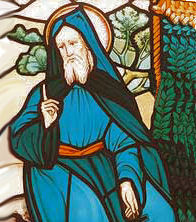
The Church in Wales celebrates the Optional Memorial of St. Beuno or Benno (545-690), one of its greatest saints. He was a monk who founded his own community and performed numerous miracles, among them restoring St. Winifred's head after she was beheaded. He was an effective preacher who evangelized much of North Wales and founded a monastery at Clynnog Fawr (Carnavonshire). The medieval picture of this saint was that he was a wonder-worker and aristocrat, monk and master of monks, patriot, and a challenger of tyrants.
Other commemorations listed today in the Roman Martyrology:
- St. Marcellinus (d. 374) who was born in Africa, of a noble family; accompanied by two other bishops, Vincent and Domninus, he went over into Gaul, and there preached the Gospel, with great success, in the neighborhood of the Alps.
- St. Agnes of Montepulciano (1268-1317) was a Dominican prioress in medieval Tuscany, she was known as a miracle worker during her lifetime.
- Pope St. Anicetus (d. 166) was the tenth successor of St. Peter. He governed the Church from 155 to 166, years of great difficulty when Christianity in Rome had to face not only persecution by the emperors but also the heretical tendencies of the second century. St. Anicetus was visited in Rome by St. Polycarp, Bishop of Smyrna, who came to discuss with him the date of Easter.
Meditation for Saturday of the Third Week of Easter
The Glory of the Resurrection
1. "Alleluia. It behooved Christ to suffer ... and so to enter into His glory." "Christ, rising again from the dead, dieth now no more; death shall no more have dominion over Him" (Rom. 6:9). Thus the glorified Christ stands before us and prays for us to His Father. "Father, I will that where I am, they also whom Thou hast given Me may be with Me [as My brethren, as members of My body], that they may see My glory which Thou has given Me" (John 17:24).
2. The glory of the risen Christ. Christ gave us a glimpse of His glory through the three apostles whom He took with Him to Mount Tabor, where "He was transfigured before them. And His face did shine as the sun, and His garments became white as snow" (Matt. 17:2). Now, after the resurrection, the splendor of the victor becomes visible on Tabor. The soul of Jesus, from the plenitude of the light of divine life with which it is flooded, sheds its heavenly beauty and strength upon His body also. Even though He was wounded, scourged, spat upon, and mocked, even though He suffered the pains and tortures of His passion, and was put to death and robbed of all beauty, yet He now shines with the brilliancy of the sun (gift of clarity). He can no longer suffer pain or death (gift of impassibility).
He has shed all the defects of mortal human nature. The fulfillment of every wish and command follows the act of the will with the speed of light, penetrating all things like thought, like a spirit; He is like a spirit, yet possesses a true body (gift of agility). For the risen Christ, walls, towers, and locks are no longer an obstacle. On Easter morning the glorified body of Jesus rises from the grave and penetrates the door of the room where the disciples were gathered with the ease with which light penetrates glass. Such was the glory of the risen Christ. "Shout with joy to God all the earth, alleluia; sing ye a psalm to His name, alleluia" (Introit).
The glory of those who rise with Christ. "When Christ shall appear [on the last day], who is your life, then you also shall appear with Him in glory" (Col. 3:4). Christ is risen, and we, too, shall one day rise from the dead. We are bound to Him by a most intimate union, for we have already risen with Him. The beginning of our resurrection is to be found in our baptism, by which we receive sanctifying grace, and in Holy Communion, by which we receive actual grace. This is the source of our eventual resurrection. "Who will reform the body of our lowness, made like to the body of His glory, according to the operation whereby also He is able to subdue all things unto Himself" (Phil. 3:21). "Then shall the just shine as the sun" (Matt. 13:43).
All the noble and holy saints who have ever lived on earth will rise and live again, and they will be honored and acclaimed in heaven for all eternity. For them there will be no more wailing, no more sorrow, no more pain. "Behold, I make all things new' (Apoc. 21:5; II Cor. 5:17). This miserable body which we now have will share in eternal life, in the glory and the immortality of the resurrection. "It is sown in corruption; it shall rise in incorruption. It is sown in dishonor; it shall rise in glory. It is sown in weakness; it shall rise in power. It is sown a natural body; it shall rise a spiritual body. ... And when this mortal hath put on immortality, then shall come to pass the saying that is written: Death is swallowed up in victory. O death, where is thy victory? O death, where is thy sting?" (I Cor. 15:42-44, 54 f.)
3. "A little while." If Christ is risen, then we, too, shall rise. After our residence on earth for a little while, the life "in My Father's house" awaits us (John 14:2). That life will not be an empty existence, a dull, shadowy life such as the pagans considered the afterlife; it will be a life full of activity, a full, eternal life spent in company with the blessed and with God, who is the fountainhead of all life and happiness. After this "little while" we shall experience complete satisfaction, we shall have every desire fulfilled, and be perfect in God. "Father, I will that where I am, they also whom thou hast given Me may be with Me" (John 17:24). A future of perfect bliss lies infallibly ahead of me. What, then, are the momentary trials and difficulties I suffer now? Two things are absolutely certain: that life on earth is brief and transient; and that after a little while there will be an eternal life of glory (c. Rom. 8:18). Indeed, they are inseparably connected. By means of this short life I earn my eternal glory. "These that are clothed in white robes, who are they? And whence came they?" John is asked in the Apocalypse. When he is unable to answer, he is told: "These are they who are come out of great tribulation and have washed their robes and have made them white in the blood of the lamb" (7:13 f.). "Out of great tribulation." That is the surest pledge and the best guarantee of a happy eternity.
Should not our hearts be filled with joy and blessed hope? We are one with the risen Christ. This union is the source of all our good fortune. If we truly believed and had full confidence, we would exclaim, "I look for the resurrection of the dead and the life of the world to come." The Christian may expect such a resurrection. "A little while…and I will see you again, and your heart shall rejoice."
—Benedict Baur, OSB, The Light of the World, Vol. 2
St. Beuno
Died c.630; he has another feast on January 14. There is evidence that Beuno was a Welsh man of importance, founder of several monasteries. His story that has been handed down to us is a legend written in 1346, but it may contain elements of truth. According to the legend, Beuno was the son of Beugi (Hywgi) and grandson of a Welsh prince. He was educated in Herefordshire, perhaps at Bangor Abbey, near which there is still a village called Llanfeuno. Beuno was the uncle of Saint Winifred, who was restored to life after her suitor severed her head.
The legend says that Cadvan was king of North Wales, and had recently been victorious over King Ethelred of Northumberland, who, about 607, had massacred the monks of Bangor. Saint Beuno gave the king a golden sceptre, and the prince in turn assigned a spot for Beuno’s monastery near Fynnon Beuno (Beuno’s Well), in the parish of Llanwunda, of which he is titular saint. But as he was laying the foundation, a woman came to him with a child in her arms, saying that the ground was this infant’s inheritance. Troubled by this, the holy man took the woman with him to the king and told him that he could not devote to God another’s patrimony. The king refused to pay any attention to his remonstrances. So the saint left. But Gwyddeiant, the king’s cousin, immediately went after him, and bestowed on him the township of Clynnog Fawr, his undoubted patrimony, where Beuno built his church about the year 616. King Cadvan died about that time; but his son and successor Cadwallon surpassed him in his liberality to the saint and his monastery.
It is related, among other miracles, that when a certain man had lost his eyebrow by some hurt, Saint Beuno healed it by applying the iron point of his staff: and that from this circumstance a church four miles from Clynnog, perhaps built by the person so healed, retains to this day the name of Llanael Hayarn, i.e., church of the iron brow.
His name is particularly associated with Clynnog in Caernarvonshire, where he may well have had a small monastery. There are many other foundations (including Aberffraw and Trefdraeth on Anglesey Island), both in central East Wales and in Clwyd, dedicated to him that may have be established by his disciples. Clynnog Fawr later passed into the hands of Benedictines of the congregation of Cluny (Clugni), from which it gets its name; previously it was named after its founder.
Beuno died and was buried at Clynnog Fawr, where a stone oratory was built over his tomb. Later his relics were translated to a new church (Eglwys y Bedd), where miracles were reported. The beautiful stone church is large and magnificent as is Saint Beuno’s chapel, which is joined to the church by a portico. In this chapel, the fine painted or stained glass in the large windows is much effaced and destroyed, except a large figure of our blessed Savior extended on the cross. Opposite this crucifix, about three yards from the east window, is Saint Beuno’s tomb, raised above the ground, and covered with a large stone, upon which people still lay sick children, in hopes of being cured.
Beuno’s cultus survived the Reformation. During the reign of Elizabeth I, there were complaints that lambs and calves were offered at his tomb and later brought back because Beuno’s cattle “prospered marvelous well.” Sick people were still brought to the supposed grave towards the end of the 18th century, where they bathed in his holy well and spent the night in his tomb. The ruins of his primitive oratory were excavated in 1914. In our age, Beuno’s memory has been revived by the Jesuits’ establishment of Saint Beuno’s College in northern Wales (Attwater, Benedictines, Encyclopedia, Farmer, Gill, Husenbeth). In art, Beuno is shown restoring his niece’s head (Roeder). He is chiefly venerated at Clynnog (Roeder).
—From Katherine Rabenstein. Saints of the Day
Symbols and Representation: Restoring the head of Saint Winifred
Highlights and Things to Do:
- Read more about St. Beuno:
- Read about the history of Shrewsbury Abbey.
- His tomb and shrine are located at Clynnog Fawr in Northwest Wales.
St. Marcellinus
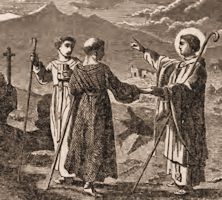 St. Marcellinus was born in Africa, of a noble family; accompanied by two bishops, Vincent and Domninus, he went over into Gaul, and there preached the Gospel, with great success, in the neighborhood of the Alps.
He afterwards settled at Embrun, where he built a chapel in which he passed his nights in prayer, after laboring all the day in the exercise of his sacred calling. By his pious example as well as by his earnest words, he converted many of the heathens among whom he lived.
He was afterwards made bishop of the people whom he had won over to Christ, but the date of his consecration is not positively known. Burning with zeal for the glory of God, he sent Vincent and Domninus to preach the faith in those parts which he could not visit in person.
He died at Embrun about the year 374, and was there interred. St. Gregory of Tours, who speaks of Marcellinus in terms of highest praise, mentions many miracles as happening at his tomb.
—Excerpted from Lives of the Saints, by Alban Butler, Benziger Bros. ed. [1894]
Highlights and Things to Do:
- Read more about St. Marcellinus:
- St. Marcellinus' relics were destroyed during the anti-religious sentiments of the French Revolution.
St. Agnes of Montepulciano
 A Dominican nun, Agnes (1268 – 1317) was renowned for her diligence in prayer and her extraordinary charity. Although born of a wealthy family in Gracchiano, Italy, she believed that charity is the only way to acquire the virtue of humility: there is no humility without charity; the one nourishes the other. She first joined the Sisters of the Sack (so-called because of their rough clothes) in Montepulciano. But when a new foundation was established in Proceno, Agnes was sent there as housekeeper; later she served as bursar and superior. Meanwhile, her austerities and her visions of Christ, Mary, and the angels had become so well known that the citizens of Montepulciano invited her to return. She did so and founded a convent in premises formerly used as brothels. Because she sought perfection according to the way of St. Dominic, she placed the convent under the direction of the Dominicans, and it grew and prospered.
St. Agnes of Montepulciano may be best known for an incident that occurred many years after her death. About seventy years after Agnes died, St. Catherine of Siena made a pilgrimage to the shrine of this revered Dominican foundress. St. Catherine bowed to kiss Agnes’ foot, the saint raised it up toward her. Catherine may not have been totally surprised, as miraculous characteristics had surrounded Agnes’ life.
This “little lamb” was born not far from Montepulciano in 1268. She expressed a desire to give her life to God and practiced pious exercises from an early age. Now and then, her parents gave in to her requests to visit the various convents in town. On one such occasion, Agnes and her mother were passing a house of ill repute, when a flock of crows suddenly descended upon her, pecking and scratching the little girl. Her mother remarked that the crows represented demonic forces threatened by her purity. Indeed, years later, Agnes would be asked to found a convent on that very spot.
In her teens, Agnes joined the Franciscans in Montepulciano and rose to become its prioress. Small white flakes in the form of crosses fell gently from the heavens in celebration. It is said that the sisters have preserved some of these until today. In 1306, God inspired Agnes to found a Dominican convent with three stones given her by the Blessed Mother in honor of the Trinity. The Blessed Mother had visited Agnes many times. On one of these occasions, she allowed Agnes to hold the Christ Child, but Agnes showed great reluctance in giving him back.
Toward the end of her life, Agnes sought healing from some famous springs. Although she did not receive healing herself, her prayers effected the resurrection of a child who had drowned in the springs. In 1317, Agnes died in Montepulciano and received her long-awaited reward.
—Excerpted from Dominican Sisters of St. Cecilia Congregation
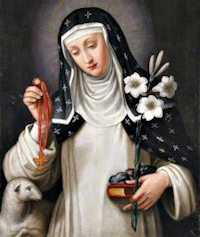
Symbols and Representation: Dominican nun gazing at the Cross with a lily at her feet; Dominican nun holding a model of Montepulciano, Italy; Dominican nun holding the Christ child; Dominican nun with Saint Catherine of Siena; Dominican nun with the Virgin and Child appearing to her; Dominican abbess with a lamb, lily, and book; Dominican with the sick who were healed at her tomb
Patronage: City of Siena, Italy
Highlights and Things to Do:
- Read more about St. Agnes:
- See some artistic renderings of St. Agnes.
- Her relics are in the Church of St. Agnes in Montepulciano. Her body is said to be incorrupt.
- St. Robert Bellarmine is also from Montepulciano, so there can be overlapping of food and drink ideas for both saints. There is a particular Montepulciano wine that would be perfect for St. Agnes (and St. Robert).
St. Anicetus
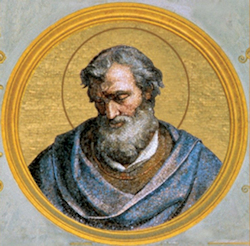 Pope Anicetus, St. Peter's tenth successor (154-165), ruled at a time when many noteworthy events transpired in the Church of God. It was the golden age of Gnosticism, and its chief proponents, Valentine and Marcion, had come to Rome. From the Orient Polycarp arrived to discuss the question regarding the day for celebrating Easter. Among other illustrious men in Rome at the time were Justin Martyr (cf. April 14), who took the occasion to write his second apology and thus precipitated his martyrdom; and the renowned Jewish Christian scholar, Hegesippus. During the pontificate of Pope Anicetus the Church suffered persecution under the Emperor Marcus Aurelius. There is extant a decree in which Anicetus forbade his clergy the vain and frivolous grooming of their hair. His grave is near that of St. Peter in the Vatican.
Highlights and Things to Do:
- Read more about Pope St. Anicetus:
- According to tradition, Pope St. Anicetus has been listed as a martyr for centuries during the reign of Emperor Lucius Verus, but there is no historical evidence of his martyrdom.
- Pope St. Anicetus' remains were transferred from Vatican Hill to the cemetery of Callistus. Later his sarcophagus which may once have contained remains is extant in the Palazzo Altemps.
- Listen to Mike Aquinina's Way of the Fathers podcast of St. Polycarp and the Social Network.
- Listen along to Catholic Culture's newest podcast on the Lives of the Popes by Thomas Mirus.