Ordinary Time: November 7th
Saturday of the Thirty-First Week of Ordinary Time
Other Commemorations: St. Fulk of Piacenza, Bishop (RM)
MASS READINGS
November 07, 2020 (Readings on USCCB website)
COLLECT PRAYER
Almighty and merciful God, by whose gift your faithful offer you right and praiseworthy service, grant, we pray, that we may hasten without stumbling to receive the things you have promised. Through our Lord Jesus Christ, your Son, who lives and reigns with you in the unity of the Holy Spirit, God, for ever and ever.
Recipes (2)
Activities (5)
Prayers (6)
Library (5)
Blog & Podcasts (0)
The month of November is dedicated to the Souls in Purgatory. Is it not sad but true that the living so soon forget the dead? We forget when we live, we are forgotten when we die. "Lay my body anywhere," pleaded the dying St. Monica with her son, St. Augustine, "only this I beg of you: remember me at the altar of God."
Historically today is the feast of St. Willibrord, apostle of Frisia and Archbishop of Utrecht and St. Engelbert, Archbishop of Cologne, Germany, slain by hired assassins and venerated as a martyr.
This year, in the current circumstances due to the “Covid-19” pandemic, the Plenary Indulgences for the deceased faithful will be extended throughout the entire month of November, with an adaptation of works and conditions to guarantee the safety of the faithful.
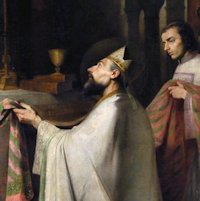
St. Fulk of Piacenza
St. Fulk was from Piacenza, with a Scottish heritage (both his parents were from Scotland), hence his name "Fulk."
The Scotti (Gauls), who spread from Piacenza throughout Italy, that is they were Scots. Scots at the time were said not to be the inhabitants of Scotland, but of Ireland. From the green Christian island, evangelized in the fifth century by St. Patrick, dozens of saints and religious had then descended on Europe, in centuries of political difficulties and moral miseries, as for a transfusion of fresh and living blood. And behind the Saints, especially when the northern islands were invaded by the Danes, came merchants, soldiers, entire families, such as the Piacenza Scotti, from which, around 1165, St. Fulk was born.
At the age of twenty he entered the canons regular of St. Euphemia, and since he was a young man of lively ingenuity, he was sent to complete his studies in theology in Paris, the intellectual capital of Christian Europe. Back in Piacenza, at the age of 30 he was made prior of Sant'Eufemia, then canon, then archpriest of the cathedral. Finally, he was elected Bishop of Piacenza. Six years later, the seat of Pavia remained vacant and St. Fulk was consecrated Bishop of this city as well.
Piacenza and Pavia were not only divided by the river, but also by a terrible hostility. They were known, and still picturesquely alive in the Italian tradition, to be rivaling neighboring cities. The rivalry between Piacenza and Pavia was of long duration and atrocious and bloody.
San Fulk was the great peacemaker of the two cities. Peace first of all internal, among citizens divided by political factions. Peace then between the two cities, Christian only in name.
In the course of his peacemaking work, St. Fulk died in 1229 of natural causes. Nothing else is known about his episcopate. But what is known, and above all remembered, is that he was an affectionate father, rich in wisdom and holiness.
Highlights and Things To Do:
- There isn't too much information about St. Fulk. See the Wikipedia entry and CatholicSaints.info for more details.