Ordinary Time: November 5th
Thursday of the Thirty-First Week of Ordinary Time
Other Commemorations: St. Bertille, Religious (RM); Feast of the Holy Relics Preserved in the Churches of the Diocese (Hist)
MASS READINGS
November 05, 2020 (Readings on USCCB website)
COLLECT PRAYER
Almighty and merciful God, by whose gift your faithful offer you right and praiseworthy service, grant, we pray, that we may hasten without stumbling to receive the things you have promised. Through our Lord Jesus Christ, your Son, who lives and reigns with you in the unity of the Holy Spirit, God, for ever and ever.
Recipes (2)
Activities (5)
Prayers (3)
Library (3)
Blog & Podcasts (6)
According to the 1962 Missal of St. John XXIII the Extraordinary Form of the Roman Rite, today is the feast of the Holy Relics Preserved in the Churches of the Diocese. It is also historically the feast of Sts. Zachary & Elizabeth, the parents of St. John the Baptist.
Since we are so closely associated with the Church Suffering in the communion of saints, fraternal charity demands that we pray fervently for those who have preceded us with the sign of faith and who rest in the sleep of peace. This thought is repeatedly inculcated in every Mass for the dead.
This year, in the current circumstances due to the “Covid-19” pandemic, the Plenary Indulgences for the deceased faithful will be extended throughout the entire month of November, with an adaptation of works and conditions to guarantee the safety of the faithful.
The Meaning of Suffrage
The just encounter God in death. He calls them to himself so as to share eternal life with them. No one, however, can be received into God's friendship and intimacy without having been purified of the consequences of personal sin. "The Church gives the name Purgatory to this final purification of the elect, which is entirely different from the punishment of the damned. The Church formulated her doctrine of faith on Purgatory especially at the Councils of Florence and Trent."
Hence derives the pious custom of suffrage for the souls of the faithful departed, which is an urgent supplication of God to have mercy on the souls of the dead, to purify them by the fire of His charity, and to bring them to His kingdom of light and life. This suffrage is a cultic expression of faith in the communion of saints. Indeed, "the Church in its pilgrim members, from the very earliest days of the Christian religion, has honoured with great respect the memory of the dead; and 'because it is a holy and a wholesome thought to pray for the dead that they may be loosed from their sins' (2 Mac 12, 46) she offers her suffrages for them." These consist, primarily, in the celebration of the holy sacrifice of the Eucharist, and in other pious exercises, such as prayers for the dead, alms deeds, works of mercy, and the application of indulgences to the souls of the faithful departed.
—Directory on Popular Piety and the Liturgy
St. Bertille
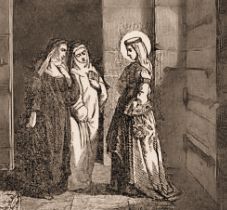 St. Bertille was born of one of the most illustrious families in the territory of Soissons (France), in the reign of Dagobert I. As she grew up she learned perfectly to despise the world, and earnestly desired to renounce it. Not daring to tell this to her parents, she first consulted St. Ouen, by whom she was encouraged in her resolution.
The Saint's parents were then made acquainted with her desire, which God inclined them not to oppose. They conducted her to Jouarre, a great monastery in Brie, four leagues from Meaux, where she was received with great joy and trained up in the strictest practice of monastic perfection.
By her perfect submission to all her sisters she seemed every one's servant, and acquitted herself with such great charity and edification that she was chosen prioress to assist the abbess in her administration.
About the year 646 she was appointed first abbess of the abbey of Chelles, which she governed for forty-six years with equal vigor and discretion, until she closed her penitential life in 692.
—Excerpted from Lives of the Saints, by Alban Butler, Benziger Bros. ed. [1894]
Highlights and Things to Do:
- Read more about St. Bertille:
- Butler's Lives of the Saints.
- Read more at AnaStPaul.
- Saints Stories for All Ages.
Feast of the Holy Relics
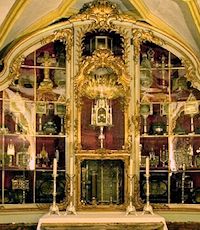 Although this is an historical feast and not on the General Roman Calendar or included in the Roman Martyrology, it is good to take time to examine how the Church venerates relics.
From Father Hardon's Catholic Dictionary:
An object connected with a saint, e.g., part of the body or clothing or something the person and used or touched. Authentic relics are venerated with the Church's warm approbation. They may not be bought or sold. Those of a martyr are placed in the altar stone at the consecration of an altar. Relics are of three classes: the first is part of the saint's body and is the type placed in the altar stone; the second is part of the clothing or anything used during the saint's life; and the third is any other object, such as a piece of cloth, that has been touched to a first-class relic. (Etym. Latin religuiae, remains.)
From the Code of Canon Law:
TITLE IV. THE VENERATION OF THE SAINTS, SACRED IMAGES, AND RELICS (Cann. 1186-1190)
- Can. 1186 To foster the sanctification of the people of God, the Church commends to the special and filial reverence of the Christian faithful the Blessed Mary ever Virgin, Mother of God, whom Christ established as the mother of all people, and promotes the true and authentic veneration of the other saints whose example instructs the Christian faithful and whose intercession sustains them.
- Can. 1187 It is permitted to reverence through public veneration only those servants of God whom the authority of the Church has recorded in the list of the saints or the blessed.
- Can. 1188 The practice of displaying sacred images in churches for the reverence of the faithful is to remain in effect. Nevertheless, they are to be exhibited in moderate number and in suitable order so that the Christian people are not confused nor occasion given for inappropriate devotion.
- Can. 1189 If they are in need of repair, precious images, that is, those distinguished by age, art, or veneration, which are exhibited in churches or oratories for the reverence of the faithful are never to be restored without the written permission of the ordinary; he is to consult experts before he grants permission.
- Can. 1190 §1. It is absolutely forbidden to sell sacred relics.
- §2. Relics of great significance and other relics honored with great reverence by the people cannot be alienated validly in any manner or transferred permanently without the permission of the Apostolic See.
- §3. The prescript of §2 is valid also for images which are honored in some church with great reverence by the people.
From the Catechism of the Catholic Church:
Besides sacramental liturgy and sacramentals, catechesis must take into account the forms of piety and popular devotions among the faithful. The religious sense of the Christian people has always found expression in various forms of piety surrounding the Church's sacramental life, such as the veneration of relics, visits to sanctuaries, pilgrimages, processions, the stations of the cross, religious dances, the rosary, medals, etc. (CCC 1674).
From Directory on Popular Piety and the Liturgy: Principles and Guidelines:
The Relics of the Saints236. The Second Vatican Council recalls that "the Saints have been traditionally honoured in the Church, and their authentic relics and images held in veneration". The term "relics of the Saints" principally signifies the bodies—or notable parts of the bodies—of the Saints who, as distinguished members of Christ's mystical Body and as Temples of the Holy Spirit (cf. 1 Cor 3, 16; 6, 19; 2 Cor 6, 16) in virtue of their heroic sanctity, now dwell in Heaven, but who once lived on earth. Objects which belonged to the Saints, such as personal objects, clothes and manuscripts are also considered relics, as are objects which have touched their bodies or tombs such as oils, cloths, and images.
237. The Missale Romanum reaffirms the validity "of placing the relics of the Saints under an altar that is to be dedicated, even when not those of the martyrs". This usage signifies that the sacrifice of the members has its origin in the Sacrifice of the altar, as well as symbolising the communion with the Sacrifice of Christ of the entire Church, which is called to witness, event to the point of death, fidelity to her Lord and Spouse.
Many popular usages have been associated with this eminently liturgical cultic expression. The faithful deeply revere the relics of the Saints. An adequate pastoral instruction of the faithful about the use of relics will not overlook:
- ensuring the authenticity of the relics exposed for the veneration of the faithful; where doubtful relics have been exposed for the veneration of the faithful, they should be discreetly withdrawn with due pastoral prudence;
- preventing undue dispersal of relics into small pieces, since such practice is not consonant with due respect for the human body; the liturgical norms stipulate that relics must be "of a sufficient size as make clear that they are parts of the human body";
- admonishing the faithful to resist the temptation to form collections of relics; in the past this practice has had some deplorable consequences;
- preventing any possibility of fraud, trafficking, or superstition.
The various forms of popular veneration of the relics of the Saints, such as kissing, decorations with lights and flowers, bearing them in processions, in no way exclude the possibility of taking the relics of the Saints to the sick and dying, to comfort them or use the intercession of the Saint to ask for healing. Such should be conducted with great dignity and be motivated by faith. The relics of the Saints should not be exposed on the mensa of the altar, since this is reserved for the Body and Blood of the King of Martyrs.
Highlights and Things To Do:
- Read Catholic Encyclopedia's entry on relics.
- Read more about this feast at New Liturgical Movement.
- Read about the Church Teaching on Relics.
- See Catholic Answers' Tract on Relics.
A Guide to Plenary Indulgences for the All Souls' "Octave", November 1-8
Visiting a Cemetery: An indulgence, applicable only to the Souls in Purgatory, is granted to the faithful, who devoutly visit a cemetery and pray, even if only mentally, for the departed. The indulgence is plenary each day from November 1-8; on other days of the year it is a partial indulgence.
Visiting a Church on November 2: A plenary indulgence, applicable only to the souls in purgatory, is granted to the faithful who, on All Souls' Day (or, according to the judgment of the ordinary, on the Sunday preceding or following it, or on the solemnity of All Saints), devoutly visit a church or an oratory and recite an Our Father and the Creed.
Praying for the Faithful Departed: A partial indulgence, applicable only to the souls in purgatory, is granted to the faithful who,
- devoutly visit a cemetery and at least mentally pray for the dead;
- devoutly recite lauds or vespers from the Office of the Dead or the prayer Eternal rest. (Manual of Indulgences, Fourth Edition, 1999)
Indulgence Requirements:
- To gain a plenary indulgence, in addition to excluding all attachment to sin, even venial sin, it is necessary to perform the indulgent work and fulfill the following three conditions: sacramental Confession, Eucharistic Communion, and prayer for the intention of the Sovereign Pontiff.
- A single sacramental confession suffices for gaining several plenary indulgences, but Holy Communion must be received and prayer for the intention of the Holy Father must be recited for the gaining of each plenary indulgence.
- The three conditions may be fulfilled several days before or after the performance of the prescribed work; it is, however, fitting that Communion be received and the prayer for the intention of the Holy Father be said on the same day the work is performed.
- The condition of praying for the intention of the Holy Father is fully satisfied by reciting one Our Father and one Hail Mary. A plenary indulgence can be acquired only once in the course of the day, a partial indulgence can be acquired multiple times.
- If a visit to a Church or an oratory is required to obtain an indulgence attached to a particular day, this may be accomplished from noon of the preceding day until midnight of the particular day.
Manual of Indulgences, Fourth Edition, 1999 (Enchiridion Indulgentarium)