Make your gift today!
Help keep Catholics around the world educated and informed.
Already donated? Log in to stop seeing these donation pop-ups.
MASS READINGS
February 03, 2008 (Readings on USCCB website)
COLLECT PRAYER
Lord our God, help us to love you with all our hearts and to love all men as you love them. Grant this through our Lord Jesus Christ, your Son, who lives and reigns with you and the Holy Spirit, God, for ever and ever. Amen.
Recipes (1)
Activities (3)
Prayers (3)
Library (0)
Blog & Podcasts (6)
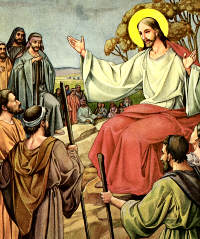
"Blessed are they who are persecuted for the sake of righteousness, for theirs is the kingdom of heaven. Blessed are you when they insult you and persecute you and utter every kind of evil against you falsely because of me. Rejoice and be glad, for your reward will be great in heaven."
Sunday Readings
The first reading is taken from the Book of the Prophet Zephaniah (one of the twelve minor prophets) 2: 3; 3: 12-13. The day was coming when God would punish not only the pagan nations, but also Judah for her pride and rebelliousness. However, a remnant would survive the day of wrath, if they continued to be humble and obedient to God's commands. It is this section of Zephaniah's prophecy that is read for us today.
The second reading is from the first Letter of St. Paul to the Corinthians 1:26-31 and continues his correction of the Corinthians for their pride.
The Gospel is from the Gospel of St. Matthew 5:1-12a. The slaves and the serfs of our Lord's day had sufficient food to keep them fit for work because their masters needed their labor; today, there are millions in the underdeveloped continents who are not slaves but who are continually on the borderline of starvation through no fault of theirs. And in the developed countries there are many thousands who are in dire need because of the injustices of their fellowmen.
The early Christians suffered tortures and death for professing the faith of Christ, but they felt privileged to be called on to imitate their divine master. Today, there are millions of Christians who are suffering a long-drawn-out, and therefore a more difficult persecution for the same cause.
To all of these, to the poor, the despised, the persecuted. Christ gave the promise of an eternal reward which would repay a thousand-fold the short-lived sufferings of this life. It was this promise that gave the strength to so many, and is still giving the strength to thousands, to persevere in their faith and in their trust in God, no matter what their earthly lot may be.
While consoling the underprivileged, Christ has positive commands for those of His followers who are in a position to carry them out, "Blessed are the merciful," He says. That is to say: those who will show mercy and compassion to their suffering, needy fellowmen, can rest assured that God will be merciful to them, when they meet Him on their judgment day. The contrary is equally true and certain. The man who shuts his eyes and his heart to the hungry, the oppressed, the naked among his fellowmen need not, and cannot, expect mercy and forgiveness, when he has to render an account of his life's work. This is a thought that should make many of us examine our consciences more closely.
A second command which would do so much to make life on this earth more tolerable for all, if only all Christians and all other men of goodwill carried it out, is: "Blessed are the peacemakers." The vast majority of men of all creeds and colors desire peace. They hate war, which brings nothing but misfortune and sufferings to all sides. If only the peace-loving people of the earth could make their voices heard, life's journey would be made so much easier for all. Christians, surely, should give the lead here: it is Christ himself who told us that it is one of the principal means to happiness, not only in the next life but in this. Life for all of us has enough of sadness, trials and catastrophes without adding the man-made sufferings and afflictions of war.
It is true that the real, the eternal, beatitude or happiness can be found by men only in heaven, but a certain portion of it could be found by us on this earth if mercy and peace-making were practiced by all Christians and non-Christians of goodwill.
— Excerpted from The Sunday Readings Cycle A, Fr. Kevin O' Sullivan, O.F.M.
Meditation: "Fasching"—Mardi Gras: The Ground of Our Freedom
Fasching—Mardi gras—is certainly not a Church festival. Yet on the other hand, it is unthinkable apart from the Church's calendar. Thus if we reflect on its origin and significance, it can contribute to our understanding of faith.
Fasching has many roots, Jewish, pagan and Christian, and all three point to something common to men of all times and places. It shows a certain correspondence to the feast of Purim in the Jewish calendar, which recalls Israel's deliverance from the menace of persecution of the Jews in the Persian empire, a deliverance brought about, in the biblical account, by Queen Esther. The joyful abandon with which this feast is celebrated is intended to express the feeling of liberation, and on this day it is not only a memory but also a promise: the person who is in the hands of the God of Israel is already, in anticipation, freed from the snares of his enemies.
But behind this exuberant, worldly feast, which had and still has a place in the religious calendar, there is also an awareness of that temporal rhythm which was given classical expression in the Book of Ecclesiastes: "For everything there is a season, and a time for every matter under heaven: a time to be born and a time to die; a time to plant and a time to pluck up what is planted;… a time to weep and a time to laugh; a time to mourn and a time to dance" (Qo 3: iff.). Not everything is appropriate at all times; the human being needs a rhythm, and the year gives him this rhythm, both through creation and through the history which faith sets forth in the yearly cycle.
This brings us to the Church's year, which enables man to go through the whole history of salvation in step with the rhythm of creation, simultaneously ordering and purifying the chaotic multiplicity of our nature. Nothing human is omitted from this cycle of creation and history, and only in this way can all human reality, its dark side and its light side, the world of sense and the world of spirit, be saved. Everything finds its place in the whole, which gives it meaning and delivers it from its isolation. So it is foolish to want to prolong Fasching when business and one's agenda seem to recommend it: such extra time, artificially created by ourselves, turns into boredom; man is left alone as his own creator and feels truly forsaken. Then time is no longer the varied gift of creation and history but the monster which devours itself, the empty preoccupation with sameness, whirling us round in a circle of meaninglessness, ultimately devouring us as well.
Let us go back to think about the roots of Fasching. As well as the Jewish, there is the pagan prehistory, whose fierce and menacing features still stare at us in the masks worn in Alpine, Swabian and Alemannic parts of Germany. What lie behind this are the rites for driving out winter and banishing demonic powers: the changes involved in times and seasons seemed to threaten the world's continuance; it was necessary to secure the earth and its fruitfulness against the void to which, in the sleep of winter, the world seemed to come perilously close.
At this point we can observe something of great significance: in the Christian world the demonic mask becomes a light-hearted masquerade, the life-and-death struggle with the demons becomes fun and merriment prior to the seriousness of Lent. This masquerade shows us something we can often see in the psalms and in the prophets: it becomes a mocking of the gods, who no longer need to be feared by those who know the true God. The masks of the gods have become an amusing show, expressing the high spirits of those who can laugh at what once brought terror. To that extent, Fasching actually does contain elements of Christian liberation, the freedom of the One God, perfecting that freedom commemorated in the Jewish feast of Purim.
In the end, however, we are faced with a question: Do we still enjoy this freedom? Or is it not a fact that, ultimately, we would like to free ourselves from God, from creation and from faith, in order to be totally free? And is not the consequence of this that we are once again handed over to the gods, to commercial forces, to greed, to public opinion? God is not the enemy of our freedom but its ground. That is something we ought to relearn in these days. Only love that is almighty can ground a joy that is free from anxiety.
—From Seek That Which Is Above by Joseph Cardinal Ratzinger (Pope Benedict XVI)