Make your gift today!
Help keep Catholics around the world educated and informed.
Already donated? Log in to stop seeing these donation pop-ups.
Lent: March 2nd
Monday of the Second Week of Lent
Other Commemorations: Bl. Charles the Good, Martyr (RM)
MASS READINGS
March 02, 2026 (Readings on USCCB website)
PROPERS [Show]
COLLECT PRAYER
Monday of the Second Week of Lent: O God, who have taught us to chasten our bodies for the healing of our souls, enable us, we pray, to abstain from all sins, and strengthen our hearts to carry out your loving commands. Through our Lord Jesus Christ, your Son, who lives and reigns with you in the unity of the Holy Spirit, God, for ever and ever.
Recipes (0)
Activities (5)
Prayers (9)
Library (0)
Blog & Podcasts (0)
The greatest proof of Christ's charity was given on the Cross. With Christ our gift of ourselves will be given to God as an expression of our love. Communion will lift our human activities up to God's level, not only in will and intention, but in the reality of the sacrament. Let us offer then, and believe, and change our lives into more loving. —St. Andrew Bible Missal
The Roman Martyrology commemorates Blessed Charles the Good (1083-1127), the Danish prince, son of the holy King Canuto IV, gained the crown of the Count of Flanders from his maternal lineage. After an initial brief interval, his reign was marked by peace and justice. Dedicated to the defense and aid of the poor and weak, he was killed by soldiers that he had tried to pacify. Leo III officially beatified him in 1882 and the new Roman Martyrology commemorates the anniversary of his martyrdom.
Meditation for Monday of the Second Week of Lent—The Value of Fasting
Is fasting really worthwhile? Whenever I consider the value of a religious practice, I always look into the earthly life of our Savior. He is our model. He dwelt with us in order to teach us how to form our lives inwardly and outwardly. Christ Himself fasted often and accorded it high praise in His teaching. Recall how He fasted forty days before entering upon His work of teaching. At the beginning of Lent the Church wishes to stamp this fact deep in our hearts: our fasting must be in union with and in imitation of Christ's.
I call to mind the mystery-laden, pregnant words spoken by our Savior when the disciples, unable to cure a possessed boy, asked, "Why could we not cast him out?," and Jesus answered, "This kind can be driven out in no way except by prayer and fasting" (Mark 9:29). This reply has always made the deepest impression on me. Prayer and fasting are extraordinary means (we may call them violent means) when other simpler ways are of no avail against the powers of hell.
Now another saying of Jesus comes to mind. When John's disciples began to reproach Him, "Why do Your disciples not fast?," He replied: "Can you make the wedding guests fast as long as the bridegroom is with them? As long as they have the bridegroom with them, they cannot fast. But the days will come when the bridegroom will be taken away from them; in those days they will fast" (Luke 5:35). There is a hidden depth of meaning in these words. The coming of Christ among men was a wedding feast. Fasting had no place. But it is most proper too fast when the divine Bridegroom is taken away. Fasting on Fridays and during Holy Week, then, is in accord with Christ's own wishes.
I should like to cite one further passage from the Gospel, one which casts light on fasting from another direction. Once our Savior compared Himself with the Baptist in these words, "John came neither eating nor drinking, and they say, ‘He has a devil!’ The Son of Man came eating and drinking, and they say, ‘Behold a glutton and a wine drinker.’" John was a man devoted to penance, an ascetic, who fasted throughout his life. Not so Christ. His way of living was not based exclusively upon self-denial and mortification, but upon an ordered enjoyment of life. So we learn from the Savior that fasting should be the exception, not the rule, in Christian morality.
To complete the lesson let us consider for a moment the passage in the Sermon on the Mount where Jesus speaks of the three important pious exercises of fasting, prayer, and almsgiving. He highly recommends all three, but warns against practicing these virtues in a pharisaical manner.
The main points in Jesus' doctrine on fasting, then, are:
- Fasting is an extremely important means of resisting the inroads of hell (hence Lent).
- Fasting should be practiced as a memorial of Christ's death (Friday, Holy Week).
- Fast days occur by way of exception in Christian life, they are not the normal practice.
- Fasting holds a place alongside prayer and almsgiving as a pious exercise.

Monday of the Second Week of Lent
Station with San Clemente (St. Clement):
The oldest level of St. Clement's is thought to be the titulus Clementis, one of the first parish churches in Rome, and probably belonged to the family of Titus Flavius Clemens, consul and martyr and a contemporary of Pope St. Clement. Set right next to a pagan temple, a Mithraeum or Temple of Mithras, it was one of the first churches in Rome.
For more on San Clemente, see:
- The Station Churches of Rome
- Rome Art Lover
- Roman Churches
- Churches of Rome
- PNAC
- Aleteia
- Station Church
- The Catholic Traveler
- Roman Despatches
- Walks in Rome
For further information on the Station Churches, see The Stational Church.
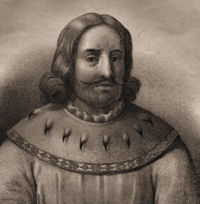
Blessed Charles the Good
Count Charles of Flanders, was called "the good" by the people of his kingdom. They named him for what they found him to truly be. He was the son of St. Canute, king of Denmark. Charles was just five years old when his father was murdered in 1086. When Charles grew up, he married a good young woman named Margaret. Charles was a mild and fair ruler. The people trusted him and his laws. He tried to be an example of what he expected the people to be.
Some nobles accused Charles of unjustly favoring the poor over the rich. He answered kindly, "It is because I am so aware of the needs of the poor and the pride of the rich." The poor of his realm were fed daily at his castles.
Charles ordered the abundant planting of crops so that the people would have plenty to eat at reasonable prices. Some wealthy men tried to hoard grain to sell at very high prices. Charles the Good found out and forced them to sell immediately and at fair prices. An influential father and his sons had been reprimanded by Charles for their violent tactics. They joined the little group of enemies who now wanted to kill him.
The count walked every morning barefoot to Mass and arrived early at the Church of St. Donatian. He did this in a spirit of penance. He longed to deepen his own spiritual life with God. His enemies knew that he walked to church and also that he prayed often alone before Mass. Many people who loved Charles feared for his life. They warned him that his walks to St. Donatian could lead to his death. He replied, "We are always in the middle of dangers, but we belong to God." One morning, as he prayed alone before the statue of Mary, his attackers killed him. Charles was martyred in 1127.
—Excerpted from Holy Spirit Interactive
Patronage: counts; Crusaders; diocese of Burges, Belgium
Symbols and Representation: nobleman with a purse and a sword; depicted after his martyrdom in the cathedral; sword
Highlights and Things to Do:
- Read more about Bl. Charles:
- His remains are in the Sint-Salvatorskathedraal or Saint-Salvator Cathedral of Bruges, Flanders, in present-day Belgium.