What Are The Pearls? Examining the SSPX’s Declaration of Faith
By Peter Swindal ( articles ) | Jun 25, 2026
Editor’s note: This article is a commentary on the Society’s May 14 “Declaration of Faith,” not on its more recent “Profession of Faith.”
In the Gospels, Jesus Christ our Lord often intersperses simpler and more direct teachings with highly mysterious proclamations or parables masked with imagery that demands interpretation.
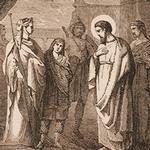
Perhaps the foremost example of the latter form of teaching is His command in the Sermon on the Mount, which we have heard in the lectionary in recent weeks: “Do not give dogs what is holy; and do not throw your pearls before swine, lest they trample them under foot and turn to attack you.” (Mt 7:8).
St. Augustine explains this passage: “We must therefore be on our guard, lest anything should be opened up to him who does not receive it: for it is better that he should seek for what is hidden, than that he should either attack or slight at what is open” (De Sermoni Domini in Monte, Bk. II, Ch. XX). More simply, in this passage, Christ is commanding that we be cautious about which truths we reveal, and to whom we reveal them; we must consider the disposition of the listener.
There has been no shortage of words regarding the coming July 1, 2026 Society of St. Pius X (SSPX) episcopal consecration. This essay will not be an analysis of the invalid ecclesial theology underlying this consecration, which has already been done very well by Eamonn Clark.
Rather, what is truly confusing and in need of further examination are the often insufficient responses to the SSPX’s claims themselves. George Weigel, examining the SSPX’s “Declaration of Faith,” clearly misrepresented both the SSPX’s position and the orthodox Catholic position on the matters, as Thomas Mirus pointed out.
In fact, there do not seem to be any major points of disagreement, depending on how they are understood when clarified, between the SSPX’s Declaration of Faith and the current position of the Holy See. At very least, no major points of disagreement are listed in the SSPX’s document, which is almost entirely composed of theses which the Church has affirmed and emphasized at various points in the past.
Many of these points center around the Church’s teaching on other religions, Hell, the Mass, political order, and salvation. It is clear that many of the theses are meant to respond to certain perceived abuses in the Church and especially of the Second Vatican Council.
For example, they write that “every man must be a member of the Catholic Church in order to save his soul, and there is but one baptism as the means of being incorporated into her. This necessity concerns the whole of humanity without exception and embraces without distinction Christians, Jews, Muslims, pagans, and atheists.”
Initially, this may seem to contradict the words of the Second Vatican Council’s Declaration Nostra Aetate, which states that the Church “rejects nothing that is true and holy in these religions. She regards with sincere reverence those ways of conduct and of life, those precepts and teachings which, though differing in many aspects from the ones she holds and sets forth, nonetheless often reflect a ray of that Truth which enlightens all men.” However, this is precisely why in the very next sentence, the Declaration states that the Church “must proclaim Christ… in whom men may find the fullness of religious life” (Nostra Aetate, p. 2, emphasis added).
There is no disagreement, therefore, between the SSPX and the Second Vatican Council on this particular issue. Why, then, does the SSPX find it necessary to declare this truth before the Holy See before illicit consecrations, stating that such a thesis is part of the “minimum indispensable to be in communion with the Church,” if they are not even in disagreement on the matter?
Perhaps the SSPX believes that the Church has not fully appreciated the truth that all are in need of the proclamation of Christ. Perhaps they believe that bishops or the Vatican itself have muddied this truth and that it ought to be kept in mind.
Yet whether this is true in particular cases is irrelevant to the question of whether what the Church says universally in the Second Vatican Council is true. The ancient maxim in the Church of abusus non tollit usum states that the deficient use of a thing in a particular case does not poison its application universally.
Quite on the contrary, if what the Church says in the Second Vatican Council about other religions is true, this could serve as an important means of evangelization without, as St. Augustine writes, the deeper truths we hold about Christ and the Church being attacked. Far from denying the truth that the Catholic Church is the true Church, it would allow Catholics to proclaim this truth according to the disposition of the listener.
Yet, ironically enough, it is manifestly clear that the Society of St. Pius X is aware of the necessity of selectively revealing truths to different audiences according to their disposition.
That is why they deliberately omitted from their Declaration of Faith their teachings on the liceity of the Novus Ordo Mass and the status of priests and bishops consecrated by that rite.
SSPX founder Marcel Lefebvre called attendance at the New Mass a “poison to the faith” and said that sacraments conferred by priests ordained under the new rite are “doubtful.” The SSPX’s website currently reads that the Novus Ordo “puts the faith in danger.”
This is clearly not a position that can be even slightly reconciled with the Second Vatican Council, as can the theses in the Declaration of Faith. Strangely enough, such a position cannot even be reconciled with the Council of Trent, which states:
If any one saith, that the ceremonies, vestments, and outward signs, which the Catholic Church makes use of in the celebration of masses, are incentives to impiety, rather than offices of piety; let him be anathema.
In response, the SSPX often argues that the Second Vatican Council created an entirely new religion, or at the very least, that the changes to the Mass done in the wake of it were illegitimate. This is why they argue there is a “state of emergency” in the Church.
The question is this: why would the SSPX mask their fundamental distrust of the Second Vatican Council and the Church’s hierarchy with a declaration of faith whose theses are almost entirely in accordance with what both the Second Vatican Council and the Church’s hierarchy currently teach, instead of openly stating their disagreements?
It seems very likely they did so to capitalize on ecclesiastical abuses in particular cases and thereby gain sympathy for their schismatic consecration among others who have witnessed such abuses.
No mistakes, however, should be made in our assessment of why this schism is occurring. It is not because members of the Church have committed abuses in particular cases. It is because they fundamentally reject the Catholic Church in its postconciliar form.
That is why they consider this belief to be a “pearl,” and the postconciliar Catholic faithful and hierarchy to be “swine.”
All comments are moderated. To lighten our editing burden, only current donors are allowed to Sound Off. If you are a current donor, log in to see the comment form; otherwise please support our work, and Sound Off!

-
Posted by: Thomas V. Mirus -
Jun. 27, 2026 12:04 AM ET USA
John - of course you are being sardonic, since the ill-formed comments of a single pope do not change the teaching of the Church. But even re: Francis, at the Wednesday general audience on April 3, 2019, the Pope clarified that he was referring to God's permissive will.
-
Posted by: john.n.akiko7522 -
Jun. 26, 2026 9:46 PM ET USA
The Church doesn't believe that anymore. Remember? Pope Francis said, "All religions are paths to reach God. I will use an analogy: they are like different languages that express the divine."
-
Posted by: benjaminmariasemv8004 -
Jun. 25, 2026 4:19 PM ET USA
I think the rub between the SSPX Declaration and Vatican II is not NA 2, but LG 16: "Those also can attain to salvation who through no fault of their own do not know the Gospel of Christ or His Church, yet sincerely seek God and moved by grace strive by their deeds to do His will as it is known to them through the dictates of conscience", echoing the Holy Office: "To obtain his salvation, it is not always required that he be de facto incorporated into the Church as a member".