


The Newman you should get to know
By Dr. Jeff Mirus ( bio - articles - email ) | Dec 02, 2025
St. John Henry Newman resisted the religious liberalism which dominated the Anglican Church in the nineteenth century and ultimately converted to Catholicism. He had a profound influence on twentieth-century popes, theologians and the Second Vatican Council. His titanic reputation led rapidly to the full series of posthumous Catholic honors: Declared venerable in 1991 by Pope St. John Paul II; beatified by Pope Benedict XVI in 2010; canonized by Pope Francis in 2019; and proclaimed a doctor of the Church by Pope Leo XIV just last month. (A new book documenting these achievements is available from Sophia Institute Press: Newman for Our Time: Saint, Scholar, and Doctor of the Church.)
Free eBook:
|
| Free eBook: Practical Theology |
It is no wonder that our own James Majewski has devoted so much time to recording Newman’s writings in Catholic Culture Audiobooks (we have fifty of these recordings so far). Indeed, given the conventions of serious writing in the nineteenth century (which was still mostly directed to a small intellectual class of highly-educated, highly-literate, and widely-read persons), a great many people today might find Newman easier to follow through these recordings. They make the rhythm and cohesion of the half-page sentences and multi-page paragraphs of nineteenth-century prose more accessible to modern readers. (I fear that Internet prose has made this even more true; it is hard to get away with writing paragraphs of more than a few lines on the web; nobody likes to scroll through dense text.)
Nonetheless, it is a very good thing to read at least some of Newman’s writings in their original form. I recall that when I was teaching at Christendom College and I wanted to assign Newman’s account of his own conversion to freshmen or sophomores, I sometimes gave them a choice of reading either his Apologia pro vita sua (in effect Newman’s autobiography, centering on a defense of the legitimacy of his conversion to Catholicism) or his novel Loss and Gain, which was a fictional account of the conversion to Catholicism of a student at Oxford during the Victorian era—and, indeed, this was the first book he published after his own entry into the Catholic Church in 1845. The fictional Loss and Gain is a far simpler book than the factual Apologia.
Or, of course, a reader could become acquainted with Newman through his poetry, perhaps beginning with “The Pillar of the Cloud”:
Lead, Kindly Light, amid the encircling gloom,
Lead Thou me on!
The night is dark, and I am far from home—
Lead Thou me on!
Keep Thou my feet; I do not ask to see
The distant scene,—one step enough for me.
I was not ever thus, nor pray’d that Thou
Should’st lead me on.
I loved to choose and see my path; but now
Lead Thou me on!
I loved the garish day, and, spite of fears,
Pride ruled my will: remember not past years.
So long Thy power hath blest me, sure it still
Will lead me on,
O’er moor and fen, o’er crag and torrent, till
The night is gone;
And with the morn those angel faces smile
Which I have loved long since, and lost awhile.
Mighty works
But there can be little question that the two greatest of Newman’s works were the books that related to his conversion. It was during his long and intense study of the development of Christian doctrine that he finally decided to leave the Anglicans and enter the Catholic Church. The resulting magnificent (and long) book could be called an “essay” in those days; in the space of several hundred pages Newman vindicated the Catholic Church by explaining that what she teaches today, though in appearance different from what was taught in the early Church, is in fact a genuine development of what had gone before—that is, a corroboration of past teaching more fully articulated rather than a contradiction. Indeed, Newman’s Essay on the development of Christian doctrine has become the gold standard for distinguishing legitimate doctrinal development from doctrinal rejection and abandonment.
If Newman delayed his reception into the Catholic Church for a a few months until he could complete this colossal study which distinguishes authentic doctrinal development from doctrinal corruption, he delayed nearly another twenty years before he finally responded to the constant public criticism by his former Anglican friends and acquaintances. In an effort to besmirch so great an intellect, these voices attacked him for what they claimed was his long period of duplicitous secret Catholicism within the Anglican Church before he publicly embraced Catholicism. They alleged that Newman secretly counseled others to go to Rome before he did so himself—a charge which was manifestly false, and which Newman finally and very ably refuted in the Apologia pro vita sua (that is, the “defense of his life” by John Henry Newman).
Many have also praised a third long book, The Idea of a University, which grew out of a series of lectures Newman gave in soliciting understanding and support for a new Catholic university he had been charged to establish in Ireland. The project ultimately failed, but there is probably no better or clearer explanation of the relationship among all the different studies and disciplines that should be fostered within any authentically Catholic academic setting. We who have seen the disastrous abandonment of the proper relationship among all the various areas of study in Catholic universities around the world over the past few generations can profit immensely from reading (or re-reading) Newman on this important subject. For each legitimate discipline has its own claim to the perception of truth by its own proper methods, and these various explorations of reality must be fostered in relationship to each other, in both their proper order and their harmonious whole.
Still later, Newman wrote An Essay in Aid of a Grammar of Assent (1870), which is a thorough study of the very complex combination of interior processing and commitment by which the human person comes to discern and accept reality by giving his assent to what is true. Though probably the least easily grasped (and surely the least entertaining) of all his writings, this is the work in which Newman seeks to explore objectively that same problem which immersed him in controversy for so much of his life—the nature and necessity of the human recognition of and commitment to the truth.
Indeed, for Newman everything comes down to truth as the mind’s grasp of reality. Five years earlier, he had even written a long poem, The Dream of Gerontius (which he always maintained was both written and published by accident). It explores the inner life of a dying man who is passing through that portal and awakening to the necessity of judgment. At such a moment, the soul’s authentic perception of reality reveals itself as the very core of life.
Final honors
When the First Vatican Council was considering the question of papal infallibility, Newman indicated that he believed the doctrine but was uneasy about its declaration because it might be misunderstood as applying to far too many papal utterances without proper differentiation regarding their nature, intention and scope. Such concerns may have earned the disfavor of Pope Pius IX, but his successor Leo XIII named Newman a cardinal—an honor Newman accepted but with the requests that he would not be consecrated a bishop and that he would be able (at age 78) to remain in Birmingham.
Even in this honor Newman wished to maintain that same constancy of which he had written years earlier in the poem entitled “My Birthday”:
It is my Birthday;—and I fain would try,
Albeit in rude, in heartfelt strains to praise
My God, for He hath shielded wondrously
From harm and envious error all my ways,
And purged my misty sight, and fixed on heaven my gaze.
And so Newman died as he had lived, in Birmingham on August 11, 1890, at the age of 89.
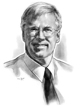
Jeffrey Mirus holds a Ph.D. in intellectual history from Princeton University. A co-founder of Christendom College, he also pioneered Catholic Internet services. He is the founder of Trinity Communications and CatholicCulture.org. See full bio.
All comments are moderated. To lighten our editing burden, only current donors are allowed to Sound Off. If you are a current donor, log in to see the comment form; otherwise please support our work, and Sound Off!

