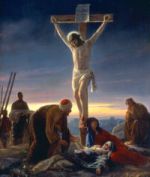
Christ’s forgotten nighttime suffering (and that’s not all)
By Dr. Jeff Mirus ( bio - articles - email ) | Feb 03, 2026 | In Reviews
Christmas seems to take a very long time to arrive, while Lent leaps out and grabs us before we have time to blink. Ash Wednesday 2026 is just a week away. So now we are called upon to reflect not on the baby in the manger but on the man whose “sweat became like great drops of blood falling down upon the ground” (Luke 22:44). The realities of the passion and death of Jesus Christ trigger in us a significantly different response than do the details of His nativity.
Our Lord’s bloody sweat was almost certainly a mixture of blood seeping through the skin and mixing with sweat, rather than the production of blood by Our Lord’s sweat glands. Though St. Luke was a physician, he was describing all this at second-hand and he likely did not know of the rare condition now called hematidrosis, in which blood seeps out through the skin without any unusual cuts or openings and mixes with sweat on the surface. But there are now many recorded cases in which this has happened under conditions of physical or emotional stress.
Our Lord, of course, was enduring what we might justly call infinite stress, for He had a complete knowledge of the magnitude of the sins for which He was about to suffer, and this long-anticipated ordeal was now upon him. To help us understand the nature and significance of this consummation, Thomas W. McGovern, MD describes what we know about Christ’s trauma in detail in a 400-page study: What Christ Suffered: A Doctor’s Journey through the Passion, published this year by Our Sunday Visitor. This is a revised and expanded edition of the original text published five years ago.
The phenomenon of “sweating blood”, of course, is just one aspect of Christ’s sufferings. The book describes and medically analyzes the entire agony step-by-step through His salvific passion and death. But it is much more than just a chronicle. Throughout, Dr. McGovern not only incorporates up-to-date medical knowledge but also explores the ancient sources to learn more about the exact nature of the punishments Our Lord suffered, including the details of crucifixion in that time and place. He also draws added insight from modern practices around the world which have had much in common with some of the physical punishments which Christ endured.
Sidelights
The book is peppered with sidelights as well, including medical, geographical and historical photographs, maps and diagrams. Dr. McGovern also believes that his own growth in the understanding of human suffering has enabled him to make this new edition significantly better than the original. Occasionally he offers his own insights on how to deal with suffering in a positive way (as Our Lord did), most particularly in chapters 11 and 12. Even in considering the Agony in the Garden in chapter 3, he notices that Christ Himself used the human technique of “reframing” to keep his sufferings in perspective, immediately shifting from his initial human dread (“if it be possible, let this cup pass from me”) to His considered fixed disposition (“nevertheless, not my will but yours be done”).
The book’s chapters cover the nature of suffering, preparation for Christ’s suffering, bloody sweat, nighttime suffering, scourging, royal treatment, way of the cross, crucifixion and death, and also post-crucifixion events, the importance of doing good by our suffering, and of doing good to those who suffer. A new final chapter introduces the importance of joy in suffering, reflecting on St. Paul’s statement in Colossians 1:24: “Now I rejoice in my sufferings for your sake, and in my flesh I complete what is lacking in Christ’s afflictions for the sake of his body, that is, the Church.” There are also two informative appendices which cover what both ancient literature and other sources of information reveal about the nature and effects of crucifixion.
Medical and spiritual knowledge
Throughout the book McGovern uses not only ancient sources but modern medical knowledge to clarify what was done to Jesus, and how His body would have responded to it. But he also sees both the psychological and spiritual aspects of suffering and how all of us can best respond to them. In addition to the immense historical research and medical knowledge displayed here, there is an emotional and spiritual wisdom regarding the value of suffering, and how the human person can respond to it as a son or daughter of God, both loving and beloved.
As Bishop James Conley of Lincoln, Nebraska noted in the introduction, McGovern’s book is a huge gain on the first small book the bishop himself read on this subject, A Doctor at Calvary by Pierre Barbet, MD, who had served as a surgeon in World War I, and who published an initial study in 1950. Three generations later, McGovern’s fresh effort is far more thorough. In addition, he takes St. John Paul II as his spiritual guide, particularly as this great pope articulated the Catholic understanding of suffering in Salvifici Doloris (Salvific Suffering) in 1984.
In What Christ Suffered we have a book not only fascinating in its details but spiritually enriching. Roughly 400 pages long, it could well serve as spiritual reading throughout the entirety of Lent—when, after all, we really should be meditating on the sufferings of the One who saved us from our sins. Indeed, we have not only our own sins to consider but also the remedy Christ has provided—the sacrifice He offered for us. That remedy is the journey of suffering that is so well described in this remarkable book.
Thomas W. McGovern, MD. What Christ Suffered: A Doctor’s Journey Through the Passion. Revised and expanded edition. Our Sunday Visitor, 2025. 423 pp. Paper $32.95.

Jeffrey Mirus holds a Ph.D. in intellectual history from Princeton University. A co-founder of Christendom College, he also pioneered Catholic Internet services. He is the founder of Trinity Communications and CatholicCulture.org. See full bio.
All comments are moderated. To lighten our editing burden, only current donors are allowed to Sound Off. If you are a current donor, log in to see the comment form; otherwise please support our work, and Sound Off!