Make your gift today!
Help keep Catholics around the world educated and informed.
Already donated? Log in to stop seeing these donation pop-ups.
Pope, in audience on Vatican II, reflects on universal call to holiness, evangelical counsels
April 08, 2026
Continuing his series of Wednesday general audiences on the Second Vatican Council and its documents, Pope Leo XIV spoke today about the universal call to holiness, as well as the evangelical counsels of poverty, chastity, and obedience.

The audience (video), which took place in St. Peter’s Square, was the thirteenth in the series and the seventh devoted to Lumen Gentium, the Dogmatic Constitution on the Church (1964). Today’s audience was entitled “Holiness and evangelical counsels in the Church.”
“Holiness, according to the Conciliar Constitution, is not a privilege for the few, but a gift that requires every baptized person to strive for the perfection of charity, that is, the fullness of love towards God and towards one’s neighbor,” Pope Leo told pilgrims in St. Peter’s Square. “Charity is, in fact, the heart of the holiness to which all believers are called.”
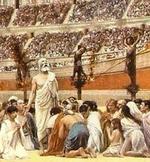
“The highest level of holiness, as in the early days of the Church, is martyrdom, the ‘supreme witness of faith and charity,’“ Pope Leo continued. “This readiness to bear witness is realized every time Christians leave signs of faith and love in society, committing themselves to justice.”
The Pope then spoke about sacramental grace and the need for conversion:
All the Sacraments, and in a pre-eminent way the Eucharist, are nourishment that fosters a holy life, assimilating every person to Christ, the model and measure of holiness. He sanctifies the Church, of which He is the Head and Shepherd: holiness is, from this point of view, His gift, which is manifested in our daily life every time we receive it with joy and respond to it with commitment ...
The sad reality of sin in the Church, that is, in all of us, invites each person to carry out a serious change of life, entrusting ourselves to the Lord, who renews us in charity. It is precisely this infinite grace, which sanctifies the Church, that entrusts us with a mission to fulfil day after day: that of our conversion. Therefore, holiness does not only have a practical nature, as if it were reducible to an ethical commitment, however great, but concerns the very essence of Christian life, both personal and communal.
“It is an invitation to be the ‘outgoing’ Church that Pope Francis spoke to us about: a Church embodied in history, always open to mission, in which we are all called to be missionary disciples, apostles of the Gospel, witnesses of the Kingdom of God, bearers of the joy of Christ whom we have encountered,” the Pontiff concluded. “Brothers and sisters, may the Easter we are preparing to celebrate renew in us the grace to be, like Mary Magdalene, like Peter and John, witnesses of the Risen One!”
Pope Leo said that consecrated life “constitutes a prophetic sign of the new world, experienced here and now in history. Indeed, signs of the Kingdom of God, already present in the mystery of the Church, are those evangelical counsels that shape every experience of consecrated life: poverty, chastity and obedience.”
He explained:
These three virtues are not rules that shackle freedom, but liberating gifts of the Holy Spirit, through which some of the faithful are wholly consecrated to God. Poverty expresses complete trust in Providence, freeing one from calculation and self-interest; obedience takes as its model the self-giving that Christ offered to the Father, freeing one from suspicion and domination; chastity is the gift of a heart that is whole and pure in love, at the service of God and the Church.
“By conforming to this style of life, consecrated persons bear witness to the universal vocation of holiness of the entire Church, in the form of radical discipleship,” the Pope added. “The evangelical counsels manifest full participation in the life of Christ, unto the Cross: it is precisely by the sacrifice of the Crucified One that we are all redeemed and sanctified!”
Pope Leo concluded:
By contemplating this event, we know that there is no human experience that God does not redeem: even suffering, lived in union with the passion of the Lord, becomes a path of holiness. The grace that converts and transforms life thus strengthens us in every trial, pointing us not towards a distant ideal, but towards the encounter with God, who became man out of love. May the Virgin Mary, the all-holy Mother of the Incarnate Word, always sustain and protect our journey.
Audiences in series “Vatican Council II through its Documents”
- Introductory catechesis (1/7/26)
On Dei Verbum, the Dogmatic Constitution on Divine Revelation (1965):
- God speaks to men as to friends (1/14/26)
- Jesus Christ reveals the Father (1/21/26)
- A single sacred deposit: The relationship between Scripture and Tradition (1/28/26)
- The Sacred Scripture: the Word of God in human words (2/4/26)
- The Word of God in the life of the Church (2/11/26)
On Lumen Gentium, the Dogmatic Constitution on the Church (1964)
- The mystery of the Church, sacrament of the union with God, and the unity of all humanity (2/18/26)
- No audience on 2/25 (Pope, Roman Curia on retreat)
- The Church, a Visible and Spiritual Reality (3/4/26)
- The Church, people of God (3/11/26)
- The Church, a Priestly and Prophetic People (3/18/26)
- On the foundation of the Apostles: The Church in her hierarchical dimension (3/25/26)
- Living stones in the Church and witnesses in the world: The laity in the People of God (4/1/26)
- Holiness and evangelical counsels in the Church (4/8/26)
For all current news, visit our News home page.
Further information:
All comments are moderated. To lighten our editing burden, only current donors are allowed to Sound Off. If you are a current donor, log in to see the comment form; otherwise please support our work, and Sound Off!