Move to: Previous Day | Next Day

Easter: April 17th

Friday of the Second Week of Easter

Other Commemorations: St. Robert of Molesme, Abbot (RM)

MASS READINGS

April 17, 2026 (Readings on USCCB website)

PROPERS [Show]

COLLECT PRAYER

Friday of the Second Week of Easter: O God, hope and light of the sincere, we humbly entreat you to dispose our hearts to offer you worthy prayer and ever to extol you by dutiful proclamation of your praise. Through our Lord Jesus Christ, your Son, who lives and reigns with you in the unity of the Holy Spirit, God, for ever and ever.

show

Recipes (1)

show

Activities (2)

show

Prayers (1)

show

Library (3)

Blog & Podcasts (0)

The Roman Martyrology commemorates St. Robert Molesme (1027-1110), traditionally considered to be the founder of the Cistercians, the reform that developed at Citeaux, France.


Meditation for Friday of the Second Week of Easter
The Sacrament of Penance
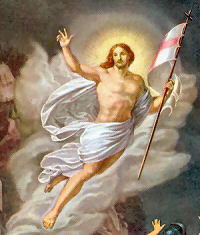
1. "At that time, when it was late that same day [Easter Sunday], the first of the week, and the doors were shut, where the disciples were gathered together for fear of the Jews, Jesus came, and stood in the midst, and said to them: Peace be to you. And when He had said this, He showed them His hands and His side. The disciples therefore were glad when they saw the Lord. He said therefore to them again: Peace be to you. As the Father hath sent Me, I also send you. When He had said this, He breathed on them, and He said to them: Receive ye the Holy Ghost; whose sins you shall forgive, they are forgiven them, and whose sins you shall retain, they are retained" (Gospel).

The sacrament of penance is the gift of the risen Christ to Ho Church, St. Jerome calls it a "second plank after our ship wreck," and Tertullian refers to it as "an arduous baptism." It is a marvelous means of salvation for those baptized.

2. "Whose sins you shall forgive, they are forgiven them." Christ sacrificed even His life for the salvation of men. Could He have done more for us? Should not the remembrance of the crucified One and the memory of His death for us inspire us with so great a love that we could never sin again? We have, moreover, the strength and the grace provided by the Eucharist, through which He gives Himself to us for the nourishment of our souls. Does not the Eucharist have the power to sanctify us so that we can overcome all sin, so that sin can no longer have any part in us? But Christ, knowing the weakness and the wickedness of men, approaches His Church on Easter might and provides her with yet another means for the remission of sin, for the healing of the wounds caused by sin, and for strengthening us against sin. He gives us the sacrament of forgiveness, of mercy, of reconciliation, a means whereby we may regain peace with God and with ourselves. "Peace be to you." This holy sacrament is His Easter greeting to His apostles, to His Church, and to us. He thus provides a new proof of His love and solicitude for us. He wishes to enrich us with grace and grant us forgiveness, even when we have been unfaithful.

"Peace be to you." He sets no limits to the number of times we may receive this sacrament, for He knows only too well our weakness and our instability. Neither does He set any limit on His mercy in this sacrament. There is no sin, however frightful, which cannot be forgiven. Even venial sins and the daily minor failings of which we are guilty, are matter for this sacrament. "Whose sins you shall forgive, they are forgiven them." Christ's mercy in giving us this sacrament shows us how concerned He is that we become incorporated in Him through baptism and the Eucharist. He wills that we be free from all sin and live as pure children of God. He desires that we begin a new life, free of all sin or infidelity to the Father. Would that we might carry out His designs!

Not only are the various mortal sins which we commit forgiven and destroyed by this sacrament, but also our venial sins and faults. Christ wills that through baptism and the Eucharist we become so firmly implanted in Him that we are freed from all sin and become children of God. He wills that we begin to live a new life that will be free from the slightest fault, and avoid even the smallest infidelity to His Heavenly Father. It is for this reason that the Church insists that all those who dedicate themselves to the quest of perfection such as priests and religious, receive this sacrament and its graces every week. She looks upon the "frequent" reception of this sacrament as an excellent means of acquiring Christian perfection. "By it genuine self-knowledge is increased, Christian humility grows, bad habits are corrected, spiritual neglect and tepidity are resisted, the conscience is purified, the will is strengthened, a salutary self-control is attained, and grace is increased in virtue of the Sacrament itself" (Pius XII, Encyclical, Mystici Corporis, Part III, 88). If the Sacrament can accomplish all these things for us, how zealously we should use it.

3. We acknowledge with gratitude and faith the precious Easter gift which the Lord has given us in the sacrament of penance. We recognize the apostles and their successors, the bishops and priests, as having the commission and the power to forgive or retain our sins. They are, therefore, placed over us as judges of our conscience. Because of these Easter gifts we subject ourselves in obedience and with confidence to the priests who have been placed over us. From them we seek and receive the forgiveness of our faults.

Since the Lord receives us in the sacrament of His mercy with so much love and solicitude, it is fitting that we respond to His advances with a like generosity. Knowing the importance and the efficacy of this sacrament, we should be eager to use it for the salvation of our soul and the enrichment of our spiritual life.
—Benedict Baur, OSB, The Light of the World


St. Robert of Molesme
St. Robert was born in 1027 near Troyes, Champagne, France, of noble birth. At age 17 he entered the Benedictine Abbey Montier-la-Celle, quickly rising to be prior of the abbey. He was made Abbot of Saint-Michel-de-Tonnerre in 1070, but considered it to have lax standards and the monks were quarrelsome, so he returned to Montiers-la-Celle. The same year he was placed over the priory Prior of Saint-Ayeul Abbey, which was connected to Montiers-la-Celle.

In 1075, in an attempt to return to a simpler form of Benedictine life requested by a group of hermits from the forests around Colan, France, he helped found the monastery at Molesme, Burgundy. The group, especially Robert, gained a reputation for piety. It is because of this reputation that in 1082 St. Bruno of Cologne came to Robert seeking advice. He lived with Robert's community for a time before going on to found the Grande Chartreuse, the first Carthusian monastery. , The growing reputation led to bequests of money, which led to an increase in size of the monastery, which led to internal difficulties, and suddenly there were many brothers that objected to the severe life practiced by the founders. Robert twice left to live on his own, but was ordered back to his position by the pope.

In early 1098 Robert, Saint Stephen Harding, Saint Alberic of Citeaux and 18 other monks left Molesme, and on March 21, they founded the monastery of Cîteaux near Dijon, France, with the goal of living strictly by the Benedictine Rule, strict vows of poverty, and frequent retreats; Robert served as the first abbot. However, with conditions deteriorating at the Molesme house he was re-assigned as abbot there in 1100 with a mandate to reform. The monks agreed to submit entirely to his interpretation of the Rule of St. Benedict. Molesme became a major center for the Benedictines under his tutelage. St. Albéric was made successor abbot at Cîteaux, with St. Stephen Harding as prior. St. Robert lived and worked in Molesme the rest of his life.

St. Robert is traditionally considered one of the founders of the Cistercians, the reform that developed at Citeaux.
—Adapted from Catholic Saints Info and Catholic Encyclopedia

Highlights and Things to Do: