Lent: March 9th
Monday of the Third Week of Lent; Opt. Mem. of St. Frances of Rome, Religious
Other Commemorations: Forty Martyrs of Sebaste (RM); St. Dominic Savio (RM)
MASS READINGS
March 09, 2026 (Readings on USCCB website)
PROPERS [Show]
COLLECT PRAYER
Monday of the Third Week of Lent: May your unfailing compassion, O Lord, cleanse and protect your Church, and, since without you she cannot stand secure, may she be always governed by your grace. Through our Lord Jesus Christ, your Son, who lives and reigns with you in the unity of the Holy Spirit, God, for ever and ever.
Optional Memorial of St. Frances of Rome: O God, who have given us in Saint Frances of Rome a singular model of both married and monastic life, grant us perseverance in your service, that in every circumstance of life we may see and follow you. Through our Lord Jesus Christ, your Son, who lives and reigns with you in the unity of the Holy Spirit, God, for ever and ever.
Recipes (2)
Activities (3)
Prayers (12)
Library (16)
Blog & Podcasts (1)
The Liturgy today is concerned with Baptism. Water by itself cannot cleanse leprosy; but God can use it to do so. If God can cleanse the leprosy of the body with water there is no reason why he cannot use it to wash leprosy of soul. The second point which the Liturgy intends to bring home to us is that God’s salvation is offered and available to all men who believe in his words and obey them. —St. Andrew Bible Missal
The Church celebrates the Optional Memorial of St. Frances of Rome (1384-1440). In the fifteenth century Frances, among the noble ladies of that great city, showed herself an example of what a Christian wife should be. After the death of her husband she retired from the world and lived in a monastery of Oblates that she had founded under the Rule of St. Benedict. God favored her with the visible presence of her guardian angel with whom she conversed familiarly.
The Roman Martyrology commemorates the Forty Holy Martyrs of Sebaste (d. 302), a group of forty soldiers who suffered a martyr's death for their steadfast faith in Christ, by freezing in a lake near Sebaste, in the former Lesser Armenia (now Sivas in central-eastern Turkey).
St. Dominic Savio (1842-1857) is also commemorated today. He was an Italian, adolescent student of Saint John Bosco. He was studying to be a priest when he became ill and died at the age of 14, possibly from pleurisy.
Meditation for Monday of the Third Week of Lent—Baptized in Christ
Baptism is a key word in Lent. As we know, its institution was as a period of intense preparation for baptism at the Easter Vigil, and ideally it still has this slant. Baptism is never over and done with. Baptism is a state—it must always continue. We have been put into a state of Baptism and we must live out the truth of that state.
What does it mean to be baptized? Various answers will come to mind, but if the answers are authentic they will reflect different aspects of the basic truth. Baptism is ultimately the sacrament of the Fatherhood of God, by it we become His sons and daughters, which is what humanhood is all about.
How is this metamorphosis of becoming a child of God effected? By dying to our purely natural life and being born again into new life, spiritual life, the life of the Risen Christ which is the life of God Himself.
How is this metamorphosis of becoming a child of God effected? By dying to our purely natural life and being born again into new life, spiritual life, the life of the Risen Christ which is the life of God Himself.
Baptism takes us up into the movement of Jesus, “I go to the Father.” We know the incredible pain, grief, darkness of that journey which we call the passion and death of Jesus. Basically it is our journey through the sadness and darkness sin or estrangement from God has caused. It is because our only way to the Father lies through death that Jesus died. He transformed that dark passage. Now it is truly a pathway of light leading straight to the Father.
We are summoned to faith. Summoned to deny, move off our own base and to stand on God’s fidelity as revealed in Jesus. We are summoned to accept His judgements, His values, His point of view; to surrender to His will, His guidance. The opposite of sin is not virtue but faith. Faith destroys sin as light destroys darkness.
To be baptized, to live in the state of baptism is to live in and by faith: not just to make acts of faith now and then but to live our lives by faith—absolute trust in the forgiving, self-donating God.
What we tend to do is live faith in fits and starts, acknowledging Him in some areas, denying Him in others. Baptism only becomes total when faith is total. Then truly we have died with Christ to a purely human life, and risen to His divine way of being.
There can be no realism in our living unless we keep our eyes on the blessed passion of Christ, and Lent is the time when the Church bids us accept the pain of having this sacred passion always before our eyes. In the passion we measure the greatness of His love, the seriousness of our lives with their countless choices, the certitudes upon which we base ourselves.
Lent is the time of effort, warfare, discipline. Let us look and look again at the suffering Jesus and take the weight of shame and sorrow.
It is often said, and rightly, that we cannot contemplate the death and resurrection of Jesus save in the radiance of the resurrection. But because of what we are, there is a need that, at a particular time of year we should, as it were, step out of this radiance and stand in the unredeemed dark—looking at what our sins have done, looking at what our redemption cost the Lord.
“You who have been baptized in Christ are clothed head to foot in Christ.” Let us accept the shame of the necessary stripping so that we may indeed rise anew at Easter, clothed in the glory of the risen Jesus.
—Ruth Burrows, Through Him, With Him, In Him
Monday of the Third Week of Lent
Station with San Marco al Campidoglio (St. Mark at the Capitol):
The Permanent Replacement Station Church: Chiesa Nuova (The New Church) / Santa Maria in Vallicella
The historical Station is in the Church of St. Mark, the full official name San Marco Evangelista in Campidoglio, St Mark the Evangelist at the Capitol, which was built in the fourth century in honor of the evangelist, by the holy Pope Mark, whose relics are kept there. This was the one of the oldest churches constructed. The church has undergone several reconstructions and restorations, including a heavy Baroque restoration.
For more on San Marco al Campidoglio, see:
- Churches of Rome
- The Station Churches
- Rome Art Lover
- Roman Churches
- PNAC
- Aleteia
- Station Church
- The Catholic Traveler
- Walks in Rome
Permanent Replacement Station Church:
Station with Chiesa Nuova/ Santa Maria in Vallicella
The first church on this site was built by Pope St. Gregory I in the late 6th century, and the dedication was to Santa Maria in Vallicella. That is still the official name, even with the newer church. Chiesa Nuova or "the New Church" was built for St Philip Neri, dedicated to Pope St Gregory the Great and Our Lady. It is the principal church of the Oratorians founded by St Philip Neri in 1561.
For more on Chiesa Nuova/ Santa Maria in Vallicella see:
For further information on the Station Churches, see The Stational Church.
St. Frances of Rome
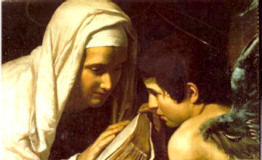 St. Frances of Rome (1384-1440) founded the institute known as the "Oblati di Tor de Specchi" in the Holy City. She was a wealthy patrician and after her husband died, she gave up all her wealth to live a life of abject poverty. Her special privilege from heaven was familiar conversation with her guardian angel. Reading the life of St. Frances, one gains the impression that she moved and lived in the spiritual world more than on earth; in fact, that which gives her life its unique character is her intimate relationship with the blessed world of holy spirits.
During the three periods of her life, three angels of different rank accompanied her, ready to protect her soul against any onslaught of hell and to lead her step by step to spiritual perfection. Day and night the saint saw her angel busy at a mysterious task. With three little golden spindles he unceasingly spun golden threads, strung them around his neck, and diligently wound them into balls. A half year before her death he changed his work. Instead of spinning more golden thread, he began to weave three carpets of varying size with the golden thread he had spun. These carpets symbolized her lifework as virgin, mother, and religious.
Shortly before her death, she noticed how the angel was hurrying his work, and his face was unusually fresh and happy. At the very moment when the last carpet had reached its required length, her soul departed into eternal bliss.
—Excerpted from The Church's Year of Grace, Pius Parsch
Patronage: against plague; automobile drivers, motorists (proclaimed by Pope Pius XII on 9 September 1951); automobilists; aviators; cab drivers, taxi drivers; death of children; lay people; motorcyclists; people ridiculed for their piety; pilots; Roman housewives; widows; women; Rome, Italy
Symbols and Representation: often depicted as a woman habited in black with a white veil, accompanied by her guardian angel, and sometimes carrying a basket of food; Nun with her guardian angel dressed as a deacon; Monstrance and arrow; book; angel with a branch of oranges; receiving the veil from the Christ Child in the arms of the Blessed Virgin
Highlights and Things to Do:
- Read more about St. Frances of Rome:
- St. Frances of Rome's remains are located at Santa Francesca Romana. Her skeleton is clothed in the habit of the Oblates of St. Frances of Rome.
- In 1925, Pope Pius XI assigned St. Frances of Rome the patronage for protection of motorists because an angel used to light the road before her with a lantern when she traveled for her safety. Invoke St. Frances' protection as you are getting in your car to drive somewhere today.
- Find out more about the Oblates of St. Frances of Rome or see the main site, in Italian.
- St. Frances was certain that she had a vocation to the religious life from the age of eleven. However, her father forced her to marry, and so she instead joyfully loved and served her husband until his death enabled her to enter the religious life when she was fifty-two years old. Even when you may have certainty that God is calling you to walk a certain path, His timing may be different from your own. Reflect on your own vocation: regardless of any doubts you may have, or seemingly unfulfilled desires to do more for God, abandon yourself to His will of the present moment, and joyfully focus on fulfilling the small duties which your vocation asks of you. Read about sanctification through the present moment in Rev. Jean-Pierre de Caussade's excellent little work, Abandonment to Divine Providence.
The Forty Holy Martyrs of Sebaste or Armenia
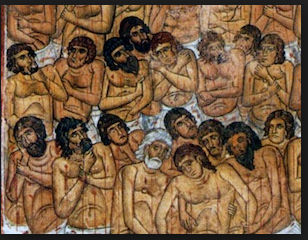 The Forty Martyrs were soldiers quartered at Sebaste in Armenia, about the year 320. When their legion was ordered to offer sacrifice to idols, they refused to betray the faith of their baptism, and replied to all persuasive efforts, “We are Christians!” When neither cajolings or threats could change them, after several days of imprisonment they were chained together and taken to the site of execution. It was a cruel winter, and they were condemned to lie without clothing on the icy surface of a pond in the open air until they froze to death.
The forty, not merely undismayed but filled with joy at the prospect of suffering for Jesus Christ, said: “No doubt it is difficult to support so acute a cold, but it will be agreeable to go to paradise by this route; the torment is of short duration, and the glory will be eternal. This cruel night will win for us an eternity of delights. Lord, forty of us are entering combat; grant that we may be forty to receive the crown!”
There were warm baths close by, ready for any among them who would deny Christ. One of the confessors lost heart, renounced his faith, and went to cast himself into the basin of warm water prepared for that intention. But the sudden change in temperature suffocated him and he expired, losing at once both temporal and eternal life. The still living martyrs were fortified in their resolution, beholding this scene.
Then the ice was suddenly flooded with a bright light; one of the soldiers guarding the men, nearly blinded by the light, raised his eyes and saw Angels descend with forty crowns which they held in the air over the martyrs’ heads; but the fortieth one remained without a destination. The sentry was inspired to confess Christ, saying: “That crown will be for me!” Abandoning his coat and clothing, he went to replace the unfortunate apostate on the ice, crying out: “I am a Christian!” And the number of forty was again complete. They remained steadfast while their limbs grew stiff and frozen, and died one by one.
Among the forty there was a young soldier named Meliton who held out longest against the cold, and when the officers came to cart away the dead bodies they found him still breathing. They were moved with pity, and wanted to leave him alive, hoping he would still change his mind. But his mother stood by, and this valiant woman could not bear to see her son separated from the band of martyrs. She exhorted him to persevere, and lifted his frozen body into the cart. He was just able to make a sign of recognition, and was borne away, to be thrown into the flames with the dead bodies of his brethren. Their bones were cast into the river, but they floated and were gathered up by the faithful.
—Excerpted from Little Pictorial Lives of the Saints, a compilation based on Butler’s Lives of the Saints and other sources by John Gilmary Shea (Benziger Brothers: New York, 1894); Vie des Saints pour tous les jours de l’année, by Abbé L. Jaud (Mame: Tours, 1950)
Patronage: Persecuted Christians
Symbols and Representation: Forty men; crown of martyrdom; martyr's palm
Highlights and Things to Do:
- Read more about the Forty Holy Martyrs:
- Read St. Basil's Homily on their festival.
- The martyrs are honored also in Eastern Orthodoxy, Oriental Orthodoxy, the Lutheran Church and the Anglican Church.
St. Dominic Savio
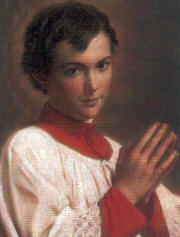 St. Dominic was a boy-saint who died at the age of fifteen, was one of the great hopes of St. John Bosco for the future of his congregation, and was canonized in 1954.
He was one of ten children of Carlo and Birgitta Savio. Carlo was a blacksmith and Birgitta was a seamstress. When Don Bosco was looking for young men to train as priests for his Salesian Order, his parish priest suggested Dominic Savio. Dominic became more than a credit to Don Bosco's school—he single-handedly organized those who were to be the nucleus of Don Bosco's order.
St. Dominic Savio was twelve when he met Don Bosco and organized a group of boys into the Company of the Immaculate Conception. Besides its religious purpose, the boys swept and took care of the school and looked after the boys that no one seemed to pay any attention to. When, in 1859, Don Bosco chose the young men to be the first members of his congregation, all of them had been members of Dominic's Company.
For all that, Dominic was a normal, high-spirited boy who sometimes got into trouble with his teachers because he would often break out laughing. However, he was generally well disciplined and gradually gained the respect of the tougher boys in Don Bosco's school.
In other circumstances, Dominic might have become a little self-righteous snob, but Don Bosco showed him the heroism of the ordinary and the sanctity of common sense. "Religion must be about us as the air we breathe," Don Bosco would say, and Dominic Savio wore holiness like the clothes on his back.
He called his long hours of prayer "his distractions." In 1857, at the age of fifteen, he caught tuberculosis and was sent home to recover. On the evening of March 9, he asked his father to say the prayers for the dying. His face lit up with intense joy and he said to his father: "I am seeing most wonderful things!" These were his last words.
—Excerpted from The One Year Book of Saints by Rev. Clifford Stevens
Patronage: Boys; children's choirs; choir boys; choirs; falsely accused people; juvenile delinquents; Pueri Cantors
Highlights and Things to Do:
- Read more about St. Dominic:
- We learned about St. Dominic from St. John Bosco's writings, which you can read online.
- Learn more about the Salesians and Salesian saints.
- Dominic is buried at Basilica di Maria Ausiliatrice or The Basilica of Our Lady Help of Christians in Turin, Italy, with St. John Bosco body nearby.