Trump’s own derangement
By Phil Lawler ( bio - articles - email ) | Apr 14, 2026
Like so many other Americans, I seriously underestimated Donald Trump’s political skill when he first burst into the presidential race of 2016. At first I was fully convinced that he was a “straw”—a candidate lured into the field by another contender, to draw off support from potential rivals.
In this case, I imagined, friends of the Clinton team in New York had encouraged Trump’s ambitions, hoping that he would disrupt and derail the campaigns of more experienced Republican candidates. Which, of course, he did.
(At this point I should add that I never thought Trump was a conscious participant in this strategy. The best sort of straw does not know that he is a straw, and it is easy to believe that a man with Trump’s outsized ego would be open to suggestions—however slyly intentioned—that he would be a strong campaigner.)
If my surmise had any validity, and Democratic operatives did encourage the early Trump candidacy, then the Clinton team also underestimated Trump. He proved to be a formidable political force, putting together an enormous winning coalition and—especially in the early days of his 2nd term—made important strides in stemming the flow of illegal immigration, protecting religious liberty, and reversing the trend toward political correctness in the federal government, among other achievements.
However Trump has always been a polarizing figure, who even at the height of his popularity has also provoked bitter opposition. His disapproval ratings have always been high, and that disapproval has been evident not just in poll data but in daily hyperbolic denunciations and angry public protests. Unlike every other president in my lifetime, Trump has made no effort to unify the American people. His political style is confrontational; he responds to criticism with attacks and insults, fanning the flames. Like Andrew Jackson, who literally became ill when he was not somehow involved in a fight, Trump thrives on conflict.
Having gained the White House as a political outsider, without the support of the Republican establishment, Trump also built his own power base, largely independent from the party regulars. His appeal is mostly personal, and his MAGA following has not notably enhanced the support for mainstream GOP candidates.
But now, as he approaches midterm elections, Trump will need strong Republican support if he hopes to continue pursuing his own agenda. The president himself will not face the voters in November—or ever again, probably—but his thin majority support in Congress will be in grave jeopardy in the midterm elections, and his inability to reach out to voters beyond his MAGA following compounds the danger. If Democrats gain control of the House of Representatives, he will undoubtedly be impeached again (although probably not convicted by a two-thirds majority in the Senate), and hounded by congressional inquiries through the remainder of his term at the White House. If a liberal majority in Congress succeeds in thwarting his plans, a Democratic candidate could regain the presidency in 2028, and ironically, in the long run the Trump phenomenon would have done lasting damage to the Republican Party.
This is all speculation, of course. But the danger to Trump’s aspirations is real, and his bombastic political style makes it easy to see how his presidency could quickly deteriorate. The same assertive personality and bulletproof self-confidence that won him such a loyal following also makes him vulnerable to overreaching, alienating even more of the electorate.
Trump has always been quick to lash out against those who oppose his political plans, even if they are former allies or potential supporters. In recent days, embattled on several different fronts at once, he has issued statements so intemperate that they raise questions about his political judgment.
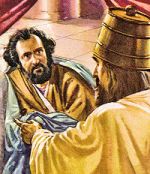
Nowhere has this weakness been more evident than in the unhinged statements that Trump has released on two successive weekends. On Easter Sunday he posted a profanity-laced statement threatening to reduce Iran to a Stone Age condition—and when questioned, doubled down, warning: “A whole civilization will die tonight, never to be brought back again.” Then this past Sunday he loosed his incoherent and vituperative attack on Pope Leo XIV, and followed up by posting an image of himself as a Christ-like figure, bringing solace to the afflicted.
The arrogance of the president’s petty and puerile attack on the Pope—in which he claimed credit for Leo’s election, and said that the Holy Father is “hurting the Catholic Church”—was a needless affront to the Catholic voters who will be a prized “swing” constituency in the midterm elections. To be sure, some of Trump’s loyal Catholic supporters took his diatribe in stride, but a far greater number, particularly among the crucial undecided voters, were appalled by a partisan blast against the Pontiff.
In some respect the Trump screed was downright irrational. He opened with the charge that Leo is “soft on crime,” a complaint that makes sense only if there is a crime wave occurring in the Vatican city-state. He accused the Pontiff of being fearful during the Covid lockdown, “when they were arresting priests… for holding church services,” but of course the Catholic Church cannot make arrests, and it was the federal government, during the first Trump term, that enforced lockdown regulations. He told reporters that “we don’t like a Pope that’s gonna say that it’s OK to have a nuclear weapon,” when he himself commands the world’s most formidable nuclear arsenal. And he confessed his preference for the Pontiff’s brother, “because Louis is all MAGA.” I wonder whether Louis is still firmly in Trump’s corner after this public assault on his brother.
Some of the president’s defenders reason that Trump’s statements should not be taken literally. He exaggerates, they point out; in fact he did not order carpet bombing of Iran. True enough, but world leaders should be held responsible for the words they use. Since we cannot know exactly what Trump intends, we can only judge what he says,
(Early in the reign of Pope Francis I was sometimes criticized for “popesplaining”—trying to provide an acceptable interpretation of the Pontiff’s troubling statements. I took that criticism to heart, and in Lost Shepherd explained how many papal statements could not be rendered in a form consistent with prior Church teaching. I suggest that “Trumpsplainers” learn the same lesson.)
Unfortunately Trump seems constitutionally incapable of tempering his speech, acknowledging his excesses, or apologizing to those he has offended. Under pressure he becomes even more combative, even more willing to take on all comers. My fear is that the hubris on display in his latest fights will produce tragic results, undoing whatever good his presidency might have accomplished.

Phil Lawler has been a Catholic journalist for more than 30 years. He has edited several Catholic magazines and written eight books. Founder of Catholic World News, he is also the lead news analyst at CatholicCulture.org. See full bio.
All comments are moderated. To lighten our editing burden, only current donors are allowed to Sound Off. If you are a current donor, log in to see the comment form; otherwise please support our work, and Sound Off!

-
Posted by: philtech2465 -
Apr. 15, 2026 3:55 PM ET USA
With his emotional immaturity and instability, Donald Trump was always a risky (to put it charitably) choice to exercise the power of the Presidency. If the risk were ever worth it, that ended when he delivered a SCOTUS that overturned Roe. And his behavior on 1/6/2021 made clear he had no respect for the Constitution or democracy. And now by attacking the moral authority of the Pope, Trump's pride is on full display. Has this "deal with the devil" been worth it? Absolutely not.
-
Posted by: feedback -
Apr. 15, 2026 2:04 PM ET USA
I thank God for Pope Leo's reaction to Trump and the war with Iran. It seems to me a sign of divine providence that we have a US-born Pope in this time of history. American-born Pope cannot be easily dismissed by the war propaganda machine. Both President Trump and Pope Leo need our prayers.
-
Posted by: TheJournalist64 -
Apr. 15, 2026 10:30 AM ET USA
We should all keep in mind that Pope Leo is NOT an "American Pope" except that he is a SOUTH American pope who happened to be born in Chicago. Moreover, he is trying to speak to the world from a "heavenly" perspective. From that point of view what Trump ordered for Iran has at least questionable morality, and some of Trump's statements have seriously crossed the line into immorality.
-
Posted by: DrJazz -
Apr. 14, 2026 10:11 PM ET USA
You are correct on many points, Phil, especially about Trump's hubris & combativeness. However, "soft on crime" is quite obviously a reference to Leo's criticism of Trump's efforts to deport illegal immigrants. I'm sure that Trump's reasoning is: Letting in illegals results in more crime. Hence, Leo, appearing to favor such immigration, is soft on crime. Leo had to know that when he publicly criticized Trump, he was going to get a public & combative response. He could have done so privately.
-
Posted by: howwhite5517 -
Apr. 14, 2026 7:13 PM ET USA
I must depart with Phil Lawler for the first time. The Pope brought this on. His public insult to American for its birthday was the opening shot. Lacking from this discussion is Iran. Their history denies them any chance of having a nuclear weapon. End of discussion. I feel very disoriented these days to the Pope and the USCCB. Protestant Charities are now of my give list.