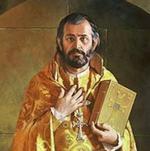
The Lives of the Popes, Part One of Infinity
By Thomas V. Mirus ( bio - articles - email ) | Feb 06, 2026 | In Lives of the Popes
Free eBook:
|
| Free eBook: Misinterpreting Catholicism |
One must beware a rabbit hole. Some time ago, I read an excerpt from the History of the Popes from the Close of the Middle Ages, by the great pioneering nineteenth-century Catholic historian Ludwig von Pastor (whose work extends to forty volumes in its English translation). I enjoyed it so much that I started to fantasize about reading the entire series someday. But then I realized, to my great dismay, that Pastor’s biographies begin only with the two-hundred-and-sixth pope, Martin V.
Was there anyone else who had written about the popes in comparable detail? Searching further, I discovered the work of Fr. Horace K. Mann. Fr. Mann, in the early twentieth century, continued in Pastor’s spirit by covering the medieval popes beginning with St. Gregory the Great (pope number sixty-four). Well then, completionist freak that I am, I would have to read Fr. Mann’s nineteen volumes too or my entire project of learning about the popes would be trifling, fraudulent, bunk.
But what about the first sixty-three popes? Unfortunately, it seems that no modern scholar has written a multi-volume series dealing with each one in detail. So I realized I would have to cobble together whatever sources I could find to learn about the early popes.
And I figured, as long as I’m reading all this stuff, why not write about it?
Here I introduce a series of articles covering the lives of the popes. It will not be a work of original research. It will be the personal study project of a non-historian, and (eventually, once I get to Fr. Mann in 590 A.D.) a way of distilling into more consumable form the monumental labors of two great Catholic scholars, of whom almost no one today has heard, and whose collective fifty-nine volumes, however fascinating they may be, few will ever find time to read for themselves. Let’s see how far I get!
Sainted popes
How many of the popes were saints? Out of the 266 popes before our Leo, 81 are universally recognized as saints. All of the first 35 popes (reaching to the year 352) were saints, as were 52 of the first 55 (through the year 532). The most obvious reason for this, other than that the Church surely needed an extraordinary outpouring of grace to find her footing in those first centuries, is that many of the earliest popes were either martyrs or had a legend of martyrdom.
Starting in the sixth century, there is a noticeable drop-off, but sainted popes are still highly common through the first eight centuries; after then, however, the vast majority of popes are not sainted (for example, there is not a single sainted pope between 867 and 1048).
Perhaps we should not judge this drop-off to be entirely the result of a lack of papal holiness. We must keep in mind that there was no universal, formal canonization process for the first millennium—sanctity was instead judged by popular veneration, approved by the local bishop. It was not until 1170 that Pope Alexander III, concerned about abuses, decreed that only he could declare someone a saint, after which it is conceivable that the standard for public veneration became more exacting (which I mean not to depreciate the many saint-popes of antiquity, so much as to sympathize with later holy popes who had a “devil’s advocate” and a more detailed historical record to contend with).
The early popes
It will not be surprising that we know little about the very earliest popes, especially those who lived during intense persecutions when few records were kept. There is no one book or series covering all the popes before St. Gregory the Great in close detail. The most detailed accessible source I found was the online Catholic Encyclopedia of 1907, which has been my main source for the popes of the first few centuries. To make sure I do not miss major discoveries or changes in consensus from the past century, I have cross-checked this with Kelly and Walsh’s 2010 Oxford Dictionary of the Popes. I have supplemented these encyclopedic sources with details from a few thematically focused historical studies: Ybarra’s The Papacy: Revisiting the Debate between Catholics and Orthodox; Nichols’s Rome and the Eastern Churches; and Hughes’s The Church in Crisis: A History of the General Councils, 325-1870. Using mainly these sources, I have already written twelve articles covering all popes up to St. Leo the Great.
An important source for the lives of the popes is a long-running medieval record called the Liber Pontificalis. But since the Liber Pontificalis began to be written in the 6th century, much of its information about earlier popes is unreliable, assigning the origin of various ancient Roman liturgical and administrative practices to this or that pope arbitrarily. Thus in this series, I will generally avoid using the LP’s statements about early popes unless we have almost no other information about them or the LP was corroborated elsewhere. That said, while the attribution of a discipline to a particular pope may be inaccurate, these were at least real practices of the Roman Church, whose precise origin was often ancient enough to be unknown.
In this same vein, incidents which would seem less significant in the case of later popes become more precious when discussing the early popes. This is not only because we have less information about them, but also because the life of the papacy and of the Church was, on the human level, still taking form in the early centuries. Things that now seem a matter of course are valued more when found in the Church’s infancy because they testify to her longevity: in some cases they were taken for granted even in the earliest centuries as customs of Apostolic origin, or if not, we can see the birth of what has since become a longstanding tradition. Things unfamiliar, of course, are likely to be interesting by that very fact.
Putting this project in perspective
Though the pope is the greatest earthly authority in the Church, it would be a mistake to equate the Church with the papacy, to assume that in studying the lives of the popes we therefore gain a thorough grasp of Church history. We cannot know what God would consider the most important spiritual events of any given century, but it seems safe to assume that those events, if history is even aware of them, have in many cases not been directly connected to the biography of the pope under whose reign they occurred.
It is with perfectly good reason that we remember, to pick a random example, St. Francis de Sales more than the names of the popes who reigned over him. Yet precisely because so many popes are unknown and forgotten in comparison with the great saints of their times, there must be a great deal of fascinating history waiting to be uncovered and plenty of lessons to be learned. And sometimes, by the most benign hand of Providence, the pope has been one of the great saints of his time.

Thomas V. Mirus is President of Trinity Communications and Director of Podcasts for CatholicCulture.org, hosts The Catholic Culture Podcast, and co-hosts Criteria: The Catholic Film Podcast. See full bio.
All comments are moderated. To lighten our editing burden, only current donors are allowed to Sound Off. If you are a current donor, log in to see the comment form; otherwise please support our work, and Sound Off!

-
Posted by: Thomas V. Mirus -
Feb. 09, 2026 5:16 PM ET USA
They will be published in the Commentary section gradually as I have time to research and write them. The first one will appear tomorrow. I also am planning to release them in podcast form.
-
Posted by: Crusader -
Feb. 09, 2026 12:09 PM ET USA
When will this start? Will it appear on the Commentary site, Recourses, etc?