Atheist Comedians
By Fr. Jerry Pokorsky ( bio - articles - email ) | May 04, 2026
Reality is often a bitter pill to swallow. A good comedian is very intelligent and has a keen sense of irony. Irony requires the ability to contrast the way things are with the way things should be. Religion has similar qualities.
Intelligent irony without faith may be amusing, but often cynical, even vicious. Some comedians challenge the existence of God and His benevolence due to the various difficulties they find, particularly in the Old Testament. The brilliant and appropriately censored quips of George Carlin are insightful and hilarious. But he hated the Catholic Church, and his comedic attacks are legendary. Cherry-picking the Bible, how could an all-good God command the Israelites to slaughter their enemies? Why would Jesus teach salvation and condemnation? He may have added—but he didn’t—“Why did Jesus suffer and die on the Cross for us?”
We cannot—and must not—deny these Scriptural problems. But it helps to begin with humility: “For my thoughts are not your thoughts, neither are your ways my ways, declares the Lord.” (Isaiah 55:8-9) And the constant teaching of the Church, sometimes disrupted by hiccups of misunderstanding and error, helps us gain a higher perspective, deepens our appreciation of God’s love for us, and rescues us from world-weariness and cynicism.
God’s Word is not a dead letter, subject to barren rational analysis. In understanding God’s Word, we must sort through the literal, poetic, metaphorical, anthropological, and even comedic use of language. We understand the living Word from the vantage point of the Resurrection, the Ascension, Pentecost, and the Church. God’s Word lives and continues throughout history, with human logic, assisted by grace, helping the Church formulate doctrine.
In the early Church, the Apostles and first priests read Scriptures, quoted the words of Jesus, reported His mighty deeds, and preached the Gospel in the first Masses. The Evangelists compiled the sayings of Jesus and composed the four Gospels. The letters of Paul (and others) were delivered, read, and reproduced by early Catholic scribes. By the time of the death of the last Apostle, public revelation came to an end. Doctrinal formulations sprouted from the apostolic deposit of faith.
By the 4th century, the Church gathered all these scrolls, identified those reliably used in the celebration of Mass and catechism classes, eliminated the heretical scrolls (such as the Gnostic Gospel of Thomas), and assembled the canon of Sacred Scripture. The Bible did not float down from heaven. The Church gave birth to the Bible.
Theologians and ordinary Catholics alike assemble the doctrinal framework of God’s revelation by referring to the Bible, the writings of early Church Fathers, Sacred Tradition, and the witness of the saints. Sometimes the insights are impressive. Frequently, due to poor reasoning and faithlessness—even on the part of Church officials—theological speculation fails. The “Church Vigilant” guards the content of the faith.
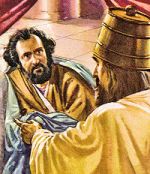
During the Last Supper (cf. John 14:1-14), Jesus teaches His first priests, “Let not your hearts be troubled; believe in God, believe also in me. In my Father’s house are many rooms.” In response to St. Thomas, Jesus reveals, “I am the way, and the truth, and the life; no one comes to the Father, but by me.” He adds, “If you had known me, you would have known my Father also.” Comedic ridicule of these words seems impossible.
From the perspective of the Resurrection and after centuries of Catholic doctrinal development, we may plausibly suggest that Jesus is describing the Holy Sacrifice of the Mass.
The two major components of the Mass are the Liturgy of the Word and the Liturgy of the Eucharist. The Liturgy of the Word fulfills the worship of the Jewish synagogue. The Liturgy of the Eucharist fulfills the sacrificial worship of the Temple.
The Liturgy of the Word is the terrestrial (to borrow Cardinal Ratzinger’s term) liturgy. In the Liturgy of the Word, we hear the words of Jesus. His words, and the words of the priest, direct us to His way of life. His words direct us to the Father. If we know Jesus, we know the Father, and we know everlasting life.
The Liturgy of the Eucharist is the celestial liturgy. During the Liturgy of the Eucharist, through the ministry of priests, God makes present the single Sacrifice of Christ throughout history. After the Resurrection, the ritual shedding of blood is no longer part of the worship of the Chosen People.
Just as He foretold after the multiplication of loaves, Jesus feeds us with His Body and Blood. In obedience to His command, “Do this in memory of me,” bread and wine become the sacred Body and Blood of Jesus. In our Communion with Him, we enter into Communion with His Mystical Body, the Church. At Mass, we are in communion with the entire Church throughout the world, and we enter into heavenly glory. In heaven, we will glorify and praise God in communion with Him and His Church forever. In heaven, the Mass is everlasting.
Without the mantle of the Church and the firm certainties of faith, taking Scriptural liberties of interpretation is dangerous. The great heresies testify to the dangers of reading the Scriptures apart from the Church and her guardrails of orthodoxy. But since the Bible was born into the Church under her watchful authority, the Church is the final arbiter of the authentic interpretation of revelation.
Although we continue to encounter many mysterious guardrails of the faith, we have many opportunities to deepen our understanding of the human condition beyond the cynicism of atheist comedians. God rescues us from despair. After the Resurrection, it’s hard for comedians to ridicule the tender words of Jesus that forgive sins and promise everlasting life.
The Church directs friend and foe alike to her indispensable mission and directs us to Jesus. Jesus is the living Synthesis of God’s saving revelation: “In times past, God spoke in fragmentary and varied ways to our fathers and through the prophets; in this, the final age, he has spoken to us through his son….” (Hebrews 1:1-5)
Fr. Jerry Pokorsky is a priest of the Diocese of Arlington who has also served as a financial administrator in the Diocese of Lincoln. Trained in business and accounting, he also holds a Master of Divinity and a Master’s in moral theology. Father Pokorsky co-founded both CREDO and Adoremus, two organizations deeply engaged in authentic liturgical renewal. He writes regularly for a number of Catholic websites and magazines. See full bio.
All comments are moderated. To lighten our editing burden, only current donors are allowed to Sound Off. If you are a current donor, log in to see the comment form; otherwise please support our work, and Sound Off!