Easter: May 2nd
Memorial of St. Athanasius, Bishop and Doctor of the Church
Other Commemorations: St. Antoninus, Bishop (RM)
Today the Church celebrates the Memorial of St. Athanasius (295-373), Bishop of Alexandria and a great defender of the orthodox faith, throughout his life opposed the Arian heresy. By denying the Godhead of the Word the Arians turned Christ into a mere man, only higher in grace than others in the eyes of God. St. Athanasius took part in the Council of Nicea in 325 and until the end remained a champion of the faith as it was defined by the Council. In him the Church venerates one of her great Doctors. He was subjected to persecutions for upholding the true teaching concerning the person of Christ and was sent into exile from his see no less than five times. He died at Alexandria in 373 after an episcopate of forty-six years.
The Roman Martyrology commemorates St. Antoninus (1389-1459), Bishop of Florence, and a member of the Dominican Order. In the exercise of his pastoral charge he showed great charity. He died in 1459.
Meditation for Saturday of the Fourth Week of Easter:
The Power that Regenerates the World
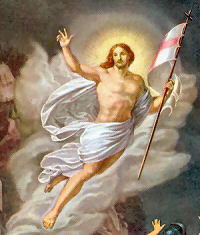
Earthly history and the workings of the cosmos undoubtedly continue their course and are not identified with the rate at which the Kingdom of Christ develops. In fact, pain, evil, sin, death, yet claim their victims, in spite of the resurrection of Christ.
The cycle of one thing succeeding another, the cycle of becoming, is not at a standstill. If it were, history would be at an end! And so facts and events are continually being repeated and give rise to thoughts of an irremediable conflict here on earth between the two kingdoms, or, as St. Augustine said, between the two cities. Think, for example, of the contrast which is to be found in this Holy Year between celebration of the Redemption on the one hand and on the other hand the offenses against God, the misdeeds committed against man and, at bottom, the challenges to Christ which are continually being launched.
This is the most impressive aspect, the most mysterious dimension of the historic dialectic between the forces of good and the forces of evil: the fact that obstacles are raised or indifference is shown to the forces of Redemption let into the world by Christ through his Resurrection as the principle which resolves the conflict between death and life.
The world is in need, today as yesterday, for the "new people" to remain in its midst, among the vicissitudes, the conflicts, the variations which not seldom lead to situations which are so difficult, sometimes even dramatic. The world has need of this people which will dedicate itself with humility, courage and perseverance to service of the Redemption and give concrete form, in good Christian conduct, to the regenerating power of Christ's resurrection.
This is the function which Christians have as evangelizers and witnesses to the Resurrection in history.
—Excerpted from Prayers and Devotions from Pope John Paul II, edited by Bishop Peter Canisius, 1984
St. Athanasius
A champion of orthodoxy! He did not die a martyr, but his life was martyrdom in the truest sense. Athanasius was the Church's greatest hero in the battle against Arianism (a heresy that denied Christ's divinity). Even as a young deacon at the Council of Nicea (325), he was recognized as "Arius' ablest enemy" and the foremost defender of the Church's faith. After the death of his bishop (328), "the entire Catholic congregation with one accord, as one soul and body, voiced the wish of the dying bishop Alexander that Athanasius should succeed him. Everyone esteemed him as a virtuous, holy man, an ascetic, a true bishop."
There followed fifty years of constant conflict. Under five emperors and by exile on five different occasions, he gave testimony to the truth of the Catholic position. His allegiance to the Church never wavered, his courage never weakened. As consolation in the face of horrendous calumnies and cruel persecution, Athanasius looked to the unwavering love of his Catholic people. Even time brought no mitigation in Arian hatred. For five years he hid in a deep, dry cistern to be safe from their raging wrath and their attempts to assassinate him. The place was known only to one trusted friend who secretly supplied necessary food.
That Athanasius enjoyed God's special protection should have been obvious to all. On one occasion when the emperor's assassins were pursuing him, Athanasius ordered the ship on which he was fleeing to double-back and sail upstream so that he might meet and by-pass his persecutors. Not recognizing the boat upon meeting in semi-darkness, they naively asked whether the ship carrying Athanasius was still far ahead. Calmly and truthfully Athanasius himself called back, "He is not far from here." So his persecutors kept sailing on in the same direction, allowing the saint to complete his escape.
Preserved by divine Providence through a lifetime of trial and danger, he finally died in his own quarters at Alexandria during the reign of the Emperor Valens (373). Athanasius enriched Christian literature with many important works, some pointed toward piety and edification, others polemical and dogmatic in nature. He ruled the Church of Alexandria for forty-six years.
—Excerpted from The Church's Year of Grace, Pius Parsch
Symbols and Representation: open book; two columns; boat on the Nile; equilateral triangle; open book between two Greek Doric columns; archbishop's pallium; scroll with quotation from his writings.
Often Portrayed As: Bishop arguing with a pagan; bishop holding an open book; bishop standing over a defeated heretic
Patronage: Bellante, Italy
Highlights and Things to Do:
- Find out more about St. Athanasius:
- Read more about the Athanasian Creed.
- The Catholic Culture podcasts have several recordings on the life of Athanasius and his writings.
- If you are feeling academic you might like to read Ecclesiastical History by Salaminius Hermias Sozomenus.
- Catholic Culture's library also has many writings of St. Athanasius:
- Watch this excellent EWTN video on St. Athanasius of Alexandria.
- Read Select Treatises of St. Athanasius translated by John Henry Newman here.
- Purchase a copy of On the Incarnation by St. Athanasius.
- See his statue on the St. Peter's Colonnade.
- St. Athanasius was originally buried in Alexandria, but his remains were later transferred to the Chiesa di San Zaccaria in Venice, Italy. In 1973, Pope Paul VI gave the Coptic Patriarch a relic of Athanasius, which is currently preserved in the St. Mark's Coptic Orthodox Cathedral in Cairo, Egypt. See Saints in Rome.
St. Antoninus
He wanted to join the Dominicans, but he was so small he scarcely reached above the tabletop in the office of Blessed John Dominici, the Dominican prior of Santa Maria Novella in Florence. To put him off, the prior told him to go home and memorize the Decrees of Gratian, a compilation of Church law. Within a year, the boy had returned, had committed the decrees to memory, and was given the habit of a Dominican.
St. Antoninus was one of the first novices at Fiesole, which Blessed John had built, and among his fellow novices was the future artist Fra Angelico. After his ordination to the priesthood, Antoninus was made prior at Rome, Gaeta, Siena, Fiesole, and finally at Florence where he founded the famous Convento di San Marco, where Fra Angelico did some of his most memorable work.
He was summoned by Pope Eugene IV to take part in the Council of Florence in 1438, and as prior of San Marco, welcomed many of the prelates and scholars to Florence for the sessions of the council that took place there. It was at this time also that the great library of San Marco was opened to the public.
In 1446, much against his will, he was appointed archbishop of Florence but continued to live as a simple Dominican friar. Then, he became a veritable dynamo of activity: he rebuilt churches, visited parishes, preached incessantly, and brought about peace between political factions and religious orders. He was in Rome at the deathbed of Pope Eugene IV and was consulted by succeeding pontiffs in the reform of the papal curia. He was a superb theologian, his writings on moral theology and economics are considered pioneer works in the changing society of his times.
Shortly before the death of Antoninus, a plague hit Florence, decimating the city, with many of his friars dying, and the people starving from famine. He sold everything to help the hungry and destitute. When a violent earthquake hit Florence, he helped to rebuild the city, housing some of the victims in his own home. He died on May 2, 1459, and Pope Pius II himself came to attend his funeral. The people of Florence, who loved Antoninus, placed his statue in the Uffizi Palace, the city's hall of fame.
—Excerpted from The One Year Book of Saints by Rev. Clifford Stevens
Patronage: against fever; Filicaja, Italy; Moncalvo, Turin, Italy; University of Santo Tomas Graduate School, Manila, Philippines; Saint Antoninus Parish, Municipality of Pura, Tarlac Philippines
Symbols and Representation: Lily; pair of scales in which he weighs false merchandise against God's word; scales; wearing bishop's mitre, holding the cross, and giving the sign of blessing in absolution
Highlights and Things to Do:
- Read more about St. Antoninus:
- St. Antoninus' body lies in the Chapel of St. Antoninus in the Church of San Marco, Florence, Italy.
- St. Antoninus was noted for his love of people: people of all kinds, from those in high places to the poorest of the city. To help the poor, he organized the Men of St. Martin, who exist to this day.