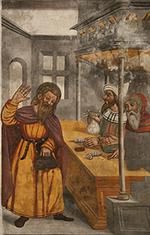
Make your gift today!
Help keep Catholics around the world educated and informed.
Already donated? Log in to stop seeing these donation pop-ups.
The Virginity and Celibacy of the Holy Family
By Fr. Jerry Pokorsky ( bio - articles - email ) | Dec 29, 2025
Catholics are accustomed to viewing the Holy Family of Jesus, Mary, and Joseph as the model for every family. Yet because all three were celibate—understood in a broad and proper sense—this connection requires clarification. Mary was perpetually a virgin. Joseph was her “most chaste spouse.” The celibacy of Jesus was integral to His sacred mission.
Far from undermining family life, virginity and celibacy buttress and strengthen every holy family because they signify obedience, unity, and love ordered toward God. The Holy Family reveals that obedience to God, rather than biological generation alone, is the deepest bond of family life.
Chastity is the virtue that governs our reproductive urges. Distorted by the sinful inclinations of Original Sin, these urges must be ordered according to one’s state of life. Within marriage, chastity includes the normal marital embrace that, God willing, brings children into the world. For various reasons, marriage may also include periods of continence or abstinence. Outside of marriage, chastity necessarily includes celibacy.
Celibacy is not merely the absence of marriage but a disciplined form of chastity that requires self-mastery and respect for the dignity of self and others. Even within marriage, chastity may include forms of continence. A virtuous married man temporarily separated from his spouse—for example, by military service or work—practices a form of celibacy. A virtuous widow or widower likewise lives a celibate life.
Celibacy, as an aspect of chastity, does not reject natural desires but orders them according to God’s will, with custody of the eyes and prudent oversight of memory, imagination, and emotions.
Celibacy as a state of life also has a practical dimension. A celibate doctor or scientist may devote more time to his work. A celibate soldier is not burdened by the immediate responsibilities of spouse and children as he enters battle. Celibacy allows undivided attention to duties directed toward the service of others and the worship of God.
Celibacy is also sacramental. A priest who promises celibacy commits himself to proclaiming the Gospel and administering the sacraments in imitation of Christ’s own celibate life. Like every sacred gift, however, celibacy can be abused—just as marriage itself can be abused. The outward appearance of celibacy may sometimes disguise slothful or even scandalous living, as Mark Twain observed with characteristic irony when he described the worldliness of certain Roman clergy in his 1869 travelogue The Innocents Abroad. Twain’s observation reminds us that external discipline, whether celibacy or marriage, cannot substitute for interior conversion.
The virginity and celibacy of Jesus, Mary, and Joseph convey a meaning that transcends and enriches every family. Mary, conceived without Original Sin, gives birth to Jesus, the eternal Word made flesh. In Jesus, God and man are reconciled by the power of the Holy Spirit. Joseph, initially resolved to divorce Mary quietly in order to protect her reputation, obediently accepts his vocation as the chaste spouse of the Virgin and the faithful foster father of Jesus. During His public ministry, the celibate Jesus called the Twelve Apostles, symbolically fulfilling and transforming the twelve tribes of Israel and loosening the primacy of tribal bonds.
The example of the Holy Family points toward a deeper understanding of family life and of communities of families: tribes, nations, and cultures. Bonds of blood are real and important. The genealogies of Joseph and Mary in the Gospels of Matthew and Luke establish the legal and prophetic credentials of the Messiah in continuity with Israel’s history. Yet with the coming of Jesus, the bonds of blood are no longer ultimate. Henceforth, obedience to God determines true kinship. Jesus warns of the fragility of family ties when they are severed from faithfulness to God:
Brother will deliver up brother to death, and the father his child, and children will rise against parents and have them put to death; and you will be hated by all for my name’s sake. (Mt. 10:21–22)
At the same time, Jesus purifies and elevates family love:
He who loves father or mother more than me is not worthy of me; and he who loves son or daughter more than me is not worthy of me. (Mt. 10:37–38)
When His mother sought Him, Jesus made the principle unmistakable:
Whoever does the will of my Father in heaven is my brother, and sister, and mother.” (Mt. 12:50)
In these passages, Jesus establishes the proper hierarchy of Christian life: God first, family second, and all else ordered accordingly.
In this light, the virginity and celibacy of the Holy Family reveal that divine obedience binds a family more securely than blood alone—a truth especially evident in families formed through adoption. Mary obeys the Angel Gabriel. Joseph obeys the same angel. Jesus obeys His lawful parents after being found in the Temple and remains obedient unto death to His Heavenly Father. Holy obedience and authentic family happiness are inseparable.
Family and tribal bonds are essential to cultural life, yet when absolutized, they can become sources of conflict and violence—from clan feuds and sectarian divisions to modern ethnic and national conflicts. Even within our own households, loyalty to family must never supersede obedience to God’s law. Fidelity to Christ may require resisting the normalization of grave sins—for the sake of truth, charity, and salvation.
The “celibate” Holy Family thus helps us understand the sacramentality of marriage. Marriage participates in the loving, sacrificial obedience of Jesus within the New and Everlasting Covenant—a covenant that transcends all tribes and nations. Every marriage, family, and earthly lineage will pass away, but this covenant will never pass away.
It has rightly been said, “So goes the family, so goes the Church.” The holiness of families depends upon obedience to the teachings of Jesus as they are faithfully handed on in the Church. The Holy Family stands as our model—not because it mirrors every family circumstance, but because it reveals the truth every family must learn: that obedience to God is the source of freedom, the condition of love, and the foundation of lasting unity.
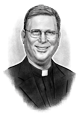
Fr. Jerry Pokorsky is a priest of the Diocese of Arlington who has also served as a financial administrator in the Diocese of Lincoln. Trained in business and accounting, he also holds a Master of Divinity and a Master’s in moral theology. Father Pokorsky co-founded both CREDO and Adoremus, two organizations deeply engaged in authentic liturgical renewal. He writes regularly for a number of Catholic websites and magazines. See full bio.
All comments are moderated. To lighten our editing burden, only current donors are allowed to Sound Off. If you are a current donor, log in to see the comment form; otherwise please support our work, and Sound Off!