The SSPX, the German bishops, and the parable of the two sons
By Phil Lawler ( bio - articles - email ) | May 05, 2026
This summer Pope Leo will face two serious challenges to his authority: one from the Society of St. Pius X (SSPX), which has announced plans to consecrate new bishops without a papal mandate; the other from the German bishops’ conference, which is introducing a ritual for the blessing of illicit conjugal unions. On paper the two cases are quite different, involving distinct theological and canonical principles. But the Vatican’s treatment of the two wayward groups will surely invite comparisons, for two reasons. First because the disputes are coming to a head at roughly the same time. Second (and more important, from the perspective of public perceptions) because the two cases involve two opposite centrifugal forces within the Church: the progressive German hierarchy and the traditionalist SSPX.
The SSPX has been ordered not to proceed with the scheduled ordinations. (True, the order did not come directly from the Pope, but from Cardinal Fernandez. Still Pope Leo obviously could countermand it, and has not done so.) Yet the SSPX, which professes unswerving loyalty to papal authority, plans to ignore that order, claiming that a “state of necessity” justifies their defiance.
The German bishops, on the other hand, have repeatedly assured the world that their plans are fully in line with the perennial teachings of the Church, as articulated most recently in Fiducia Supplicans. But this week the Dicastery for the Doctrine of the Faith (DDF)—Cardinal Fernandez, again—released the text of a cautionary letter written to the German hierarchy two years ago, warning them that the rituals they proposed were not in accord with Fiducia Supplicans.
So in both cases we appear to be at an impasse. Will the SSPX leaders acknowledge the Vatican’s authority to judge whether or not the Church is in a “state of necessity”? Will the German bishops acknowledge that what they propose is not authorized?
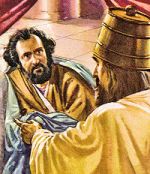
This uneasy state of affairs brings to mind the parable of the two sons, recounted by St. Matthew (21:28-31). Jesus said:
A man had two sons; and he went to the first and said, “Son, go and work in the vineyard today.” And he answered: “I will not,” but afterward he repented and went. And he went to the second and said the same; and he answered, “I go, sir,” but did not go. Which of the two did the will of his father?
Unconfirmed rumors circulating around Rome this week suggest that if the SSPX proceeds with the unauthorized episcopal ordinations, all of the priests of the SSPX, as well as the bishops involved in the illicit ceremonies, could be excommunicated for the canonical crime of schism—that is, for setting up an ecclesiastical body separate from the Catholic Church. That charge cannot easily be dismissed; the traditionalist group insists that it must have its own bishops in order to preserve the integrity of the faith—thus clearly implying that the integrity of the faith has not been preserved elsewhere in the universal Church. Father Davide Pagliarani, the superior general of the SSPX, had made the distressing claim: “In an ordinary parish, the faithful no longer find the necessary means to ensure their eternal salvation.” The unavoidable implication is that “an ordinary parish” is not associated with the true Church of Jesus Christ—and the SSPX is. That is a claim the Sovereign Pontiff cannot accept.
But now consider the proposal pending before the German bishops, to approve a manual of “blessings for couples who love one another.” As Cardinal Fernandez pointed out, in the letter made public this week, the manual offers blessings for a “union,” when even Fiducia Supplicans, for all its weakness, cautions that an illicit union must not be blessed. Thus Cardinal Fernandez complains that the German manual “seems to aim at legitimizing the status of such couples”, in a sense contrary to what is affirmed by Fiducia Supplicans.
The German bishops have persistently ignored the Vatican’s objections, saying that the proposed blessings would not be tantamount to approval of same-sex marriages. Irme Stetter-Karp, the president of the Central Committee of German Catholics—who sits alongside the leaders of the bishops’ conference in the leadership of the German “Synodal Path”—assures the world: “There is no possibility of confusing [the proposal blessing] with the sacrament of marriage.”
Perhaps not; perhaps the church blessing would not be seen as a celebration of marriage. But it would be seen as giving the formal approval of the Church to an illicit and immoral sexual union. “The Holy See has made it clear that we do not agree with the formalized blessing of couples—in this case, homosexual couples,” Pope Leo said in a recent interview. The German bishops and their lay co-conspirators are being disingenuous, pretending that their initiative is no threat to the integrity of Catholic teaching, when in practice the proposed manual of blessings would directly challenge the Church’s teachings on sexuality.
Furthermore, while they profess a willingness to embrace all viewpoints, the progressive German prelates show their determination to enforce their own approach, regardless of conscientious objections. Cardinal Reinhard Marx of Munich, one of the most influential prelates in the Church, plans not only to adopt the new formal blessings, but to require all priests either to provide those blessings or to refer couples to another priest who will oblige them.
No reasonable person should doubt that Pope Leo wants both the SSPX and the German bishops’ conference to cancel their current plans. The coming weeks will show whether either “son” is willing to do the wishes of the Holy Father, and how far the Pope is willing to tolerate the acts of wayward sons.

Phil Lawler has been a Catholic journalist for more than 30 years. He has edited several Catholic magazines and written eight books. Founder of Catholic World News, he is also the lead news analyst at CatholicCulture.org. See full bio.
All comments are moderated. To lighten our editing burden, only current donors are allowed to Sound Off. If you are a current donor, log in to see the comment form; otherwise please support our work, and Sound Off!

-
Posted by: dcnmthompson7484 -
May. 06, 2026 11:43 AM ET USA
I oscillate between Pope Francis making the smart move of letting some of the sexual deviance hidden beneath the surface come to full light, so the light of Christ can shine on it rather than exist in the shadows, where satan can work...and the ignorance of the process and its collateral effects. Let's trust in the Holy Spirit who guides His Church that the wounds must be understood so they can be healed and after the struggle - a stronger, healthier body of Christ.
-
Posted by: Crusader -
May. 05, 2026 6:05 PM ET USA
The Vatican put the camel's nose under the tent with Fiducia Suppplicans. The German bishops are just allowing more of the camel to enter. Bound to happen. I would guess serious discipline for SSPX, not so serious discipline for the Germans. We shall see.