Popes of the Theotokos
By Thomas V. Mirus ( bio - articles - email ) | Aug 03, 2026 | In Lives of the Popes
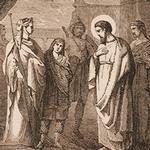
Both of the popes featured in this installment are remembered for honoring the Blessed Virgin Mary. Most of our time will be spent on the first, St. Celestine, who is important chiefly for his involvement in the Council of Ephesus, which confirmed the title of Mary as Mother of God.
43—St. Celestine I (422-32)
St. Celestine served as a deacon under Pope St. Innocent. He is said to have lived with St. Ambrose at one time, and he was also a friend of St. Augustine, who wrote Celestine a very loving letter four years before his papacy began. In another letter from Augustine just after Celestine’s election, we learn that unlike his predecessor St. Boniface, Celestine became pope without any controversy. In this same letter, Augustine begs for the pope’s help in dealing with a young African bishop whom Augustine himself had placed in his office, but who had turned out rather badly. After St. Augustine’s death, St. Celestine wrote in praise of his memory and forbade the semi-Pelagians to write critically about him.
As pope, Celestine stood firm against the Manichaeans, Donatists, Novatians, and Pelagians, all of whom were active at this time. He maintained the position of his predecessor in the matters of Illyricum, of the overweening Bishop of Arles, and (less successfully) with regard to Apiarius and the African bishops. He sent directions to some Gallic bishops, forbidding bishops and priests to dress differently from laymen:
We should be distinguished from the common people by our learning, not by our clothes; by our conduct, not by our dress; by cleanness of mind, not by the care we spend upon our person.
He admonished other bishops that the clergy should know the holy canons and that laymen should not be elected as bishops over clergy, even if the people desired it. St. Celestine used what became a well-known phrase, docendus est populus, non sequendus (“the people should be taught, not followed”).

Most importantly, it was under St. Celestine that the Council of Ephesus condemned the Nestorian heresy. While Celestine was favorable toward Nestorius at the beginning of the latter’s career as Bishop of Constantinople, word soon got out about Nestorius’s heretical teachings. He seemed to think that Christ was a union of two persons, divine and human, and definitely said that Mary was only the mother of Christ’s human nature and so did not deserve the title “Mother of God.”
After receiving sufficient evidence of Nestorius’s errors in a missive from St. Cyril, Patriarch of Alexandria, as well as having consulted the great St. John CassianPope St. Celestine condemned Nestorius in a Roman synod. Empowering St. Cyril to act with papal authority in the matter, he instructed him to excommunicate and depose Nestorius unless he retracted his errors within ten days of being notified of the pope’s judgment.
Soon after, Emperor Theodosius II called an ecumenical council at Ephesus, at which the matter of Nestorius would be addressed. Pope Celestine wrote to St. Cyril saying that he could not make the journey to the council himself, but told Cyril to proceed in charity with the aim of reconciling Nestorius to the true faith. The pope also sent three legates, two bishops and a priest, to work with Cyril and to judge the proceedings on behalf of the Holy See.
The fact that not every early ecumenical council had the pope personally present is often used by Orthodox and other non-Catholic apologists as an argument against papal supremacy in the early Church. For this reason, it is worth describing at length Pope Celestine’s remote, but crucial, involvement in the Council of Ephesus, relying on Fr. Philip Hughes’s excellent history of the General Councils.
The pope wrote a letter to the council fathers, summarized by Fr. Hughes:
It is a moving document, in which Celestine reminds the bishops of the beloved apostle St. John, whose remains lie in the church at Ephesus where they are meeting, and reminds them that they are the successors of the twelve apostles, privileged to preserve what their labours had established. The pope speaks plainly about the Nestorian novelties: they are treason to the faith. He exhorts the bishops to unanimity, and to be courageous in act. Then he presents his legates, who will take part in the council and will tell the bishops, “the things which we decided at Rome were to be done.” “Nor do we doubt your assent to all this,” the pope goes on, “when it is seen how all that is done has been ordered for the security of the whole church.”
To the legates the pope entrusted a letter for the emperor, announcing that he would be represented at the council by legates, and praying he would give no encouragement to these novel ideas now causing such trouble, the work of men who would reduce the idea of God to the limits of what a finite intelligence could explore. The pope leaves it in no doubt, in this as in the other letter, that Nestorius is already condemned; if the pope consents to the case being discussed once more, this is in the hope that the unfortunate man will retract.
There was, unsurprisingly, a long wait for all the bishops to journey to Ephesus from far-flung regions. St. Cyril, already endowed with authority to act on behalf of the pope, ultimately began the council before either the pope’s legates or the large cohort of Antiochean bishops (sympathetic to Nestorius) arrived. As the seniormost bishop present, Cyril led the proceedings, and on the very first day, June 22, 431, the bishops with loud acclamations invoked the creed of Nicaea and anathematized Nestorius (the heretic was absent because he had three times ignored the summons to the council). After this, a letter from the pope to Nestorius was read aloud, and after various other proceedings, Nestorius was deposed from his bishopric.
This bit of essential business done, the Council was far from over, lasting for three months, especially because the emperor had refused to recognize the June 22 decisions, since the bishops did not follow his instructions. The papal legates arrived in time for the session of July 10. Quoting Fr. Hughes once more at length:
The difference in the procedure is evident, notable, significant. Cyril presided, and the session opened with a demand from the legates that the pope’s letter to the council, which they had brought with them, should be read. This was done, and one of the legates then said, “We have satisfied what custom demands, namely, that first of all, the letters from the Apostolic See be read in Latin.” They were next read in Greek—a translation brought by the legates.
And now there were acclamations from the council. The papal sentence had anticipated the bishops’ own vote. The counteraction of John of Antioch against themselves for their support of Cyril, the emperor’s gesture of repudiation, were, perhaps, the lighter for this wholehearted confirmation. “Celestine,” they called, “is the new Paul. Cyril is the new Paul. Celestine is the guardian of the faith. Celestine agrees with the council. There is one Celestine, one Cyril, one faith of the council, one faith of the world-wide church.” And then one of the papal legates intervened to point out that what Celestine’s letter had said was that it was the council’s business to carry out what he at Rome had decided should be done. And another legate, acknowledging the acclamations, said in a terse phrase, “The members have joined themselves to the head, for your beatitude is not ignorant that the head of the whole faith, and furthermore of the Apostles, is the blessed apostle Peter.” And then this legate, the priest Philip, asked for the official record of what had been done on June 22, so as to be able to confirm the sentence passed, according to the instructions of “our blessed pope.”
At the session of the following day the same legate pronounced that the judgment of June 22 had been made “canonically and in accordance with ecclesiastical learning”; and, “conformably with the instructions of the most holy pope, Celestine,” the judgment was confirmed. Whereupon the minutes of the session and the sentence against Nestorius were read, following which the legate Philip made a speech in which occurs this passage, that has never ceased to be quoted since: “No one doubts, nay it is a thing known now for centuries, that the holy and most blessed Peter, the prince and head of the Apostles, the pillar of the faith and the foundation on which the Catholic Church is built, received from Our Lord, Jesus Christ, the saviour and redeemer of the human race, the keys of the kingdom, and that to him there was given the power of binding and of loosing from sin; who, down to this day, and for evermore, lives and exercises judgment in his successors.”
In the report of these last proceedings made by the bishops to the emperor, the principal part which the Roman see has played in the condemnation of Nestorius, “before the present council was summoned,” is stressed, and the fact that Cyril had been charged by the pope to act in his place.
In other words, there is plenty of evidence that the Council Fathers saw themselves not as re-evaluating the case so much as fulfilling the judgment the pope had already made of Nestorius in his ten-day ultimatum, the implementation of which had only been delayed by the emperor’s calling of the Council.

Aside from his role in condemning Nestorianism, Celestine will forever have the glory of being the pope who sent St. Patrick to Ireland. Patrick, as is well known, had already lived on that island as a slave, and greatly desired to return to preach the Gospel, but Celestine originally refused him the task. Palladius was sent instead, but was scared away from Ireland by a hostile chieftain. Then St. Germain of Auxerre recommended St. Patrick to the pope. Just a few days before St. Celestine met his eternal reward, he gave the mission to St. Patrick, along with gifts of relics. He also gave him a new name: apparently Patrick was not his birth name, but Celestine called him “Patricius” or something similar, meaning he would be pater civium (the father of his people).
44—St. Sixtus III (432-40)
We know little about St. Sixtus III. He was falsely accused of sympathizing with the Pelagian and Nestorian heresies, perhaps partly because of his success in reconciling St. Cyril of Alexandria with John, Patriarch of Antioch, who had been an ally of Nestorius. But Sixtus approved the Acts of the Council of Ephesus, and maintained the excommunication of the Pelagian leader Julian of Eclanum.
Pope St. Sixtus III is remembered as a great builder of Roman churches, for his name is seen by millions of tourists and pilgrims every year on the triumphal arch of the papal basilica of St. Mary Major: Xystus Episcopus plebi Dei (Sixtus the bishop to the people of God). He rebuilt that church from what was formerly the Basilica of Liberius, likely to commemorate the Council of Ephesus’s recent declaration of the first Marian dogma.
Also theologically emphatic was the octagonal baptistery he built by the Lateran Basilica, with its inscriptions referring to the power of grace, which had been denied by the Pelagians. This was long the only baptistery in Rome. And Sixtus also founded the earliest known monastery in Rome, at the church of S. Sebastiano.
His building projects, in part a work of restoration after the Gothic sack of Rome, were continued by his successor, who would be the most illustrious pope since St. Peter himself.


Thomas V. Mirus is President of Trinity Communications and Editor-in-Chief for CatholicCulture.org, hosts both the Catholic Culture Podcast and Lives of the Popes, and co-hosts Criteria: The Catholic Film Podcast. See full bio.
All comments are moderated. To lighten our editing burden, only current donors are allowed to Sound Off. If you are a current donor, log in to see the comment form; otherwise please support our work, and Sound Off!

-
Posted by: Thomas V. Mirus -
Aug. 04, 2026 1:18 PM ET USA
How interesting, winnie! How did you end up choosing St. Celestine as your confirmation saint?
-
Posted by: winnie -
Aug. 03, 2026 3:14 PM ET USA
I am grateful to learn that my somewhat obscure confirmation saint, Celestine, was a friend of St. Augustine and also learn of his condemnation of the Nestorian Heresy.. I ask his daily intercession.